 how-to
How to Store Handmade Soap: Keep Bars Fresh Longer
Table of Contents
- Why Handmade Soap Needs Different Storage Than Commercial Bars
- How to Store Handmade Soap: Ideal Temperature, Humidity, and Airflow
- How to Make Handmade Soap Last Longer: Curing, Packaging, and Rotation
- Handmade Soap Shelf Life: How Long Different Oil Bases Last
- The Best Soap Dish for Handmade Soap (and What to Avoid)
- Preventing Rancidity, Pests, and Common Storage Mistakes
- Long-Term Preservation and Visual Organization for Craft Shows
- Frequently Asked Questions
Last Updated: September 25, 2026
Why Handmade Soap Needs Different Storage Than Commercial Bars
Handmade soap behaves nothing like mass-produced bars. Commercial bars use synthetic hardeners and preservatives that let them sit for years. Handmade soap, especially cold process, is made with natural ingredients like vegetable oils, essential oils, and lye that react to their surroundings. Store handmade soap the wrong way and you will meet rancidity, orange spots, and bars that smell like old crayons.
How to Store Handmade Soap: Ideal Temperature, Humidity, and Airflow
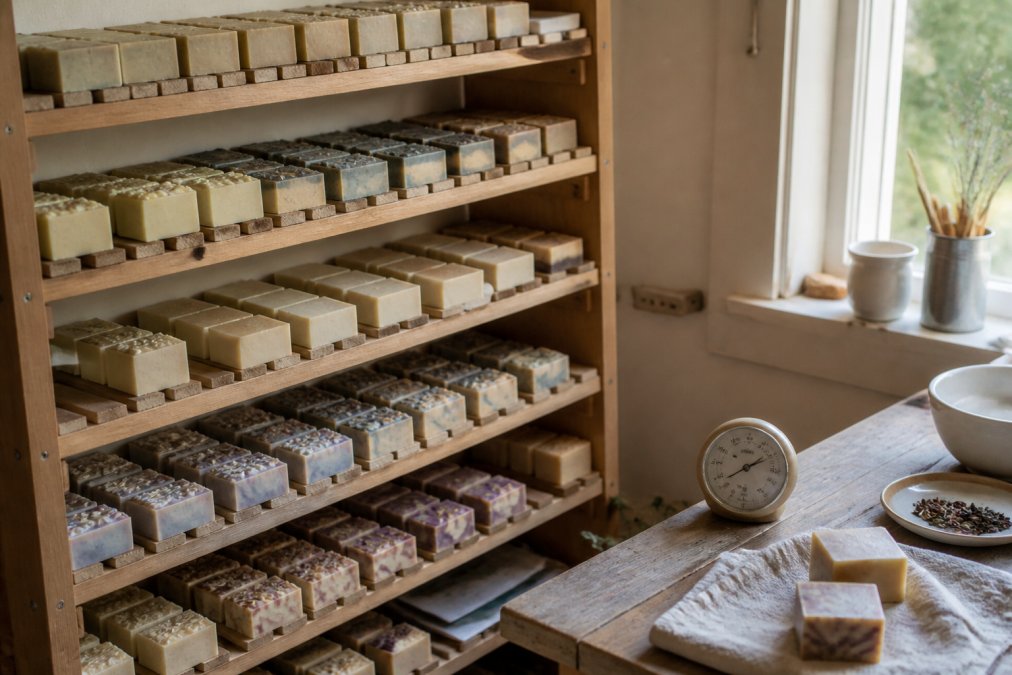
Store handmade soap at 50-70°F with humidity under 60% and steady air movement. Those three conditions do more for shelf life than any container you can buy. Get them right and a bar stays fresh well over a year; get them wrong and you will see spoilage within weeks.
Temperature and Humidity Ranges That Prevent Spoilage
High heat melts the oils and speeds oxidation; high humidity softens soap and invites spoilage. The sweet spot is cool and dry.
- Temperature: 50-70°F. Avoid attics, garages, and cars in summer.
- Humidity: under 60%. A cheap hygrometer tells you where you stand.
- Light: keep bars out of direct sunlight. UV breaks down essential oils and fades color.
- Temperature fluctuations: avoid them. Repeated swings cause sweating and cracking.
Climate-Specific Storage: Humid vs. Arid Regions
Most guides hand you the same 50-70°F and under-60% humidity target no matter where you live. That breaks down in a Gulf Coast summer or a high-desert winter. The numbers stay the same, but the tactics change completely.
In humid climates (Southeast, Gulf Coast, Mid-Atlantic summers):
- Run a dehumidifier set to 45-50% relative humidity in the storage room, not just a closet. Empty the reservoir daily or plumb it to a drain.
- Use a small oscillating fan on low 24/7. Still air in a humid room is worse than no room at all.
- Skip cardboard boxes; cardboard wicks moisture from the air to the bars it touches.
- Rotate bars every two weeks instead of monthly.
- Store bars on wire or slatted shelving, never on a concrete floor or against an exterior wall, both of which sweat in summer.
In arid climates (Southwest, Mountain West, high plains):
- Rapid drying and cracking are the problem, not humidity. Bars can lose moisture too fast and split along the cut lines.
- Skip the dehumidifier. Cure and store in a room with natural humidity around 40-50%.
- Wrap bars in parchment or cloth within a few weeks of curing to slow moisture loss.
- Dry air pulls scent out of a bar faster than humid air, so rotate stock and use older bars first.
- Keep bars out of direct sun even in winter; UV damage happens year-round.
In four-season climates:
- Move storage seasonally. A cool basement that works in July may drop below 50°F in January, which slows cure but does not harm a finished bar.
- Watch spring and fall humidity spikes. Those shoulder seasons cause more spoilage than summer because people stop paying attention.
Air Circulation and Ventilation Requirements
Air circulation is the quiet hero of soap storage: moving air carries moisture away before it soaks in. Stack bars with space between them, not in a tight brick.
- Leave a finger-width gap between bars on a shelf or curing rack.
- Never stack bars more than two deep.
- Keep a small fan running on low in a closed storage room.
- Rotate bars every few weeks so all sides get air.
How to Make Handmade Soap Last Longer: Curing, Packaging, and Rotation
The single best way to make handmade soap last longer is a full cure before storage. Cold process soap needs 4-6 weeks to finish saponifying and shed excess water. Skip the cure and you are storing a wet bar; cure it properly and you are storing a hard, long-lasting one.
Once cured, packaging and rotation take over.
- Cure first: 4-6 weeks on a rack with airflow, turning bars weekly.
- Then package: choose breathable materials for long storage.
- Rotate stock: use the oldest bars first, like a grocery shelf.
- Track batches: write the make date on every bar or box.
Breathable Packaging vs. Airtight Containers
Breathable packaging wins for long-term storage of handmade soap; airtight containers trap moisture and speed spoilage. The right choice depends on your plan.
| Storage Goal | Best Packaging | Why |
|---|---|---|
| Long-term storage (months) | Parchment paper or cloth wrap | Lets the bar breathe and keeps curing |
| Retail display | Shrink wrap with a small vent | Protects the bar but allows some airflow |
| Daily use | Open soap dish with drainage | Dries the bar between uses |
| Gifting | Kraft paper box, unsealed | Looks good, still breathable |
Handmade Soap Shelf Life: How Long Different Oil Bases Last
Handmade soap shelf life runs from about 12 months for soft-oil bars to 24 months or more for hard-oil bars, when stored well. The oil base decides the clock. Soft oils like olive and sunflower oxidize faster. Hard oils like coconut, palm, and tallow hold up longer.
- Olive oil heavy: 12-18 months. Gentle, but softer and quicker to spoil.
- Coconut and palm: 18-24 months. Harder bars, longer life.
- Tallow or lard: 24 months or more. Very stable.
- High superfat: shorter life. More free oil means more to oxidize.
- Essential oil scented: shorter scent life. The smell fades before the bar spoils.
Multi-Year Storage: Vacuum Sealing vs. Paper Wrapping
If you want a bar to survive two, three, or five years, packaging matters more than the oil base. Two approaches dominate, and they trade off differently.
Paper or cloth wrapping (breathable):
- Lets the bar keep curing and releasing moisture for months after it leaves the rack.
- Best for bars you plan to use within 12-18 months.
- Fails in humid rooms, where paper wicks moisture straight to the bar.
- Cheap, compostable, and easy to label.
Vacuum sealing (airtight):
- Removes oxygen, the fuel for oxidation and orange spots.
- A fully cured, bone-dry bar vacuum-sealed in a cool, dark room can hold quality for several years.
- Fails if the bar is not fully cured; residual water gets trapped and the bar goes soft or rancid inside the seal.
- Requires a vacuum sealer and thicker bags; thin bags puncture and lose the seal.
- Scent still fades even with oxygen removed, so rotate scented bars first.
Pest Prevention Without Harsh Chemicals
Mice, pantry moths, and ants find soap attractive because of the oils and sugars in additives like honey or milk. Most guides skip this, and it is why a stash can be ruined in a single season.
- Keep soap off the floor. Rodents travel along walls and baseboards; a shelf at least 18 inches up removes the easiest access.
- Use cedar blocks or cedar-lined drawers. Cedar oil is a natural repellent and does not transfer scent to wrapped bars.
- Bay leaves and whole cloves in a breathable sachet deter pantry moths and ants. Replace every few months as the oils fade.
- Inspect wrapped bars quarterly. Look for chew marks, frass (small dark specks), or fine webbing. Catch an infestation early and you save the batch.
- Avoid cardboard and open paper bags in garages or sheds; those are pest highways. Use lidded plastic bins in dry rooms only.
- Never use mothballs or pesticide sprays near soap. The chemicals absorb into the bars and cannot be washed out.
The Best Soap Dish for Handmade Soap (and What to Avoid)
The best soap dish for handmade soap drains water away and lets air reach all sides. A dish that holds a puddle is the number one killer of handmade bars at home; even a perfectly cured bar turns to mush in standing water.
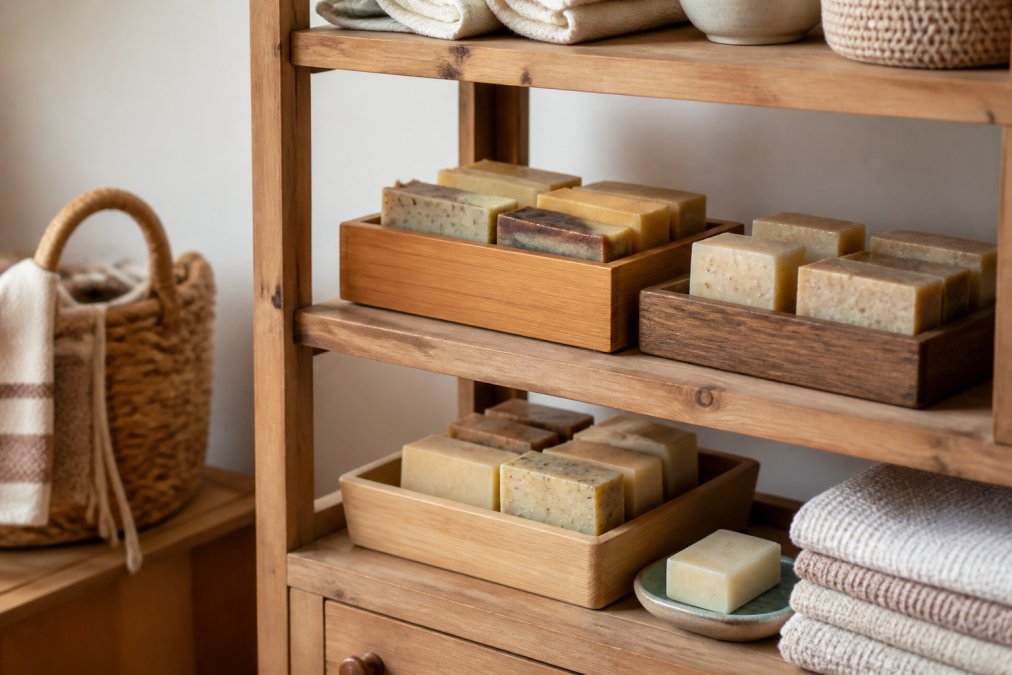
- Choose: slatted or ridged dishes that let water drip through.
- Choose: dishes with raised feet so the bar sits above the water line.
- Avoid: flat ceramic trays that pool water.
- Avoid: closed travel cases for daily use.
- Avoid: metal dishes that can react with the soap.
Preventing Rancidity, Pests, and Common Storage Mistakes
Rancidity is the main threat to stored handmade soap. It shows up as a sour smell, a greasy feel, or orange spots from oxidation, the same reaction that turns butter rancid. You cannot reverse it, but you can prevent it with cool, dry, dark storage and good airflow.
- Store soap in sealed bins only if the room is dry and the bars are fully cured.
- Add cedar blocks or bay leaves near stored bars to deter insects.
- Keep storage off the floor and away from garage walls.
- Check wrapped bars every few months for chew marks.
Common storage mistakes to stop making:
- Storing soap in a hot garage or attic.
- Boxing bars before they finish curing.
- Leaving bars in direct sun on a windowsill.
- Stacking bars in a tight pile with no airflow.
- Using an airtight tub in a humid room.
Long-Term Preservation and Visual Organization for Craft Shows
Craft show logistics demand a system, not just a shelf. You need to move stock, keep it fresh, and let shoppers see every bar. Visual organization solves both problems at once.
- Group by scent family: florals together, citrus together, earthy together.
- Group by color: a rainbow display reads faster than a jumbled pile.
- Label every bar: name, scent, and make date on the back.
- Use tiered risers: shoppers see more bars without digging.
- Keep backup stock in breathable boxes under the table, not sealed tubs.
Frequently Asked Questions
How long does homemade soap typically last?
Most handmade soap stays fresh for 12 to 24 months when stored properly. Cold process bars with stable oils like olive or coconut can last even longer, while those with high amounts of soft oils or added essential oils may fade sooner. The key is keeping bars dry, ventilated, and away from direct sunlight. After the curing phase, store bars in a breathable wrapper or open shelf rather than sealed plastic. Rotate older batches to the front so you use them first.
Does handmade soap go rancid if stored improperly?
Yes. When handmade soap is exposed to heat, moisture, or poor airflow, the oils in the bar oxidize and turn rancid. You may notice dreaded orange spots, a yellow discoloration, or a crayon-like smell. This happens faster with superfatted bars and those made with unstable vegetable oils. To prevent rancidity, keep bars in a cool, dry place with good air circulation, avoid airtight containers for long-term storage, and use a draining soap dish between uses.
Can you store handmade soap in plastic wrap?
Shrink wrap and plastic wrap can work for short-term display or shipping, but they trap moisture and prevent airflow. For long-term storage, breathable packaging like parchment paper or tissue paper is better. If you do use plastic, make sure bars are fully cured and completely dry first, and poke small holes for ventilation. Airtight containers are fine for short trips or gift sets, but not for months of storage.
What is the best soap dish for handmade soap?
The best soap dish for handmade soap has drainage holes or raised ridges that keep the bar out of standing water. Look for dishes made of wood, bamboo, or ceramic with a slatted design. Avoid solid plastic or metal dishes that trap moisture against the bar, which softens the soap and shortens its life. Place the dish away from the shower stream and rinse it weekly to prevent buildup.
Storing handmade soap well takes a little planning, but the payoff is real: bars that stay firm, smell lovely, and feel gentle on your skin for months. The Beekeeper's Basket makes every bar in small batches with fresh, natural ingredients, so we want yours to stay that way long after it arrives. Our handcrafted soaps, beeswax melts, and skin-nourishing lotions are designed for exactly this kind of care. Explore our collection and find your next favorite bar. LET'S EXPLORE!