 how-to
How to Verify Sustainable Skincare: 2026 Guide
Table of Contents
- Why Verifying Sustainable Skincare Claims Matters
- How to Spot Greenwashing in Beauty
- Third-Party Skincare Certifications List
- How to Read Skincare Labels for Sustainability
- Identifying Microplastics and Synthetic Polymers
- Refillable vs. Recyclable Packaging: What to Check
- Lifecycle Assessment: A Consumer's Guide
- Verifying Social and Labor Claims
- Frequently Asked Questions
Last Updated: September 19, 2026
Why Verifying Sustainable Skincare Claims Matters
Learning how to verify sustainable skincare claims starts with one uncomfortable fact: the label on the bottle is not evidence. The word "natural" has no legal definition in cosmetics, and "eco-friendly" can mean almost anything a marketing team wants it to mean. This guide walks through the checks that actually hold up, from certification databases to ingredient lists.
How to Spot Greenwashing in Beauty
Greenwashing is marketing that makes a product look more environmentally friendly than it is. Common examples include vague phrases like "earth-friendly," leafy imagery on a plastic bottle, and tiny "made with organic ingredients" notes on a product that is mostly synthetic.
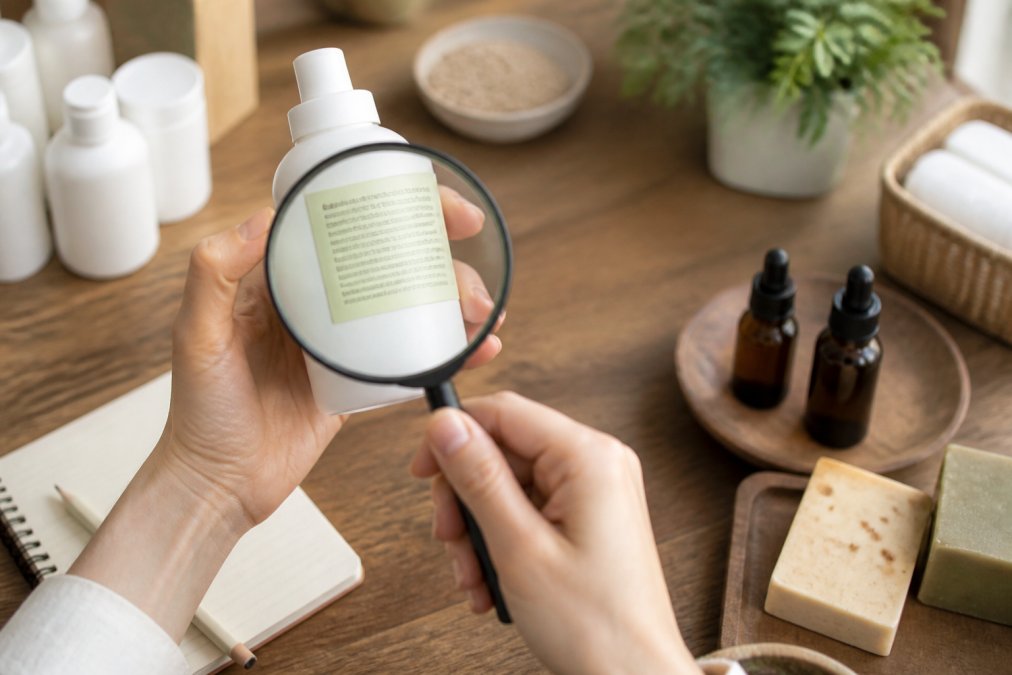
Watch for these red flags:
- Claims with no certifying body named
- A single green leaf icon doing all the work
- "Chemical-free" on a product made of chemicals, including water
- Sustainability claims buried in footnotes
Third-Party Skincare Certifications List
A third-party certification is a stamp issued by an outside group that audits a product or company against published standards. The certifier, not the brand, controls the logo. That distinction matters because a brand can print a leaf, but it cannot print a certifier's mark without passing that certifier's audit.
Certifications That Verify Environmental Claims
- USDA Organic, Governed by the National Organic Program. It applies to agricultural ingredients and to products that meet the program's percentage thresholds. A product labeled "100% organic" must contain only organically produced ingredients (excluding water and salt); "organic" requires at least 95% organically produced ingredients; "made with organic ingredients" requires at least 70%. Anything below 70% cannot carry the USDA Organic seal on the front panel. Crucially, USDA Organic says nothing about packaging, carbon footprint, or labor practices.
- COSMOS, An international standard with two tiers: COSMOS ORGANIC (a minimum share of organic ingredients plus strict formulation rules) and COSMOS NATURAL (natural-origin ingredients with limited processing). It also bans or restricts certain petrochemical ingredients and requires documented environmental management at the manufacturing site.
- Ecocert, One of the older cosmetic certifiers, with standards covering organic content, renewable raw materials, and responsible manufacturing. Ecocert certification is often a prerequisite for COSMOS, so seeing both is common and not redundant.
- Leaping Bunny, Administered by Cruelty Free International. It verifies that a brand and its suppliers do not conduct animal testing at any stage, including ingredient suppliers. It is a cruelty standard, not an environmental one, do not read it as proof of sustainability.
Certifications That Verify Social and Labor Claims
- Fair Trade marks, Verify minimum prices, premiums paid to cooperatives, and prohibitions on forced and child labor for specific commodities. They apply to the ingredient supply chain, not to the finished product's factory.
- B Corp, A whole-company assessment covering governance, workers, community, environment, and customers. A brand must reach a minimum verified score and re-certify periodically. It is broad rather than deep on any single issue.
- Fair for Life, A certification focused on supply chain labor conditions and fair trade, with on-site audits of producers and processors.
How to Actually Verify a Certification
A logo image is easy to copy; a database entry is not. The verification step most shoppers skip is the one that matters:
- Go to the certifier's own website, not the brand's site.
- Use the certifier's public search or brand directory.
- Confirm the brand name, the specific product or facility, and the certification's current status and expiry.
- Check the scope. A company-level B Corp score does not certify a single serum; a Fair Trade mark on one ingredient does not cover the whole formula.
How to Read Skincare Labels for Sustainability
Reading a label for sustainability means checking three things: the ingredient list order, the certifier names, and what the brand does not say. Ingredients are listed by weight, so anything after the preservative is usually present in tiny amounts.
Decoding Ingredient Names and Percentages
- The first five ingredients make up most of the formula
- "Fragrance" can hide dozens of compounds
- "Natural origin" is not the same as "natural"
Natural vs. Organic: What the Labels Actually Mean
Natural has no legal definition in cosmetics. Organic does, but only when tied to a real standard like USDA Organic. A product can say "made with organic ingredients" while most of the bottle is something else entirely.
Identifying Microplastics and Synthetic Polymers
Microplastics in skincare are tiny plastic particles, often added as exfoliants or texture agents. On a label, look for polyethylene, polypropylene, nylon, and acrylates copolymers. These do not break down and can wash straight into waterways.
Scan for these terms:
- Polyethylene (PE)
- Polypropylene (PP)
- Nylon-12
- Acrylates copolymer
- Carbomer (a polymer, though generally considered lower concern)
Refillable vs. Recyclable Packaging: What to Check
Recyclable packaging is only recyclable if your local program accepts it. Refillable packaging cuts waste only if you actually refill it. Ask two questions: does my city take this material, and will I use this product again?
| Packaging Type | Real-World Reality | Best For |
|---|---|---|
| Refillable glass | Lowest waste if reused | Loyal users |
| Recyclable PET | Depends on local program | Most households |
| Mixed-material pumps | Rarely recyclable | Convenience buyers |
| Aluminum tins | Widely accepted | Solid bars and balms |
Lifecycle Assessment: A Consumer's Guide
A lifecycle assessment, or LCA, measures a product's impact from raw material to disposal. You will rarely see one on a label, but you can approximate it.
Ask these questions:
- Where do the ingredients come from?
- How far did the product travel?
- What happens to the packaging after use?
- How long does one unit last?
Verifying Social and Labor Claims
Social claims are the hardest to check, because labor happens far from the shelf, often several tiers upstream of the brand that sells the finished product. Most guides stop at "look for a Fair Trade logo." That is a starting point, not a verification method. Here is a more technical framework.
Step 1: Map the Supply Chain Tiers
A skincare formula typically has four or more tiers: the brand, the contract manufacturer (the fill-and-finish facility), the ingredient suppliers, and the raw-material growers or harvesters. Labor risk concentrates in the lower tiers, farming, harvesting, and primary processing, which is exactly where brands have the least visibility.
Step 2: Match the Certification to the Tier
- Fair Trade marks apply to specific commodities and specific cooperatives, for example, shea, cocoa, or certain oils. They verify minimum prices and premiums at the producer level. They do not cover the factory that fills the bottle.
- Fair for Life audits producers and processors along the chain and is one of the few standards that explicitly addresses labor conditions at multiple tiers.
- B Corp assesses the company's own operations and some supply chain practices, but it is a company-level score, not a product-level labor guarantee.
- SA8000 is a social accountability standard used in manufacturing audits. It is more common in apparel than in beauty, but when a contract manufacturer holds it, that is a meaningful signal about the fill-and-finish tier.
Step 3: Look for Disclosure That Goes Beyond a Logo
A logo alone tells you a standard exists somewhere in the chain. Disclosure tells you where. The strongest signals, in rough order of usefulness:
- A published supplier list naming ingredient suppliers and their locations.
- Audit summaries, even redacted, showing which facilities were audited, by whom, and when.
- A grievance mechanism or whistleblower channel that workers can actually use.
- A named responsible-sourcing or human-rights policy with a date and a named executive owner.
Step 4: Cross-Check the Claims Against Public Records
The Federal Trade Commission's Green Guides set the rules for environmental marketing claims, and the FTC has also brought enforcement actions over deceptive "all natural" and social-benefit claims. The U.S. Department of Labor's List of Goods Produced by Child Labor or Forced Labor identifies commodities and source countries where labor abuses are documented, useful for checking whether a brand's key ingredient originates in a high-risk region.
Step 5: Read the Annual Report for What Is Missing
The Federal Trade Commission's Green Guides set the rules for environmental marketing claims, and they are worth a read before you trust any label. For ingredient safety data, the Environmental Working Group's Skin Deep database offers a searchable starting point. The USDA Organic program confirms which products carry real organic certification.
Frequently Asked Questions
What does sustainable skincare actually mean?
Sustainable skincare refers to products made with minimal environmental impact across their lifecycle, from ingredient sourcing to packaging disposal. It includes ethical labor, reduced carbon footprint, and biodegradable or recyclable materials. A truly sustainable product addresses sourcing, formulation, manufacturing, and end-of-life. Look for third-party certifications, transparent supply chain information, and packaging that is refillable or made from post-consumer recycled content. No single label guarantees full sustainability, so evaluate multiple factors together.
How can I tell if a skincare brand is greenwashing?
Greenwashing often uses vague terms like eco-friendly or natural without proof. Watch for unsubstantiated claims, lack of third-party certification, and misleading imagery. Check if the brand publishes specific data on sourcing, carbon footprint, or packaging. If a company claims to be sustainable but does not disclose its supply chain or audit results, treat those claims with caution. Independent verification through databases or certification bodies is the most reliable way to confirm a brand's environmental commitments.
Which third-party certifications should I look for on skincare labels?
Reliable certifications include USDA Organic, Leaping Bunny for cruelty-free, and Fair Trade Certified for ethical sourcing. For environmental claims, look for B Corp or Ecocert. Each certification verifies different aspects, so choose based on your priorities. Always check that the certification logo is current and applies to the specific product, not just the brand. Cross-reference with the certifying body's online database for confirmation.
How do I check if skincare packaging is truly recyclable?
Check the resin identification code (usually a number 1-7 inside a triangle). Codes 1 (PET) and 2 (HDPE) are widely accepted curbside. Codes 3-7 often are not. Also consider the full package: pumps, caps, and labels may not be recyclable even if the bottle is. Look for refillable options or packaging made from post-consumer recycled content. Brands that provide clear disposal instructions or take-back programs are more likely to be genuinely committed to reducing waste.
Verifying sustainable skincare claims takes a few extra minutes, but it protects your skin and your values. The Beekeeper’s Basket makes that easy with handcrafted, small-batch products, bee-inspired formulas, and freshness you can trace. Explore the collection and find your next favorite bar or balm. LET'S EXPLORE!