 ultimate-guide
Why Small Batch Soap Is Better: 2026 Guide
Table of Contents
- What Does Small Batch Soap Actually Mean?
- Cold Process Soap vs Commercial Soap: Key Differences
- Best Natural Soaps for Dry Skin: What Makes Them Work
- Sensitive Skin and Small Batch Soap: What to Know
- Freshness, Curing Time, and Shelf Life
- How to Store Handmade Soap So It Lasts
- Cost, Safety, and Environmental Impact
- Conclusion
- Frequently Asked Questions
Last Updated: September 17, 2026
What Does Small Batch Soap Actually Mean?
Small batch soap is soap produced in limited quantities, typically by hand, with each batch carefully measured, poured, and monitored rather than run through continuous industrial manufacturing. At The Beekeeper’s Basket, we make every bar this way in New England, which means we can control exactly what goes into each loaf and how it cures. The difference shows up in the ingredients, the glycerin content, and how the bar feels on your skin.
Small-Scale Production by the Numbers
A commercial soap facility might produce tens of thousands of bars in a single run. A small-batch maker often works in batches of a few dozen to a few hundred bars. That scale changes everything: you can weigh each oil, adjust for humidity, and catch problems before they reach a customer. It also means slower output and higher attention per bar.
Cold Process Soap vs Commercial Soap: Key Differences
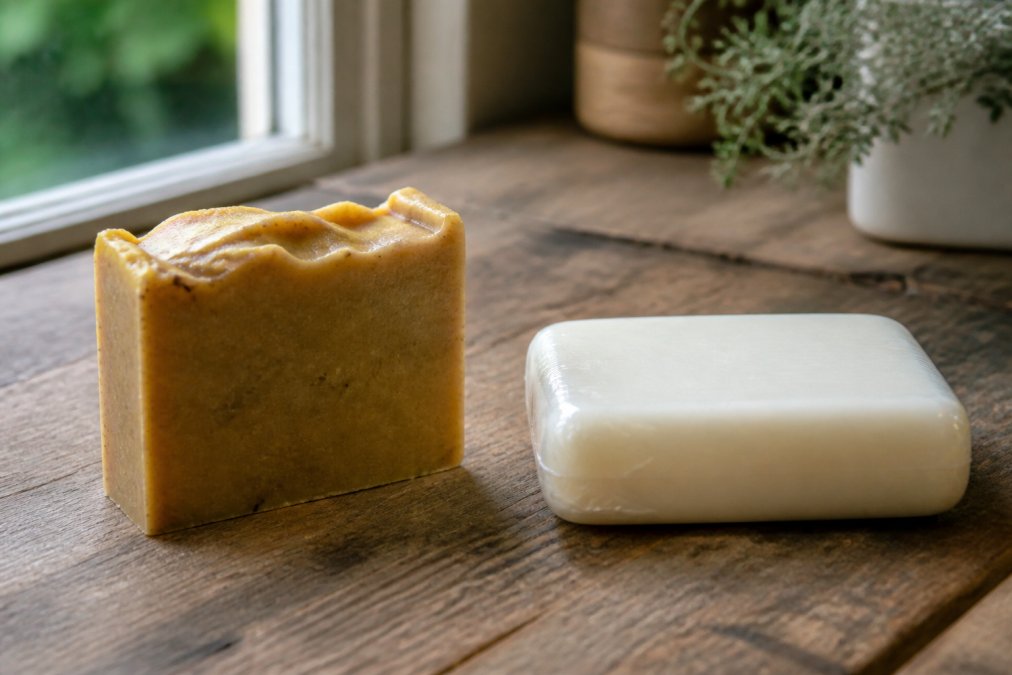
Cold process soap is made by mixing oils and lye (sodium hydroxide), which triggers saponification, the chemical reaction that turns fat and alkali into soap and glycerin. In a true soap, that reaction produces roughly 75% soap and 25% naturally occurring glycerin by weight, and in cold process the glycerin stays in the bar. Commercial bars are frequently built on synthetic detergents (syndets) such as sodium lauryl sulfate and sodium laureth sulfate instead, and the glycerin is often extracted and sold separately as a profitable co-product.
The Chemistry That Separates the Two
Three mechanisms do the real work:
- Saponification vs. syndet formulation. True soap is the salt of a fatty acid; syndets are petroleum- or plant-derived surfactants engineered to lather in hard water. Syndets can be formulated at a skin-friendly pH, but many mass-market bars pair them with fillers and chelating agents that leave skin tight.
- Glycerin retention. Glycerin is a humectant that draws moisture toward the skin. In cold process it forms during saponification and stays in the bar; in many commercial bars it is removed to extend shelf life and sold as a separate ingredient.
- Superfatting. Small-batch makers deliberately leave a percentage of unsaponified oil in the bar, commonly 3% to 8%, so the finished soap carries extra emollient. Industrial runs rarely superfat because it complicates shelf-life math.
pH, Cure, and Why Small Batches Hold the Line
A freshly poured cold process bar is not ready to use. It needs a cure of roughly four to six weeks, during which water evaporates, the crystalline structure of the bar tightens, and pH drifts down toward the skin-friendly range most practitioners target, typically around 9 to 10 for a well-formulated bar. Small-batch makers can test each loaf with pH strips or a digital meter and hold a batch back if it reads high.
Why Glycerin Matters for Your Skin
Glycerin is a humectant, meaning it draws moisture toward your skin instead of stripping it away. In cold process soap, glycerin occurs naturally during saponification and stays in the bar. In many mass-produced bars, it is removed so the soap lasts longer on a shelf. Keeping glycerin in the finished bar is one of the clearest reasons small batch soap supports moisturizing properties rather than leaving skin tight and dry.
Best Natural Soaps for Dry Skin: What Makes Them Work
The best natural soaps for dry skin share three traits: a gentle oil base, retained glycerin, and no harsh synthetic additives. Look for bars made with olive, coconut, shea, or avocado oils, and check whether the maker lists essential oils rather than fragrance oils if your skin reacts to synthetic scents. A well-formulated bar cleans without leaving that squeaky, stripped feeling.
Ingredients to Look For (and Avoid)
- Look for: olive oil, shea butter, coconut oil, castor oil, oatmeal, honey, plant-based colorants
- Look for: essential oils, which come from plants and tend to be gentler on reactive skin
- Avoid: synthetic detergents, harsh surfactants, and heavy artificial fragrance
- Avoid: bars that list glycerin as an added ingredient but strip it during processing
- Consider: superfatting, where the maker leaves a little extra oil in the bar for extra moisture
Sensitive Skin and Small Batch Soap: What to Know
Small batch soap is not automatically safe for every sensitive-skin user, but it gives you a better shot at finding a bar that works. Because small makers control the recipe, they can offer fragrance-free and additive-free options, and they can tell you exactly what is in the bar. If you have reacted badly to “natural” products before, start with an unscented, simple bar and patch-test it on your inner arm for a few days before using it in the shower.
Freshness, Curing Time, and Shelf Life
Curing time is the quiet hero of good soap. After a batch is poured and cut, cold process bars need to sit for several weeks while excess water evaporates and the bar hardens. A proper cure produces a milder, longer-lasting bar with better lather quality. Skipping it is one of the most common shortcuts in low-quality soap, and you can feel the difference: an under-cured bar turns soft and dissolves fast.
How to Store Handmade Soap So It Lasts
Handmade soap lasts longest when it stays dry between uses. The single biggest mistake is leaving a bar in a puddle on the edge of the tub, which dissolves it from the bottom up. Keep a draining soap dish, let the bar air out, and rotate your stock so older bars get used first.
Cost, Safety, and Environmental Impact
Small batch soap costs more per bar than a drugstore bar, and that is worth understanding rather than resenting. You are paying for real oils, retained glycerin, slow curing, and a maker's time. The trade-off is a bar that cleans without stripping, which for many people means less need for heavy lotions afterward.
The Cost-Per-Use Math Most Articles Skip
A mass-market bar often runs a few dollars and lasts a few weeks because it is formulated with fillers and high-lather surfactants that dissolve quickly. A small-batch cold process bar typically costs more up front but is denser, lower in water content after a full cure, and slower to dissolve when kept dry. A common pattern is that a well-cured small-batch bar outlasts a comparable commercial bar by a meaningful margin, which narrows the effective cost per shower.
Safety and Oversight
Small-batch makers operate under the same federal framework as any soap producer. The FDA regulates soap under the Federal Food, Drug, and Cosmetic Act; a product that makes cosmetic claims (moisturizing, beautifying) is a cosmetic and must be labeled accordingly, while a product that makes drug claims (treats eczema, kills bacteria) crosses into drug territory and requires more. The Consumer Product Safety Commission oversees general consumer product safety, and the Fair Packaging and Labeling Act governs how ingredients and net contents must appear on the label.
Environmental Footprint: Where Small Batches Win
The sustainability advantage of small-batch soap is structural, not marketing. Three factors drive it:
- Shorter supply chains. Ingredients sourced regionally travel fewer miles than oils and surfactants pulled from global commodity markets, which reduces the transportation emissions embedded in each bar.
- Less packaging. Small-batch bars are commonly sold naked, in paper, or in compostable wrap. Mass-market bars are frequently shrink-wrapped in plastic, sometimes individually and again in multi-packs.
- Concentrated, water-free formulation. A fully cured cold process bar is largely water-free, so you are not paying to ship water or packaging weight. That also means fewer trucks per unit of usable soap.
| Factor | Small Batch Soap | Mass-Produced Soap |
|---|---|---|
| Glycerin | Retained naturally | Often removed and sold separately |
| Ingredients | Real oils, essential oils | Synthetic detergents, surfactants, fillers |
| Curing | Weeks of curing time | Rushed for volume |
| pH testing | Per batch | Formulation-level, not per unit |
| Packaging | Usually minimal, often plastic-free | Often plastic-wrapped |
| Supply chain | Regional, shorter | Global commodity |
| Consistency | Controlled per batch | Uniform but generic |
Conclusion
The real question is not whether small batch soap is better in the abstract, but whether you want a bar made with care and fresh ingredients or one engineered for shelf life. If your skin is dry or sensitive, the answer tends to be obvious once you try it.
Frequently Asked Questions
What are the primary benefits of small batch soap making?
Small batch soap making lets makers control every step: they choose fresh, plant-based oils, adjust superfatting for extra moisture, and skip synthetic detergents and preservatives. Because batches are small, there is more time for quality control, so each bar cures fully and keeps its natural glycerin. The result is a bar with moisturizing properties, a creamier lather, and fewer additives that can irritate sensitive skin.
How does small batch soap differ from mass-produced commercial bars?
Commercial bars often remove glycerin to sell it separately, then add synthetic surfactants for lather. Small batch soap keeps that glycerin, uses a cold process or hot process method, and cures for weeks. The difference shows up in how your skin feels after washing: commercial bars can leave a tight, dry feeling, while small batch bars tend to leave skin soft and comfortable.
Is small batch soap better for sensitive or dry skin?
For many people with dry or sensitive skin, yes. Small batch soap usually skips synthetic fragrance, harsh detergents, and preservatives, and it keeps natural glycerin, which draws moisture to the skin. Look for bars made with plant-based oils, essential oils instead of fragrance oils, and no added synthetic colorants. If you have a known allergy, patch-test any new bar first, even a natural one.
How do I store handmade soap to make it last?
Keep handmade soap in a dry, ventilated spot away from direct water. Use a draining soap dish so the bar dries between uses, and avoid sealing it in plastic, which traps moisture. For long-term storage, wrap cured bars in breathable paper and keep them in a cool, dark place. Properly stored, a cured bar can last a year or more without losing its lather quality or scent.