 blog
blog
Best Natural Skincare for Gifts: 2026 Guide
Table of Contents
- Why Natural Skincare Makes a Standout Gift in 2026
- Artisan Beeswax Skincare Benefits You Can Gift With Confidence
- How to Choose Natural Skincare for Sensitive Skin
- What Goes Into a Great Natural Skincare Gift Set
- Sourcing, Sustainability, and Packaging Transparency
- Seasonal Skincare Adjustments for Every Gift Occasion
- Cost Per Ounce: What You're Really Paying For
- Conclusion: Giving Skincare They'll Actually Use
- Frequently Asked Questions
Last Updated: September 10, 2026
Why Natural Skincare Makes a Standout Gift in 2026
The best natural skincare for gifts solves a problem most presents create: it gets used. According to Mintel's global beauty and personal care research, interest in naturally positioned personal care has climbed steadily as shoppers read labels more carefully than ever. This guide covers what makes a natural skincare gift worth giving, how to match it to the recipient's skin, and what you're really paying for ounce by ounce.
A common mistake is treating "natural" as a single category. It isn't. A bar of cold-pressed soap and a synthetic-fragrance-free lotion solve different problems for different skin.
Artisan Beeswax Skincare Benefits You Can Gift With Confidence
Beeswax earns its place in artisan skincare because it works as an occlusive, sealing moisture into the skin rather than simply adding water to it. That matters for skin barrier repair: a compromised barrier lets water escape through transepidermal water loss, which shows up as tightness, flakiness, and dullness. Beeswax forms a breathable layer that slows that loss while humectants like honey pull water in and emollients from plant-based lipids soften the surface.
Small-batch makers favor beeswax for a practical reason too. It gives balms and salves structure without synthetic thickeners, and it carries botanical extracts gently. If you're gifting to someone who has never tried a beeswax product, start with a hand salve or lip balm, the two formats where the texture difference is most obvious.
How to Choose Natural Skincare for Sensitive Skin
Choosing natural skincare for sensitive skin comes down to three filters: short ingredient lists, no synthetic fragrance, and a patch test before full use. Sensitivity reactions usually trace to fragrance, essential oils, or preservatives rather than to the base oils themselves. A product labeled hypoallergenic and pH-balanced is a safer starting point than one that simply says "natural."
Here is the mechanism worth understanding. The skin barrier is a brick-and-mortar structure: corneocytes are the bricks, and a lipid matrix of ceramides, cholesterol, and fatty acids is the mortar. When that mortar is depleted, by over-cleansing, dry indoor air, or repeated exposure to irritants, water escapes through transepidermal water loss and outside substances get in more easily. That is why a product can be perfectly gentle on one person and irritating on another: the reaction depends as much on the state of the barrier as on the ingredient.
Essential oils deserve special caution. Lavender, citrus, peppermint, and tea tree oils are common in artisan skincare and are also among the more frequently reported contact allergens. "Natural" and "hypoallergenic" are not synonyms. A citrus oil that smells wonderful in a soap can trigger a reaction in someone with a compromised barrier.
How to Patch Test a Natural Product
Patch testing is the step most gift-givers skip, and it is the single highest-value habit you can build into giving skincare. The protocol is simple:
- Choose the site. Apply a small amount, about the size of a pea, to the inner forearm or behind the ear. These areas are thin-skinned and reactive, similar to the face.
- Wait 24 hours. Do not wash the area. Check for redness, itching, burning, or small bumps.
- Wait 48 hours if you can. Some reactions are delayed and do not appear on day one. A second check the following morning catches them.
- Test one product at a time. If you test three products at once and react, you have learned nothing about which one caused it.
- Stop at the first sign of a reaction. Wash the area with cool water and a gentle cleanser. Do not "wait and see."
If you are gifting, include a small note with the patch-test instructions. It signals care and it protects the recipient from a surprise.
Look for these markers on the label:
- Synthetic fragrance-free rather than "unscented," which can mask odor with other chemicals
- Non-comedogenic oils that won't clog pores
- Paraben-free and sulfate-free formulations
- Dermatologist-tested claims backed by a named testing standard
The American Academy of Dermatology's guidance on skin care recommends gentle, fragrance-free products for reactive skin, which aligns with what small-batch makers already do by default. The practical takeaway: fewer ingredients, no synthetic fragrance, and a 48-hour patch test before the gift is used in earnest.
What Goes Into a Great Natural Skincare Gift Set
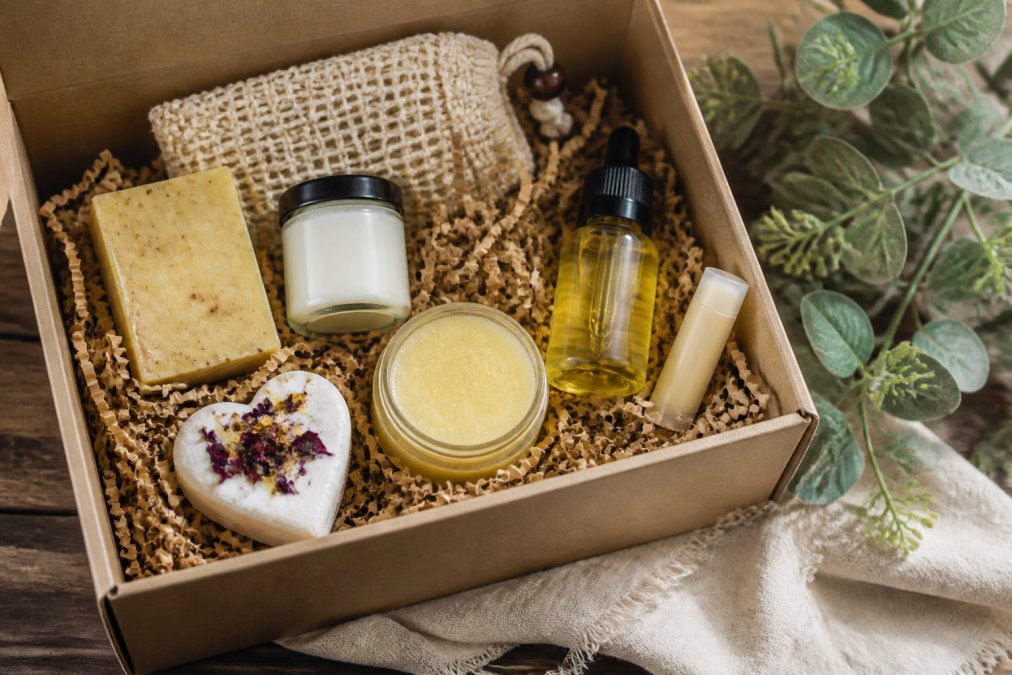
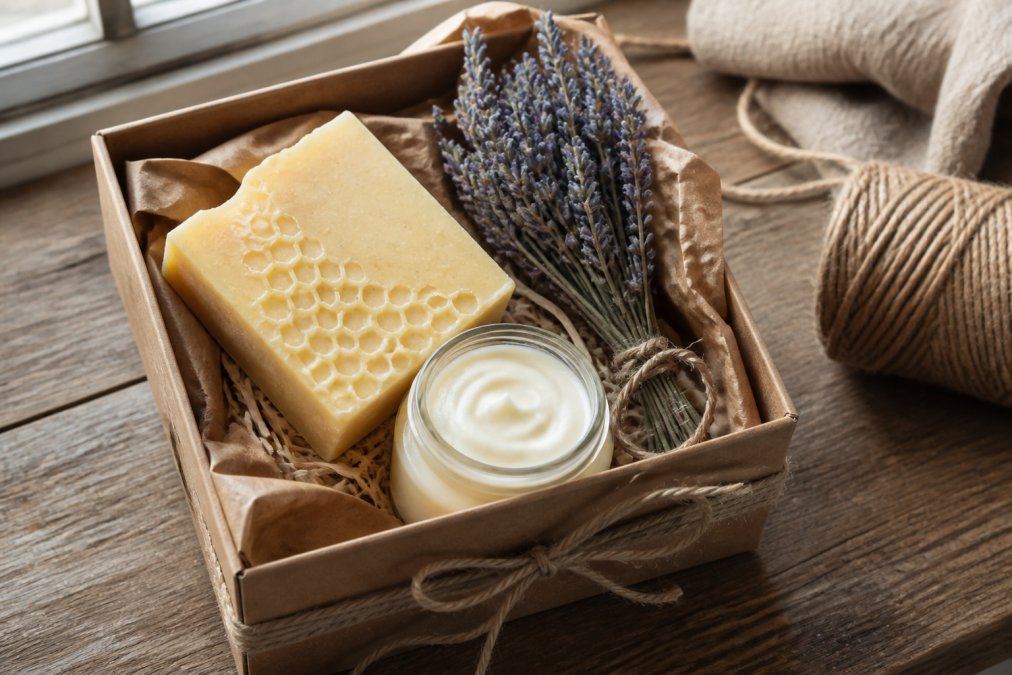
A great natural skincare gift set pairs three to four products that work together as a routine, not a random assortment. The strongest sets combine a cleanser, a moisturizer, and one treatment item, all matched to the recipient's skin type. Presentation matters too: kraft paper, twine, and a handwritten note turn a functional gift into a personal one.
Sets for Dry Skin
Dry skin needs lipid replenishment more than it needs water. Build these sets around occlusives and rich emollients: a cold-pressed oil cleanser, a beeswax-based body lotion, and a balm for hands and cuticles. Add a lip treatment as the finishing piece. Avoid anything with drying alcohol high on the ingredient list.
Sets for Sensitive Skin
Sensitive skin sets should stay minimal. A fragrance-free cleanser, a simple moisturizer with pro-ceramides or plant-based lipids, and a single soothing balm cover the essentials. Fewer products means fewer chances for a reaction, and the recipient can add items once they know what their skin tolerates.
Sourcing, Sustainability, and Packaging Transparency
Sustainability claims are easy to make and hard to verify, so ask where the ingredients come from and how the product ships. Small-batch makers in New England often source beeswax and botanicals regionally, which shortens supply chains and keeps money in local economies. Packaging transparency means the maker tells you what the jar, label, and shipping materials are made of, and whether they're refillable or recyclable.
The Federal Trade Commission's Green Guides set the standard for how environmental claims can be marketed, which is why vague terms like "eco-friendly" without specifics should raise a question. A maker who names their supplier and their packaging material is telling you something a slogan can't.
Seasonal Skincare Adjustments for Every Gift Occasion
Skincare needs shift with the seasons, and a gift that ignores this often sits unused. Winter calls for heavier occlusives and barrier support because indoor heat and cold air both strip moisture. Summer favors lighter humectant-forward formulas that absorb quickly and won't feel heavy under sunscreen. Spring and fall sit in between, which makes them the safest seasons for gifting an unfamiliar product.
For holiday gifts, lean toward rich balms and body butters. For spring birthdays and Mother's Day, a lighter lotion and a botanical soap set fits better. Matching the season to the product is a small detail that makes the gift feel considered.
Cost Per Ounce: What You're Really Paying For
Cost per ounce is the honest way to compare natural skincare, because a small jar and a large bottle aren't the same purchase. Divide the price by the net weight in ounces to see what you're actually paying. A concentrated balm often costs more per ounce than a lotion but lasts longer because you use less per application.
Here is the calculation in practice. A 2-ounce balm priced at $24 works out to $12 per ounce. A 12-ounce lotion priced at $18 works out to $1.50 per ounce. On the shelf, the lotion looks like the better deal. But if you use a pea-sized amount of balm per application and a quarter-sized amount of lotion, the balm may deliver more applications per container. The number that actually matters is cost per use, not cost per ounce, and most product pages never show it.
How to Estimate Cost Per Use
You do not need a lab to get a useful estimate. Use this method:
- Note the net weight in ounces from the label.
- Estimate your dose. A lip balm application is roughly 0.01 ounces. A hand salve application is roughly 0.05 ounces. A body lotion application is roughly 0.25 ounces.
- Divide net weight by dose to get approximate applications per container.
- Divide price by applications to get cost per use.
A 2-ounce balm at $24 with a 0.05-ounce dose yields about 40 applications, or roughly $0.60 per use. A 12-ounce lotion at $18 with a 0.25-ounce dose yields about 48 applications, or roughly $0.38 per use. The lotion wins here, but swap in a thinner balm or a lighter dose and the math flips. The point is to run the numbers rather than trust the shelf price.
What Drives the Premium in Small-Batch Natural Products
Pricing for small-batch products depends on ingredient sourcing, batch size, and packaging, so it varies by maker. Check the brand's website for current prices rather than assuming a range. What you're paying for in a small-batch product is freshness, a shorter ingredient list, and the labor of hand production.
A few cost drivers are worth knowing:
- Ingredient sourcing. Regionally sourced beeswax and botanicals can cost more per pound than commodity alternatives, but they shorten supply chains and support local producers.
- Batch size. Small batches mean less buying power and more hands-on labor per unit. That cost shows up in the price.
- Packaging. Glass jars, refillable tins, and recyclable shipping materials cost more than plastic tubs. If a maker is transparent about packaging, that transparency is part of what you are paying for.
- Freshness. Shorter shelf life often means fresher ingredients and smaller production runs. You are trading shelf stability for quality.
| What You're Comparing | What to Check | Why It Matters |
|---|---|---|
| Cost per ounce | Price divided by net weight | Reveals true value across sizes |
| Cost per use | Price divided by estimated applications | The number that actually reflects value |
| Ingredient list length | Count the items | Shorter lists suit sensitive skin |
| Occlusive content | Beeswax, shea, plant butters | Determines moisture retention |
| Packaging | Refillable or recyclable | Signals real sustainability effort |
| Batch date | Printed on the label | Fresher products perform better |
For gifting, cost per use is the more useful metric. A concentrated balm that costs more up front but lasts three months of daily use is a better gift than a large lotion that sits half-empty on a shelf.
Conclusion: Giving Skincare They'll Actually Use
The hardest part of gifting skincare is guessing what someone's skin will accept. The fix is to choose short ingredient lists, match the product to the season and skin type, and buy from a maker who can tell you where everything came from. The Beekeeper's Basket handcrafts bee-inspired soaps, lotions, and balms in small batches in New England, with skin-nourishing formulas. Explore the collection and give a gift that fits the person, not the shelf.
Frequently Asked Questions
What should I look for when buying natural skincare as a gift?
Look for short ingredient lists with recognizable botanical extracts, cold-pressed oils, and humectants like glycerin or honey. Check for synthetic fragrance-free and paraben-free labels if the recipient has sensitivities. A good natural skincare gift set should also list its full ingredients on the packaging and offer a clear return policy. Small-batch makers often share sourcing details, which signals real transparency rather than vague natural claims.
Are natural skincare products better for sensitive skin?
They can be, but natural does not automatically mean gentle. Some botanical extracts and essential oils trigger reactions in sensitive skin. Look for fragrance-free formulas, hypoallergenic testing, and pH-balanced products that support skin barrier repair. Patch testing on the inner wrist for 24 hours before full use is the safest way to check tolerance. If you're gifting to someone with known sensitivities, choose unscented options and include a note about patch testing.
What are the benefits of beeswax-based skincare products?
Beeswax acts as an occlusive, sealing in moisture and reducing transepidermal water loss. It pairs well with plant-based lipids and emollients to soften rough patches without clogging pores when used in balanced formulas. Artisan beeswax skincare also often includes honey and propolis, which have soothing properties and antioxidant-rich compounds. For dry or flaky skin, a beeswax balm or lotion can support hydration retention through cold weather.
How can I tell if a skincare brand is truly natural?
Check the full ingredient list, not just the front label. Truly natural brands list botanical extracts, cold-pressed oils, and humectants by name, with no synthetic fragrance, sulfates, or parabens hiding behind vague terms like fragrance or preservative. Look for certifications, small-batch production notes, and sourcing transparency. If a brand can't tell you where its beeswax or oils come from, that's a red flag for marketing over substance.
Finding a skincare gift that suits sensitive skin without triggering a reaction takes more than a pretty label. The Beekeeper's Basket makes that easier with handcrafted, small-batch products built around skin-nourishing ingredients, bee-inspired formulas, and freshness you can trace. Start with a curated set or build your own, and give something they'll reach for every day. LET'S EXPLORE!