 ultimate-guide
Why Choose Locally Made Skincare: 7 Honest Reasons
Table of Contents
- Why Choose Locally Made Skincare: What Mass Production Leaves Out
- The Benefits of Small-Batch Skincare: Freshness, Potency, and Consistency
- Sustainable Beauty Practices: What Local Makers Do Differently
- How to Read Skincare Labels: Spotting What Matters
- Locally Made Skincare and Sensitive Skin: What the Evidence Shows
- The Practical Trade-offs: Shelf Life, Regulation, and Cost
- Conclusion: Making a Choice That Fits Your Skin and Your Values
- Frequently Asked Questions
Last Updated: September 15, 2026
Why Choose Locally Made Skincare: What Mass Production Leaves Out
Choosing locally made skincare means buying products crafted in small batches close to home, often with fresher botanical ingredients and clearer supply chains than mass-produced alternatives. This guide from The Beekeeper's Basket breaks down seven honest reasons to make the switch, plus the trade-offs nobody mentions.
Mass production optimizes for shelf life and shipping distance. That's not a conspiracy, it's logistics. A lotion that sits in a warehouse for a year needs heavy preservation and stabilizers to survive the trip. Small-batch makers work on a different clock, and that difference shows up on your skin.
Below, we'll show you exactly what changes when your soap was poured weeks ago instead of years ago, and where local sourcing genuinely falls short.
The Benefits of Small-Batch Skincare: Freshness, Potency, and Consistency
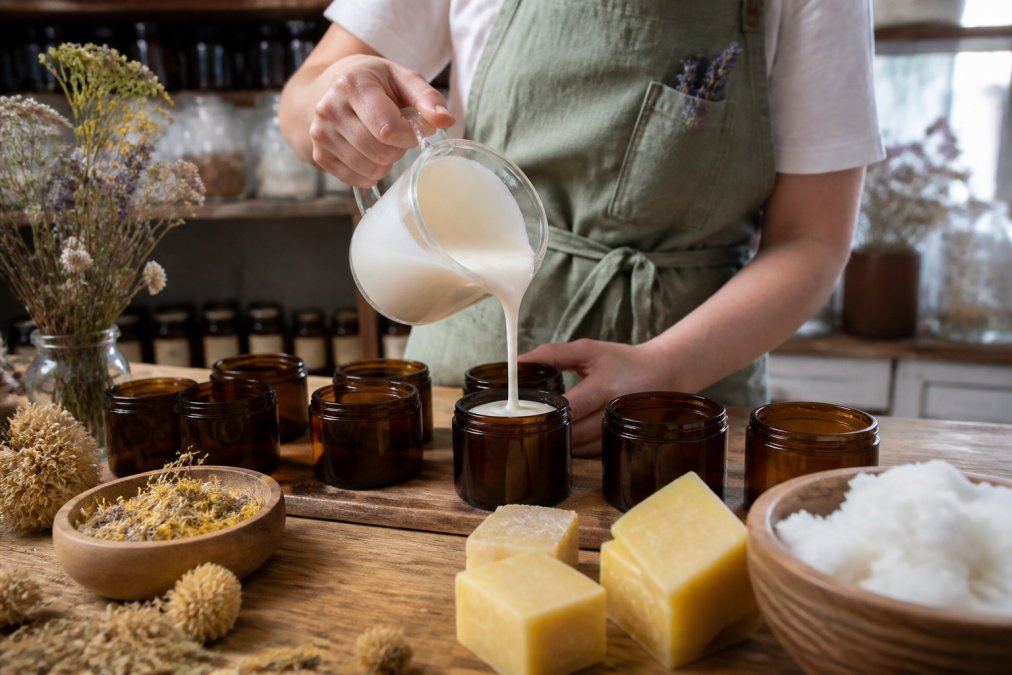
Small-batch skincare is produced in limited runs rather than continuous factory lines, which shortens the gap between formulation and use. That shorter window matters most for products built around active extracts and nourishing properties.
Why Freshness Affects Active Extracts and Nourishing Properties
Botanical ingredients degrade over time. Oils oxidize, extracts lose aroma, and the nourishing properties you paid for quietly fade. A common mistake is assuming the expiration date tells the whole story. It doesn't. A product can be technically "safe" and still be past its useful life.
How Small-Batch Makers Handle Consistency and Quality Control
Here's the honest part: consistency is the hardest thing about small-batch production. A maker who pours 40 bars this week and 40 next week has to control temperature, cure time, and raw material variance by hand.
What most guides miss is that good small makers document everything. Batch numbers, pour dates, supplier lots. Ask a maker how they track batches before you buy. The answer tells you more than any label claim.
Sustainable Beauty Practices: What Local Makers Do Differently
Sustainable beauty practices at the local level usually mean shorter supply chains, refillable or minimal packaging, and ingredients sourced from farms the maker can actually name. The environmental impact shrinks mainly because products travel less.
Traceability, Ethical Sourcing, and Supply Chain Transparency
Traceability is the ability to name where each raw material came from and who handled it. Farm-to-face sourcing sounds romantic, but the practical version is simple: the maker knows their suppliers personally.
That's also your best defense against greenwashing. If a brand can't tell you which farm grew the calendula, "eco-conscious" is just a word on a label. The FTC Green Guides on environmental marketing claims set the standard for what companies can legally claim about sustainability.
How to Read Skincare Labels: Spotting What Matters
Reading a skincare label well means knowing the difference between marketing language and the ingredient list, which is the only part regulated for accuracy. Front-of-package claims are persuasion. The back panel is fact.
Ingredients to Avoid: Surfactants, Synthetic Chemicals, and Hidden Fragrances
You don't need to fear every synthetic chemical, but you should know what you're putting on your skin.
- Harsh surfactants like sodium lauryl sulfate can strip the skin barrier, especially on dry or reactive skin
- "Fragrance" or "parfum" legally hides dozens of compounds, a real problem for allergen awareness
- Synthetic preservatives like parabens and formaldehyde releasers trigger contact dermatitis in some users
- Natural emulsifiers and gentle surfactants are the small-batch alternative worth looking for
Locally Made Skincare and Sensitive Skin: What the Evidence Shows
For sensitive skin, locally made skincare offers one structural advantage that mass-produced products cannot easily replicate: a shorter, more question-able ingredient list and a maker you can actually reach. Fragrance and preservatives are the most common triggers of contact dermatitis, according to Mayo Clinic's overview of contact dermatitis, so reducing the number of ingredients reduces your exposure surface. That logic is simple. The execution is where most guides stop short.
Why Fewer Ingredients Does Not Automatically Mean Fewer Reactions
A short ingredient list is only helpful if every remaining ingredient is one your skin tolerates. Botanical extracts, essential oils, and natural preservatives like sodium benzoate can all trigger reactions in the right person. Lavender oil, citrus oils, and tea tree oil are among the more frequently cited botanical irritants in dermatology practice. "Natural" describes origin, not safety profile.
The practical move is to treat a local product the same way you would treat any new formulation: request the full ingredient list before purchase, compare it against products you already know your skin tolerates, and patch-test on your inner forearm for 48 hours. That advice applies double to small-batch products because formulas can shift slightly between batches. A maker who reformulates seasonally, which many do when a supplier's harvest changes, may hand you a bar that behaves differently from the one you loved last spring.
The Seasonal Angle Most Guides Skip
Sensitive skin is not a fixed condition. Barrier function drops in cold, low-humidity months and in heated indoor air, which is when fragrance and preservative reactions tend to flare. Local makers who source regionally often build their product calendar around this: heavier balms and unscented tallow or beeswax-based moisturizers in winter, lighter lotions and gentle cleansers in summer. That seasonal alignment is hard for a national brand to pull off because its formula has to work in every climate at once.
If you have reactive skin, ask your local maker two questions: what changes in this product between seasons, and which batch number am I buying. The first tells you whether the formula is stable enough for your skin. The second tells you whether you can reorder the exact version that worked.
The Practical Trade-offs: Shelf Life, Regulation, and Cost
Local skincare is not automatically better, and pretending otherwise does not help you. The real trade-offs are shelf life, regulatory oversight, and price. Each one has a mechanism behind it, and understanding the mechanism is what separates a smart purchase from a hopeful one.
Why Preservative-Free Products Need Extra Care
Water is the problem. Any product with water in it, lotions, creams, toners, most cleansers, is a potential growth medium for bacteria, mold, and yeast. A properly preserved water-based cosmetic resists that growth for months. An unpreserved one can be compromised within weeks of opening, especially in a warm bathroom.
Oil-based products behave differently. Bars of soap, balms, and anhydrous (water-free) salves do not support microbial growth the same way, which is why many small makers lean on them. Their risk is oxidation instead: oils go rancid, butters develop off smells, and vitamin-rich botanicals lose potency. That is a quality problem, not usually a safety problem.
The practical rules are straightforward. Buy smaller sizes of water-based products. Store them cool and dark. Use clean hands or a spatula, never wet fingers. And treat the maker's stated shelf life as a ceiling, not a target.
What Regulation Actually Requires of Local Makers
What You Are Actually Paying For
| Trade-off | Mass-Produced | Locally Made |
|---|---|---|
| Shelf life | Long, heavily preserved | Shorter, use promptly |
| Ingredient freshness | Variable | Typically fresher |
| Traceability | Often opaque | Usually nameable |
| Safety testing | In-house labs, stability data | Varies; ask for batch and test records |
| Regulatory oversight | Federal plus state, audited | Federal plus state, varies by maker |
| Cost | Lower per unit | Higher per unit |
| Batch consistency | Highly uniform | Varies by maker |
Conclusion: Making a Choice That Fits Your Skin and Your Values
Frequently Asked Questions
What are the primary benefits of using small-batch skincare products?
Small-batch skincare is made in smaller quantities, which means ingredients spend less time in storage before reaching you. That matters for active extracts and botanical ingredients that lose potency over time. Small-batch production also lets makers maintain tighter quality control and use fresher raw materials.
How can I tell if a skincare brand is truly local and artisan?
Look for specific claims, not vague ones. A genuine local maker will name where they produce, describe their small-batch process, and list ingredient sources. Check whether they publish batch dates or make-to-order timelines. If a brand claims to be local but ships from a third-party warehouse and cannot answer basic questions about sourcing, that is a red flag. Transparency about supply chain and raw materials is the clearest signal.
Is locally made skincare safer than mass-produced alternatives?
Not automatically. Local makers follow FDA labeling requirements and good manufacturing practices, but smaller operations may have less automated quality testing. The advantage is traceability and freshness; the trade-off is that preservative-free or low-preservative products have shorter shelf lives and need careful storage. Ask about preservative systems and expiration dates. Safety depends on formulation and handling, not just on whether a product is local.
How does locally sourced skincare contribute to environmental sustainability?
Shorter supply chains reduce the carbon footprint of shipping raw materials and finished goods. Local makers often source botanical ingredients from nearby farms, which supports the local economy and makes ethical sourcing easier to verify. Smaller operations also tend to produce less overstock, meaning less waste. That said, sustainability claims vary widely, so look for specifics about sourcing, packaging, and eco-conscious practices rather than general statements.