 ultimate-guide
Why Handmade Lotion Is Better for Your Skin
Table of Contents
- What Makes Handmade Lotion Different
- Natural Ingredients for Sensitive Skin
- How Handmade Lotion Supports Your Skin Barrier
- The Shelf Life of Natural Skincare Products
- Small-Batch Freshness vs. Mass Production
- Common Misconceptions About Handmade Lotion
- Conclusion
- Frequently Asked Questions
Last Updated: September 16, 2026
What Makes Handmade Lotion Different
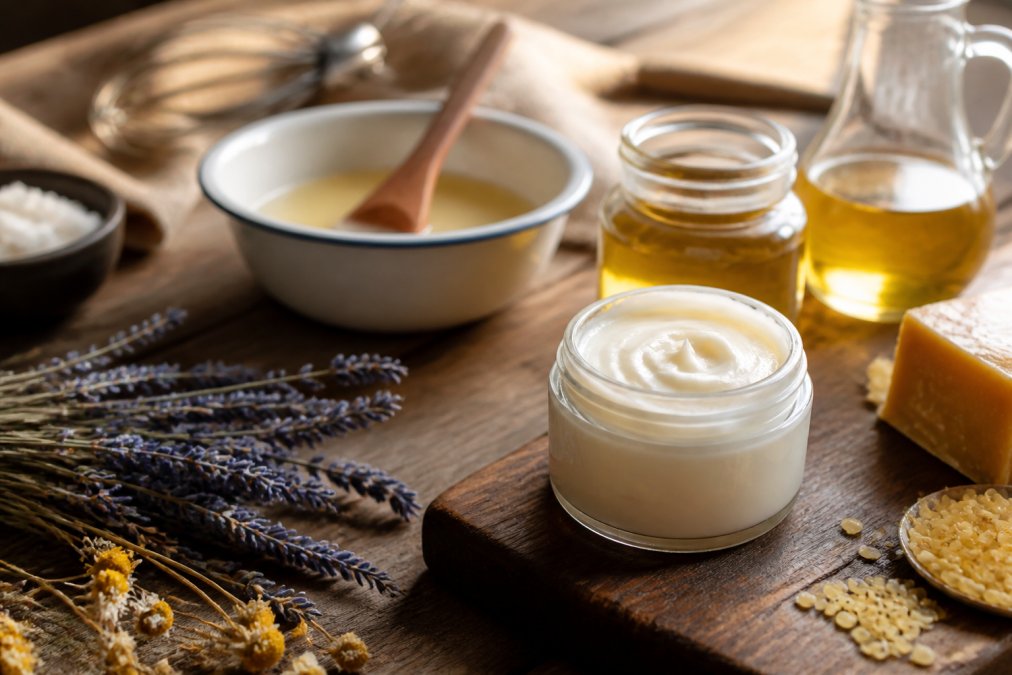
Handmade lotion is a small-batch skincare product blended by hand from oils, butters, water, and an emulsifier rather than mixed on a factory line. The difference shows up in the ingredient list: fewer synthetic fillers, fresher raw materials, and formulas built around skin nourishment instead of shelf logistics. This guide walks through what actually separates the two.
Mass-produced lotions are engineered for one thing above all: sitting on a shelf for years without separating. That goal shapes everything in the bottle. Water comes first because it is cheap. Mineral oil and petrolatum follow because they are stable and inexpensive. Then come synthetic fragrances, dyes, parabens, and phthalates, all there to keep the product looking and smelling identical for a very long shelf life.
A handmade formula starts from a different question. Which carrier oils, butters, and botanical extracts actually feed the skin barrier? How much humectant does dry skin need? What emulsifier holds the whole thing together without a lab full of stabilizers?
That shift changes the texture, the scent, and how the lotion behaves on your skin. It also changes how long the jar lasts, which is the trade-off nobody mentions in most guides.
Natural Ingredients for Sensitive Skin
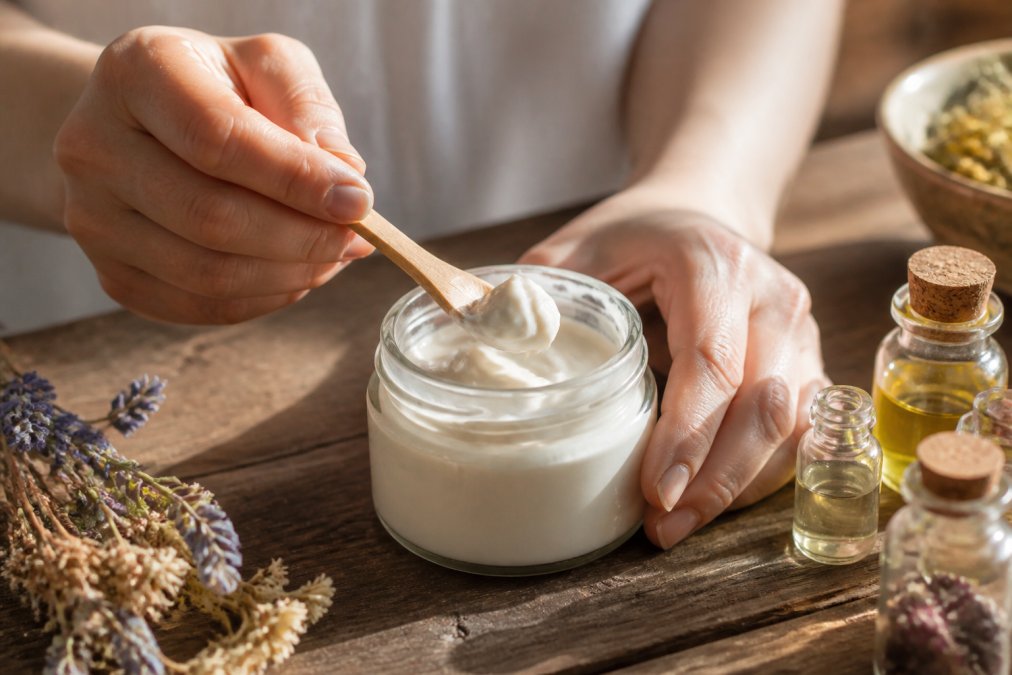
Natural ingredients for sensitive skin are the oils, butters, waxes, and extracts that moisturize and calm without the irritants common in drugstore formulas. For reactive skin, the ingredient list matters more than the marketing on the front of the jar, and so does where each ingredient came from.
Which Ingredients to Look For
Look for a short list of recognizable ingredients that serve a clear purpose:
- Carrier oils like jojoba, sweet almond, and sunflower, which absorb without leaving a heavy film
- Butters such as shea and cocoa, which add richness and help seal in hydration
- Humectants like glycerin or honey, which pull water into the upper layers of skin
- Occlusives such as beeswax, which slow moisture loss through the skin barrier
- Botanical extracts like chamomile and calendula, chosen for their soothing properties
Which Ingredients to Avoid
For sensitive skin, the usual suspects are synthetic fragrances, dyes, parabens, and phthalates. Fragrance blends are a frequent trigger because "fragrance" on a label can hide dozens of individual compounds, and you have no way to know which one your skin will react to. Dyes add nothing to how the lotion works. Parabens and phthalates are preservative and texture agents that many people prefer to skip.
If you have reacted to "natural" products before, check whether fragrance was the culprit. It often is.
Why Sourcing Changes How a Formula Behaves
Two jars can list the same ingredients and behave nothing alike on reactive skin, because origin and processing change what is actually in the oil.
Unrefined shea butter, for example, keeps more of its natural fatty acids and phytosterols than the refined version, which is why it feels richer and smells nutty. Refined shea is smoother and nearly odorless but has had much of that character stripped out. Neither is wrong, but a label that just says "shea butter" is not telling you which one you got.
Cold-pressed carrier oils retain more of their natural antioxidants than heat- or solvent-extracted versions.
Reading a Handmade Label Like a Formulator
When you are comparing small-batch products for sensitive skin, the label itself is the best test:
- Look for extraction method. "Cold-pressed" and "unrefined" tell you more than "pure" or "premium."
- Look for the preservative by name. A serious maker lists it. A vague "natural preservative" is a red flag.
- Look for a batch or made-on date. Freshness is the whole point of small batch, so it should be visible.
- Look for origin when it matters. Single-origin oils and fair-trade butters signal a supply chain the maker actually knows.
How Handmade Lotion Supports Your Skin Barrier
The skin barrier is the outermost layer of skin, a lipid matrix that holds water in and keeps irritants out. When that matrix is compromised, skin feels tight, flaky, and reactive. A well-made lotion supports it in two ways: humectants draw water in, and occlusives plus oils slow its escape.
The Shelf Life of Natural Skincare Products
The shelf life of natural skincare products is shorter than that of conventional lotions, and that is not a flaw. It is the direct result of skipping heavy stabilizers. A handmade lotion made with distilled water and no preservative system is a breeding ground for microbial growth within days.
Why Preservatives Matter in Handmade Lotion
Any lotion that contains water needs a preservative system. Full stop. Water is where bacteria, mold, and yeast thrive, and every time you dip a finger into the jar, you introduce new microbes.
The pH Question Most Guides Skip
Preservation and pH are not separate topics. They are the same topic. A broad-spectrum preservative only works inside a specific pH window, and most of the common ones perform best in a mildly acidic range that also happens to match healthy skin. Formulate too high or too low and the preservative you paid for is doing nothing.
Microbiological Stability Testing at Home
Most guides stop at 'add a preservative.' That is the hobbyist answer. The formulator answer is to verify that the preservative is actually holding.
- Split your batch. Keep one jar sealed and untouched as a control. Use the other the way a real customer would, fingers, bathroom humidity, temperature swings.
- Check on a schedule. Inspect the control and the in-use jar at the one-week, one-month, and three-month marks for separation, color shift, off-smell, or surface growth.
- Watch the control jar first. If the sealed control fails, the problem is the formula. If only the in-use jar fails, the problem is handling or packaging.
- Log every batch. Note the preservative used, its percentage, the measured pH, and the date. Patterns show up fast across a few batches.
Small-Batch Freshness vs. Mass Production
Small-batch production means the lotion in your jar was made recently, in limited quantities, often by the same hands that sourced the ingredients. That is the whole point. Freshness is a feature, not a marketing line.
Common Misconceptions About Handmade Lotion
The biggest misconception is that "handmade" automatically means "safer." It does not. A poorly made lotion with no preservative and unbalanced pH is worse for your skin than a conventional product, because microbial growth and pH swings cause real irritation.
| Misconception | Reality | What It Means for You |
|---|---|---|
| Handmade is always safer | Safety depends on formulation | Check for a preservative system and pH balance |
| Handmade is always greasy | Texture depends on oil ratio | Look for light carrier oils like jojoba |
| Natural needs no preservatives | Water-based products always do | Confirm a broad-spectrum preservative is used |
| Shorter shelf life means lower quality | It reflects fewer stabilizers | Buy smaller jars and use them promptly |
Conclusion
Choosing handmade lotion is really a choice about what you want in the jar: fresher ingredients, a formula built around skin nourishment, and a maker who can tell you exactly what went into it. The catch is that quality varies, so read the ingredient list, confirm there is a real preservative system, and buy from someone who makes in small batches and stands behind the freshness.
Frequently Asked Questions
How long will homemade lotion last?
The shelf life of natural skincare products depends on the preservative system and storage conditions. Lotions made with a proper broad-spectrum preservative typically last three to six months when kept in a cool, dark place and scooped with clean hands. Products without preservatives can grow mold or bacteria within days. Always check for changes in smell, color, or texture before using, and store away from direct sunlight and heat.
What makes natural ingredients for sensitive skin safer than synthetic ones?
Natural ingredients for sensitive skin, such as shea butter, jojoba oil, and colloidal oatmeal, work with your skin barrier instead of stripping it. Many commercial lotions contain synthetic fragrances, dyes, parabens, and phthalates that can trigger irritation. Handmade lotion made in small batches lets you know exactly what is inside, so you can avoid the specific ingredients that cause reactions and choose a formula built around gentle, skin-nourishing components.
Is it legal to sell handmade lotion under FDA regulations?
The FDA regulates cosmetics, including handmade lotion, under the Federal Food, Drug, and Cosmetic Act. Makers must ensure products are safe, properly labeled with ingredients, and free of adulteration. Small-batch sellers do not need pre-market approval, but they must follow good manufacturing practices and avoid making drug claims like 'cures eczema.' Reputable makers test for microbiological stability and pH balance to confirm their lotion is shelf-stable and safe for use.
Why does mass-produced lotion often cause skin irritation?
Mass-produced lotion often contains synthetic fragrances, dyes, parabens, and phthalates that can irritate sensitive skin. It also sits on shelves for months or years, so makers add stronger preservatives to extend shelf life. Handmade lotion is made in small batches with fresher ingredients and fewer synthetic additives. That shorter supply chain and simpler ingredient list reduce the chance of a reaction, especially for people with a compromised skin barrier.
That is where The Beekeeper’s Basket comes in. Every lotion is handcrafted in small batches in New England, made with bee-inspired ingredients and designed for daily skin nourishment. With over 20,000 sales and a 5-star rating, the shop has built its reputation on freshness and care rather than volume. Get started with The Beekeeper’s Basket and give your skin a lotion made the way it should be.