 how-to
Avoiding Skin Irritation From Soap: A 2026 Guide
Table of Contents
- Why Your Skin Reacts to Soap: The Barrier Connection
- Ingredients to Avoid in Soap: A Label Decoder
- What Is Contact Dermatitis and How Do You Spot It?
- Natural Soap for Sensitive Skin: What Actually Works
- How to Treat Soap Rash and Soothe Irritated Skin
- Hand Hygiene and Post-Wash Habits That Protect Your Skin
- Frequently Asked Questions
Last Updated: September 11, 2026
Why Your Skin Reacts to Soap: The Barrier Connection
Avoiding skin irritation from soap starts with understanding one thing: your skin's outer layer is a barrier, and soap can strip it. This guide breaks down what's actually happening, which ingredients trigger reactions, and the daily habits that keep your skin calm.
Contact dermatitis is inflammation of the skin caused by direct contact with an irritant or allergen. Soap is one of the most common household culprits because it's designed to lift oil and dirt, and it can't always tell the difference between grime and your skin's protective lipids.
That protective layer is called the skin barrier, sometimes described as the lipid barrier. It holds in water and keeps irritants out. When soap breaks it down, moisture escapes through a process called transepidermal water loss, and triggers like fragrance and preservatives get in more easily. The result is redness, itching, and dryness that can show up within hours or build over days.
A common mistake is blaming "sensitive skin" as a permanent trait. More often, the soap is the problem, not the person.
Irritant vs. Allergic Contact Dermatitis
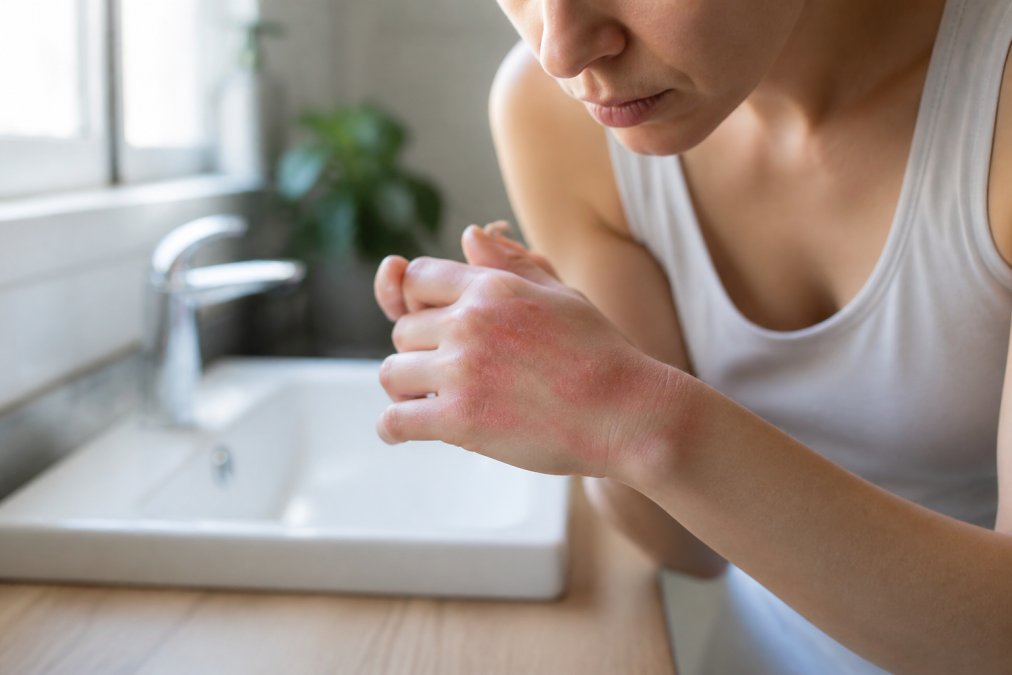
These two look similar but behave differently. Irritant contact dermatitis is a direct chemical injury: the more soap touches your skin and the longer it sits, the worse it gets, and anyone can develop it with enough exposure. Allergic contact dermatitis is an immune response. It requires a trigger, often fragrance or a preservative, and it can appear after months of using a product with no issue.
The distinction matters because the fixes differ. Irritant reactions improve when you remove the offending product and let the barrier recover. Allergic reactions need you to identify and permanently avoid the specific allergen, which is where patch testing by a dermatologist helps.
Ingredients to Avoid in Soap: A Label Decoder
Certain ingredients appear again and again in soap-related skin complaints. The three families to watch first are sulfates, parabens, and fragrance, but the trick is that none of them are usually listed under those plain names on a label.
Sulfates are surfactants that create lather and strip oils aggressively. On a label they rarely say "sulfate." Look instead for:
- Sodium lauryl sulfate (SLS)
- Sodium laureth sulfate (SLES)
- Ammonium lauryl sulfate (ALS)
- Ammonium laureth sulfate (ALES)
- Sodium coco-sulfate
- TEA-lauryl sulfate
Parabens are preservatives. The giveaway is the suffix. Scan for methylparaben, ethylparaben, propylparaben, butylparaben, isobutylparaben, and isopropylparaben. Any word ending in "-paraben" is in this family.
Fragrance is the hardest to decode because it is a legal umbrella term. On a label it can appear as "fragrance," "parfum," "aroma," or "essential oil blend", and any one of those can stand in for dozens of individual compounds. That is why "unscented" is not the same as "fragrance-free." Unscented products may contain a masking fragrance to neutralize the smell of raw ingredients. If your skin is reactive, look for the words "fragrance-free" on the front of the package, not "unscented."
A few other names worth knowing:
- Cocamidopropyl betaine, a mild surfactant, but a recognized allergen for some people.
- Methylisothiazolinone (MI) and methylchloroisothiazolinone (MCI), preservatives that are common contact allergens in liquid soaps.
- Formaldehyde releasers, quaternium-15, DMDM hydantoin, diazolidinyl urea, imidazolidinyl urea. They preserve the product by slowly releasing formaldehyde.
- "Natural" and "botanical", marketing terms with no legal definition. Essential oils and plant extracts are common allergens, and a product can be entirely plant-derived and still cause a reaction.
Reading order matters too. Ingredients are listed by concentration, so anything in the first five is present in meaningful amounts. If a sulfate or fragrance sits near the top, it is doing real work on your skin. If it appears near the bottom, exposure per wash is lower.
Sulfates, Parabens, and Fragrance
Of the three families, fragrance is the most frequent cause of allergic contact dermatitis from personal care products. Preservatives come second, and sulfates are more often irritants than allergens, they strip the barrier rather than trigger the immune system. That is why switching to a fragrance-free, sulfate-free bar is usually the first experiment worth running, and why a product labeled "gentle" can still sting if it hides fragrance under "parfum."
What Is Contact Dermatitis and How Do You Spot It?
Contact dermatitis is a red, itchy, sometimes blistered skin reaction caused by contact with a substance your skin can't tolerate. It's not contagious and it's not an infection.
Symptoms of soap-induced irritation typically include redness, itching, dryness, and a burning or stinging sensation, often on the hands, forearms, or face, since those areas meet soap most often. In more severe cases, the skin can crack, ooze, or develop small blisters. People with existing eczema are more vulnerable because their barrier is already compromised.
The timing is a useful clue. Irritant reactions usually appear quickly and worsen with repeated exposure. Allergic reactions can take 24 to 72 hours to show up, which makes them harder to connect to a specific product (the American Academy of Dermatology). If a rash keeps returning after you've stopped using a suspect soap, or if it spreads beyond the contact area, see a dermatologist. Patch testing is the standard way to identify a true allergen.
Natural Soap for Sensitive Skin: What Actually Works
The best soap for sensitive skin is one with a short ingredient list, no added fragrance, and a pH close to your skin's natural level. "Natural" alone doesn't guarantee that.
Look for bars built on gentle cleansing agents rather than harsh surfactants, and formulas that include humectants like glycerin, which draw water into the skin, and emollients like shea or cocoa butter, which soften and seal. Soap-free cleansers, sometimes called syndets or synthetic detergents, use milder surfactants and are often better tolerated than traditional lye soap.
At The Beekeeper’s Basket, our handcrafted soaps are made in small batches with gentle, skin-nourishing ingredients. Small-batch production also means fresher bars, which matters because oils can turn rancid over long shelf lives.
pH Balance and the Acid Mantle
Your skin's acid mantle is a slightly acidic film, typically around pH 4.5 to 5.5, that helps keep the barrier intact and discourages harmful bacteria. Traditional bar soaps are often alkaline, with a pH well above that range. Washing with them temporarily pushes your skin's surface toward alkaline, and repeated use can leave the barrier struggling to recover.
pH-balanced cleansers are formulated to sit closer to your skin's natural range, which means less disruption per wash. If you're dealing with recurring irritation, this is one of the most overlooked fixes. A soap can be gentle in every other way and still cause problems if its pH is far from your skin's.
How to Treat Soap Rash and Soothe Irritated Skin
Treating soap rash begins with stopping the exposure, then rebuilding the barrier. Here's the sequence that works:
- Stop using the suspect soap immediately. Switch to plain water or a fragrance-free cleanser while your skin calms.
- Rinse with lukewarm water to remove any residue without adding heat stress.
- Pat dry, don't rub. Friction worsens irritation.
- Apply a thick moisturizer within a few minutes of washing, while skin is still slightly damp, to lock in water.
- Skip actives like exfoliating acids and retinoids until the skin settles.
- Use a cool compress for itching, and resist scratching, which breaks the barrier further.
- See a dermatologist if it doesn't improve within a week or two, or if it blisters or spreads.
For mild cases, an over-the-counter hydrocortisone cream can reduce inflammation, but it's worth checking with a pharmacist or doctor before using it on your face or for more than a few days (the FDA).
Hand Hygiene and Post-Wash Habits That Protect Your Skin
Frequent hand washing is non-negotiable for hygiene, but the way you wash matters as much as how often. The goal is to clean your hands without repeatedly stripping the barrier.
Use a gentle, fragrance-free cleanser, lather briefly, and rinse thoroughly. Then moisturize every time. If you're washing many times a day, keep a moisturizer at the sink so it becomes automatic rather than an afterthought. When hands are badly irritated, an alcohol-based hand sanitizer can sometimes be gentler than repeated soap and water, since it doesn't strip oils the same way, though it can sting on broken skin, so it is not a fix for an already-cracked barrier.
Water Temperature and Drying Techniques
Hot water feels satisfying, but it dissolves skin oils faster and increases irritation (the American Academy of Dermatology). Lukewarm water cleans just as effectively for everyday hand washing. The reason is mechanical, not cosmetic: heat softens the lipid barrier and speeds up the rate at which the oils that hold your skin together are emulsified and rinsed away. A soap that is gentle at 90°F can behave like a harsh one at 110°F.
Drying technique is the step almost everyone skips, and it is where a lot of irritation is actually created. Rubbing with a rough towel creates friction that damages a fragile barrier. The fix is simple but specific:
- Pat, don't rub. Press the towel against the skin to wick water away, then lift. Do not drag it back and forth.
- Leave skin slightly damp. A thin film of water left on the skin gives your moisturizer something to trap.
- Skip the air-dry. Letting hands air-dry completely lets evaporation pull water out of the skin along with the surface moisture, which is the opposite of what you want.
- Moisturize within three minutes. The window matters. Skin that is still damp absorbs and holds far more water than skin that has been left to dry completely.
- Choose the towel, not the technique alone. A soft, clean towel causes less friction than a rough or stiff one. If your hands are already irritated, a paper towel patted gently can be less abrasive than a terry cloth rubbed hard.
This combination, lukewarm water, a gentle fragrance-free cleanser, patting instead of rubbing, and prompt moisturizing, is the habit loop that prevents most soap-related irritation from ever taking hold. Each step is small. Together they are the difference between skin that recovers between washes and skin that never gets the chance.
Frequently Asked Questions
What ingredients in soap cause skin irritation?
Sulfates, parabens, synthetic fragrances, and some preservatives are common triggers. Sulfates strip the skin barrier and disrupt the acid mantle, leading to dryness and redness. Fragrance mixes can cause allergic reactions even in products labeled natural. Check labels for sodium lauryl sulfate, parabens, and unspecified fragrance. Choosing a soap-free cleanser or a pH-balanced natural soap for sensitive skin reduces exposure to these irritants.
How do I know if I am allergic to my soap?
Signs include redness, itching, dryness, or a rash that appears within hours or days of washing. Irritant contact dermatitis is more common and causes immediate burning or stinging, while allergic contact dermatitis may take repeated exposure to develop. A dermatologist can perform patch testing to identify the exact trigger. If you suspect a reaction, stop using the product and switch to a fragrance-free, hypoallergenic option.
Can fragrance-free soap still cause skin irritation?
Yes. Even without fragrance, some cleansers contain preservatives, surfactants, or other ingredients that can trigger irritation in sensitive skin. Look for products labeled hypoallergenic and free of common allergens like methylisothiazolinone. A soap-free cleanser with humectants and emollients is less likely to disrupt the lipid barrier. Always patch test new products on a small area before full use.
How can I soothe skin that is irritated by soap?
Rinse with lukewarm water, pat dry gently, and apply a thick moisturizer within three minutes to lock in hydration. Avoid hot water and scrubbing. Over-the-counter hydrocortisone cream can calm inflammation, but see a dermatologist if symptoms persist. To prevent future flare-ups, switch to a gentle, pH-balanced cleanser and moisturize after every wash to support the skin barrier.
Soap irritation is rarely about having "bad skin." It's about a barrier that's been worn down by the wrong ingredients, the wrong pH, or the wrong habits, and it responds well to a gentler routine. If you're ready to simplify, The Beekeeper’s Basket makes small-batch, handcrafted soaps and skin-nourishing products designed for sensitive skin, with short ingredient lists and no mystery fragrance. Explore our collection and find a bar your skin can actually live with. LET'S EXPLORE!