 how-to
How Long Does Natural Skincare Take to Work?
Table of Contents
- Why Natural Skincare Takes Time: Skin Cell Turnover Explained
- Short-Term vs. Long-Term Results: What Changes First
- How Long to Try a New Skincare Routine Before Judging Results
- Ingredient-by-Ingredient Timelines for Natural Actives
- Signs a Skincare Product Is Working (and Signs It Is Not)
- How to Patch Test Skincare Products Safely
- Choosing a Natural Moisturizer for Dry Skin
- Conclusion: Consistency, Patience, and Knowing When to Stop
- Frequently Asked Questions
Last Updated: October 13, 2026
Why Natural Skincare Takes Time: Skin Cell Turnover Explained
Natural skincare is skin care made with ingredients derived from plants, bees, and minerals rather than synthetic chemicals. The key word is patience: natural skincare takes time to work because your skin renews itself slowly, not overnight. At The Beekeeper's Basket, we hear the same question every week: how long does natural skincare take to work? The honest answer is weeks, not days.
The 28-Day Skin Renewal Cycle
Your skin sheds and rebuilds itself on a roughly 28-day cycle. New cells form at the base of the epidermis, then travel upward and flake away. That cycle slows with age, often stretching to 40 days or more.
So a new product is only "finished" with its first full pass through your skin after about a month. Visible results timeline expectations should follow that rhythm.
Short-Term vs. Long-Term Results: What Changes First
Hydration and skin comfort improve first, often within days. A good natural moisturizer for dry skin can soften tightness and flaking quickly because it holds water in the outer layer.
Deeper changes take longer. Skin texture, smoothness, and reduced redness follow weeks behind the first comfort gains.
- Days 1-7: less tightness, softer surface
- Weeks 2-4: better hydration, calmer feel
- Weeks 6-12: texture improvement, more even tone
Hydration and Skin Comfort Improvements
Moisture is the fastest visible win. Humectants like honey pull water into the skin, while beeswax and plant oils seal it in. You may notice comfort within a week, even before texture shifts.
How Long to Try a New Skincare Routine Before Judging Results
Give any new routine six to eight weeks before you decide. Four weeks shows early signs; eight weeks tells the real story. This is the most common mistake we see: people quit at day ten, right before results arrive.
Track changes with photos in the same light, same angle, same time of day. Note how your skin feels, not just how it looks.
| Timeframe | What to Expect | What to Do |
|---|---|---|
| Week 1 | Hydration, less tightness | Keep going, no judgment yet |
| Weeks 2-4 | Calmer, softer skin | Take progress photos |
| Weeks 6-8 | Texture, tone changes | Decide whether to continue |
| Weeks 8-12 | Full results for most | Adjust or stop |
Ingredient-by-Ingredient Timelines for Natural Actives
Natural actives do not share one timeline. What separates them is mechanism: some work by holding water in the outer layer, some by calming visible redness, and some by influencing how skin cells behave over a full renewal cycle. That is why a honey mask can feel soothing the same evening while a rosehip oil may take two months to shift tone.
Here is a realistic breakdown, with the caveat that individual results depend on concentration, formulation, your skin type, and how consistently you use the product.
- Honey and other humectants: draw water into the stratum corneum, so comfort and softness can appear within days. This is a surface hydration effect, not a structural change.
- Beeswax, shea butter, and plant oils (jojoba, olive, sweet almond): act as occlusives and emollients, slowing water loss and smoothing the surface. Most people notice softer skin in 1-2 weeks; barrier support builds over 2-4 weeks of regular use.
- Colloidal oatmeal and aloe: have well-documented soothing properties. Temporary calming of tightness or visible redness can happen within days, but sustained improvement in reactive skin typically takes 1-2 weeks of consistent use.
- Niacinamide (often derived from or paired with botanical sources): supports the skin barrier and can gradually even out tone. Expect 4-8 weeks for visible tone changes, and note that higher concentrations do not necessarily work faster.
- Vitamin C from botanicals (rosehip, sea buckthorn, kakadu plum): these oils and extracts supply antioxidants and support collagen-related processes, but the vitamin C content is usually lower and less stable than in dedicated serums. Tone and texture changes generally appear over 6-12 weeks.
- Gentle botanical exfoliants (fruit enzymes, lactic acid from plants): can smooth texture within 1-2 weeks, but overuse causes irritation. Two to three times per week is a common starting point.
What Natural Ingredients Can and Cannot Do
A common assumption is that because an ingredient is plant-derived, it works faster or is automatically safer. Neither is guaranteed. Botanical extracts are complex mixtures, and any of them can trigger contact dermatitis in a sensitive person. Essential oils, in particular, are a frequent cause of irritation even when diluted.
What natural ingredients generally do well is support hydration, barrier function, and comfort. What they are less reliable for is rapid, dramatic change in pigmentation, deep wrinkles, or active acne. For those concerns, a naturally derived routine can still help, but the timeline is measured in months, and pairing it with guidance from a dermatologist is reasonable.
The practical takeaway: judge each ingredient by its mechanism, not its origin. A soothing oat product and a vitamin-C-rich oil do not belong on the same timeline, and neither one should be expected to outperform a well-formulated conventional active just because it is natural.
Signs a Skincare Product Is Working (and Signs It Is Not)
Gradual change is hard to judge from memory. Day-to-day impressions swing with sleep, stress, hormones, and weather, so the most reliable way to know whether a natural product is working is to track a few concrete signals over time.
How to Measure Progress Objectively
A simple three-part log removes most of the guesswork:
- Photos: take one in the same spot, same light, same time of day, roughly once a week. Natural window light without direct sun works well. Keep the camera at the same distance and angle.
- Symptoms: note specific, countable things rather than general impressions. Examples: number of dry patches, how many days your skin felt tight after cleansing, whether redness covered one cheek or both.
- Product use: record how often you actually applied the product and whether you introduced anything else that week. This is what lets you connect a change to a cause.
After four weeks, compare week one to week four side by side. After eight weeks, compare again. Patterns that survive that comparison are real; patterns you only feel on a bad day usually are not.
When to Stop a Product
Stop using a product and do not restart it if you notice:
- Persistent burning or stinging that lasts beyond a few minutes after application
- Swelling of the face, lips, or eyelids
- A rash that spreads or keeps worsening after you stop
- New breakouts that continue to multiply past two to three weeks, especially in areas you do not normally break out
These are signs of irritation or an allergic reaction, not a normal adjustment period. Continued use can damage the skin barrier and turn a small reaction into a longer-lasting one.
When to Seek Professional Advice
A dermatologist or other qualified clinician is the right resource if:
- A reaction is severe, painful, or accompanied by trouble breathing (seek urgent care)
- Acne is deep, cystic, or leaving marks
- A concern has not improved after two to three months of consistent, appropriate use
- You have a known skin condition such as eczema, rosacea, or psoriasis and are unsure how a new product fits in
Natural does not mean risk-free, and a clinician can help you tell the difference between a product that needs more time and one that is working against your skin.
How to Patch Test Skincare Products Safely
Patch testing is simple, and it takes 48 hours. Apply a small amount to your inner forearm, cover it, and wait two days. If no redness or itching appears, test again near your jaw before using it on your whole face.
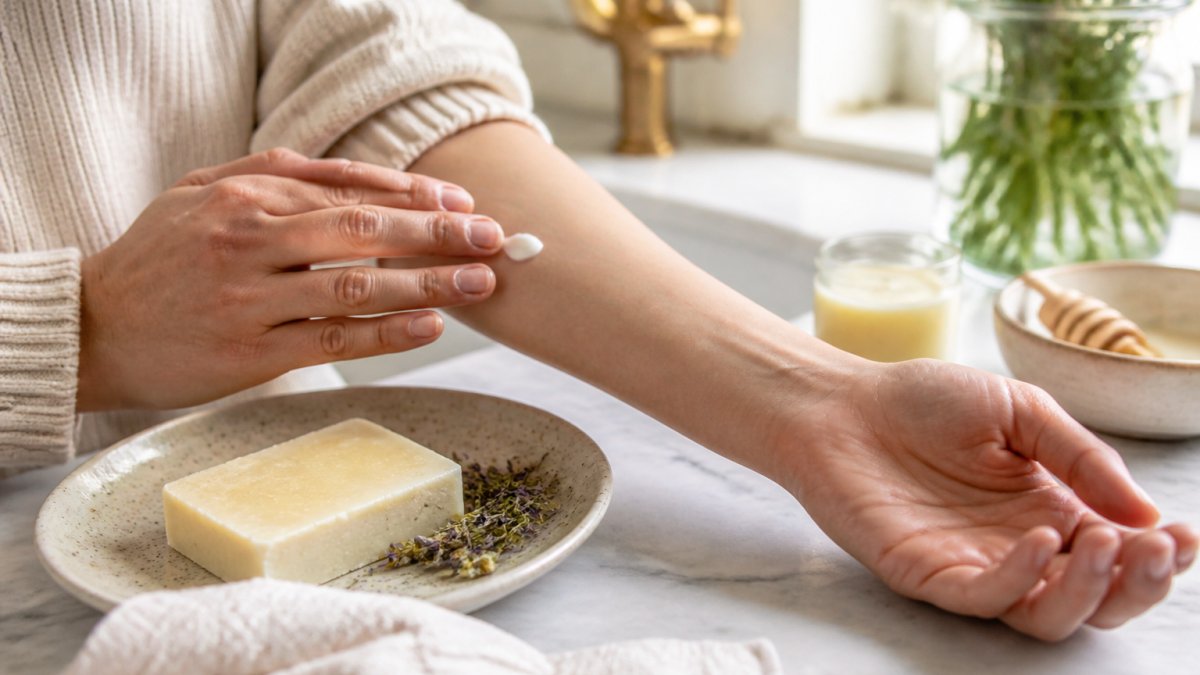
Here is how we would do it:
- Wash and dry your inner forearm
- Apply a pea-sized amount of product
- Cover with a bandage and wait 24 hours
- Check for redness, itching, or swelling
- If clear, repeat for a second 24 hours
- If still clear, test a small spot near your jaw
Purging vs. Irritation: Telling Them Apart
Purging brings breakouts where you normally get them, and it settles within a few weeks. Irritation brings redness, stinging, and bumps in new places, and it gets worse, not better. Purging is common with exfoliating actives; irritation means stop.
Choosing a Natural Moisturizer for Dry Skin
The best natural moisturizer for dry skin pairs a humectant with an occlusive. Honey or aloe draws in water; beeswax and oils hold it there. Look for short ingredient lists and small-batch makers who date their products.
For sensitive skin, skip heavy fragrance at first. Our handcrafted soaps and lotions are made in small batches in New England, which keeps them fresh and gentle. You can explore the full collection at The Beekeeper's Basket.
If you want to understand how skin barriers work, the American Academy of Dermatology explains barrier care in plain terms. And for guidance on reading ingredient labels, the U.S. Food and Drug Administration publishes clear cosmetic labeling rules.
Conclusion: Consistency, Patience, and Knowing When to Stop
The real challenge with natural skincare is patience. Results come in weeks, not days, and consistency matters more than any single product.
At The Beekeeper's Basket, we craft small-batch, bee-inspired products designed to nourish skin gently over time. Our handcrafted soaps, lotions, and beeswax melts are made fresh in small batches, with over 20,000 sales and a 5-star rating behind them.
Get started with The Beekeeper's Basket and give your skin the full cycle it needs to show real results.
Frequently Asked Questions
How long until I see results from natural skincare?
Most people notice hydration and skin comfort improvements within 3 to 7 days of regular use. Texture and smoothness changes typically appear around 2 to 4 weeks, while reduced redness or fading of dark spots can take 8 to 12 weeks. Your skin cell turnover cycle runs roughly 28 days, so any product needs at least one full cycle to show meaningful change. Individual results vary based on skin type, age, and how consistently you apply the product.
How long should I try a new skincare routine before changing it?
Give a new routine 6 to 8 weeks before deciding whether it works. That covers two full skin renewal cycles, which is enough time for texture, hydration, and tone changes to surface. If you see no improvement at all after 8 weeks, or if irritation worsens, stop and reassess. Introduce one product at a time so you can tell which one is helping or causing problems.
Can natural skincare products work right away?
Some effects are immediate. A natural moisturizer for dry skin can relieve tightness and flaking within hours because it restores the skin barrier and locks in moisture. But deeper changes like smoother texture, fewer breakouts, or reduced redness take weeks to months. Natural actives often work more gradually than synthetic ones, so steady, regular use matters more than a fast overnight fix.
What should I do if a new skincare product irritates my skin?
Stop using it immediately and rinse with cool water. Redness, burning, or itching that starts within minutes to hours is irritation, not purging. Wait until your skin calms down, then patch test the product on your inner forearm for 24 to 48 hours before trying it on your face again. If the reaction is severe or does not fade within a few days, see a dermatologist. Always patch test new products before full application.