 how-to
How to Identify Pure Beeswax: 7 At-Home Tests
Table of Contents
- Why Pure Beeswax Matters and What Adulteration Looks Like
- The Beeswax Purity Test: 7 At-Home Methods That Actually Work
- Beeswax vs Paraffin Wax: How to Tell Them Apart
- Color, Texture, and Wax Bloom: What Natural Variation Tells You
- Filtration, Processing, and What Labels Do Not Tell You
- The Benefits of Beeswax for Skin (and Why Purity Matters)
- Sourcing Directly From Beekeepers: Questions to Ask Before You Buy
- Conclusion
- Frequently Asked Questions
Last Updated: September 12, 2026
Why Pure Beeswax Matters and What Adulteration Looks Like
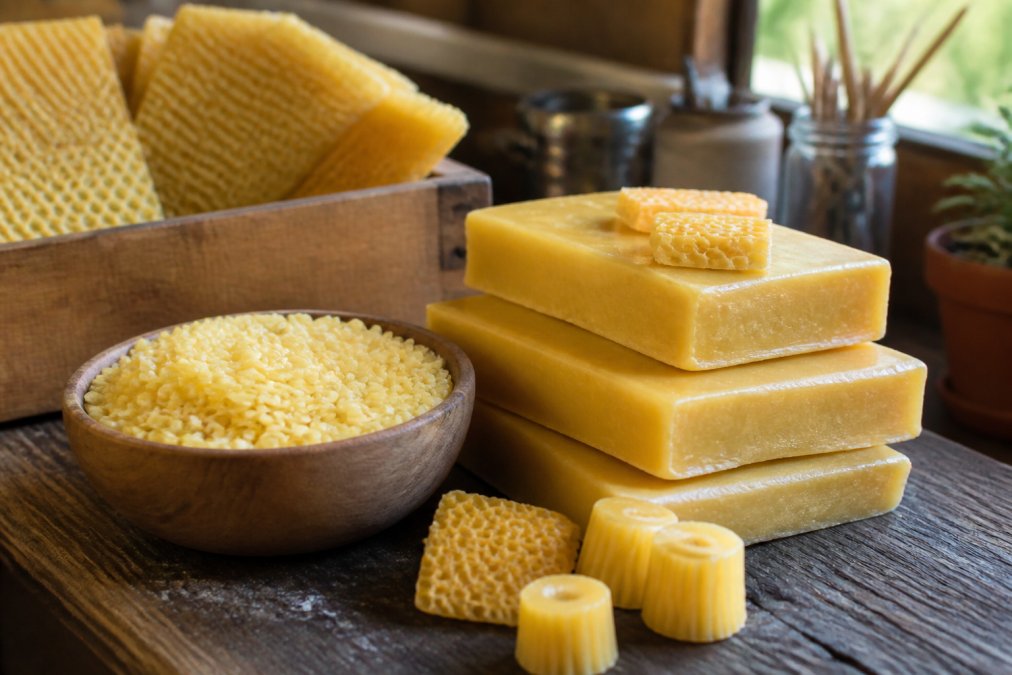
Pure beeswax is the unmodified wax honeybees produce to build comb, containing nothing but wax, propolis traces, and natural color compounds. Anything else means you are not getting what you paid for, so learning to identify pure beeswax protects your skin and candle-making results.
Adulteration is common because beeswax costs far more than paraffin or soy alternatives, and stretched blocks still look convincing.
Common Additives: Paraffin, Stearic Acid, and Synthetic Fillers
Paraffin is the most frequent offender: a colorless, odorless petroleum byproduct that dilutes beeswax without obvious clues. Stearic acid, a fatty acid from palm or animal fats, hardens the bar and raises the melting point. Synthetic fillers and cheap vegetable waxes round out the list.
Each additive changes behavior: paraffin burns faster and sootier, stearic acid feels greasier and less tacky, and none carry the honey-like aroma of real comb wax.
The Beeswax Purity Test: 7 At-Home Methods That Actually Work
You can run a reliable beeswax purity test with kitchen items. The seven methods below build on each other: scent, feel, float, flame, solubility, specific gravity, and the freezer check. Use at least three together before trusting a verdict.
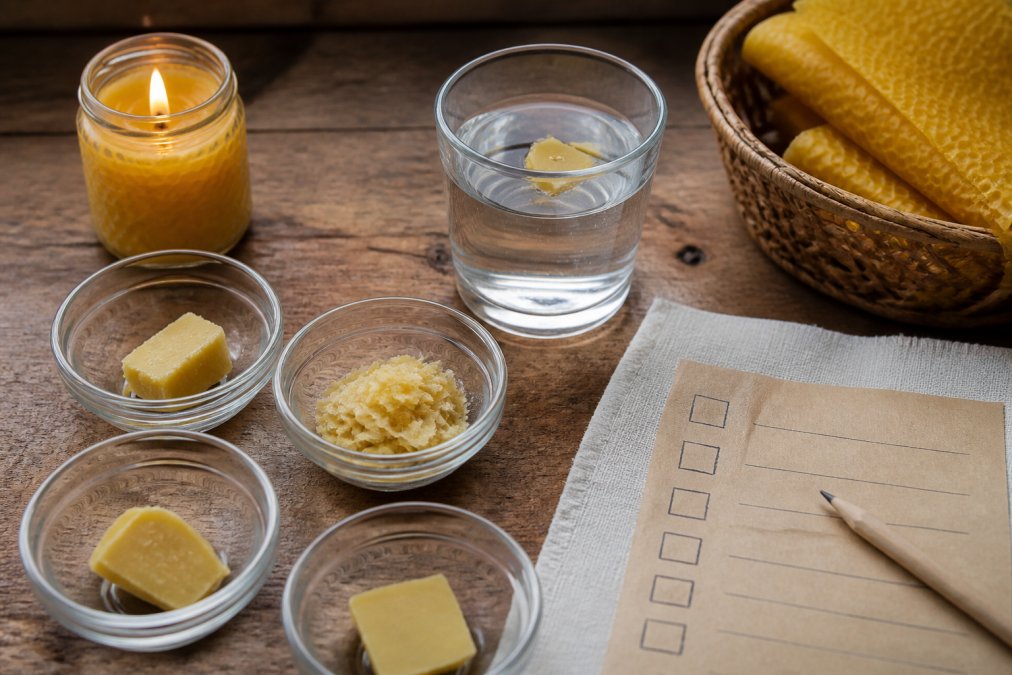
Here is the testing sequence, in order:
- Scent test: Warm a small piece and smell it. Real wax smells like honey and flowers.
- Texture test: Press a fingernail in. Pure beeswax is firm but yields slightly and feels tacky.
- Float test: Drop a piece in water. Pure beeswax floats; paraffin blends often sink.
- Flame test: Light a wick dipped in the wax. A steady flame with minimal soot points to purity.
- Solubility check: Try dissolving a shaving in rubbing alcohol. Beeswax resists; many additives dissolve.
- Specific gravity check: Pure beeswax sits around 0.95 to 0.96 g/cm³, lighter than water (PubMed).
- Freezer test: Chill a piece for an hour. Genuine wax develops a pale, powdery bloom.
The Scent Test: Honey-Like Aroma vs. Chemical Odor
The scent test is the fastest filter. Warm the sample between your palms or near a hair dryer, then breathe in. Genuine raw beeswax releases a warm honey-like aroma with faint floral notes; adulterated wax smells flat, waxy, or faintly chemical, sometimes crayon-like from paraffin.
The Float Test, Solubility, and Specific Gravity Checks
Drop a chunk into room-temperature water. Pure beeswax floats because its density is below water's; paraffin and heavily filled blends sink or hover. For solubility, place a shaving in isopropyl alcohol: beeswax holds its shape while many synthetic additives break down. Specific gravity is the precise version of the float test, weigh a known volume and divide. Well above 0.96 g/cm³ means something else is in the block.
Beeswax vs Paraffin Wax: How to Tell Them Apart
Beeswax and paraffin differ in origin, scent, flame behavior, and feel, making them easy to separate once you know what to look for.
| Feature | Pure Beeswax | Paraffin Wax |
|---|---|---|
| Origin | Honeybee comb | Petroleum byproduct |
| Scent | Honey-like, floral | Odorless or chemical |
| Flame | Steady, low soot | Fast, sooty |
| Melting point | Roughly 62-65°C (144-149°F) | Roughly 46-68°C (115-154°F) |
| Surface | Tacky, dull finish | Slick, shiny surface |
Flame Quality, Soot Production, and Melting Point Differences
Light a candle made from the sample and watch for a few minutes. Pure beeswax burns steady with very little soot and a faint honey scent; paraffin burns hotter and faster, throws more soot, and leaves black deposits on the jar. Melting point tells the same story: beeswax softens around 62-65°C (144-149°F), while paraffin can melt as low as 46°C (115°F) (PubMed).
Color, Texture, and Wax Bloom: What Natural Variation Tells You
Natural color variations of beeswax run from pale cream to deep golden yellow, and every shade between is normal. Color depends on what the bees fed on, how old the comb was, and whether the wax came from cappings or brood comb. A uniform, bright white block is a red flag, usually bleached or refined wax.
Texture matters just as much. Raw beeswax feels firm, slightly tacky, and grainy when broken. A dull finish is normal; a shiny surface suggests additives or over-processing. Wax bloom, the pale powdery film on aged or chilled wax, is a natural sign of purity, not spoilage. Opaque blocks that refuse to turn translucent when melted are usually loaded with fillers.
Filtration, Processing, and What Labels Do Not Tell You
Filtration and processing change beeswax more than most buyers realize, and labels rarely map cleanly to what is in the block. Understanding the processing tiers, and which labeling claims are enforceable, is the difference between trusting a package and verifying it.
Raw, Filtered, and Bleached: Three Different Products
Sellers use these terms loosely, but they describe distinct products:
- Raw wax comes straight off the hive, carrying honey residue, propolis, pollen, and occasional bee parts. Color ranges from pale cream to dark brown depending on comb age and forage. It smells strongly of honey and feels tacky and slightly grainy. Raw wax is the hardest to fake because the impurities are hard to replicate.
- Filtered wax has been melted and passed through cloth, mesh, or a fine screen to remove debris. Light filtering keeps most of the aroma and color; heavy filtering strips pollen and propolis and produces a cleaner, more uniform block. Filtered wax is still real beeswax, filtration is physical, not chemical.
- Bleached or refined wax has been treated with hydrogen peroxide, sunlight, or chemical agents to remove color and odor. It is often blended with cheaper waxes because bleaching hides the source. Bright white, odorless blocks are the classic signature of this tier.
The practical takeaway: raw and lightly filtered wax are the tiers where purity is easiest to confirm by scent and texture. Bleached wax removes the very cues you rely on, which is why it is the tier most associated with adulteration.
What '100% Pure' Actually Means on a Label
In the United States, cosmetic and craft labeling is governed primarily by the FDA under the Federal Food, Drug, and Cosmetic Act and the Fair Packaging and Labeling Act (the FDA). Those rules require truthful, non-misleading labeling and an ingredient list on most cosmetic products, but they create no dedicated beeswax grade standard and do not define 'pure' or '100% beeswax' as a regulated claim the way 'organic' is defined under the USDA National Organic Program.
That gap is why a block can say '100% pure beeswax' on the front and list paraffin, stearic acid, or 'vegetable wax' on the back. The front claim is marketing; the ingredient list is legally enforceable. An organic claim, by contrast, requires USDA organic certification, a much tighter standard than 'pure.'
How to Read a Beeswax Label Like a Buyer
Use this checklist before you trust a package:
- Find the ingredient list. If there is no ingredient panel on a cosmetic product, treat that as a red flag, not a minimalist design choice.
- Look for named adulterants. Paraffin, microcrystalline wax, stearic acid, carnauba, candelilla, and 'vegetable wax blend' are the usual fillers. Their presence does not automatically mean a bad product, but it does mean the block is not pure beeswax.
- Check for a single-ingredient claim. A product that lists only 'beeswax' (or 'Cera alba') is making a verifiable claim you can test at home.
- Distinguish 'organic' from 'pure.' Only 'organic' carries a defined federal standard. 'Pure' and 'natural' are unregulated descriptors on beeswax packaging.
- Ask for the processing tier. A seller who can tell you whether the wax is raw, filtered, or bleached knows the supply chain.
'Pure' and 'natural' are marketing words on beeswax packaging. 'Organic' is the only claim with a federal definition behind it. The ingredient list, not the front of the label, is what you can actually hold a seller to.
The Benefits of Beeswax for Skin (and Why Purity Matters)
The benefits of beeswax for skin come down to how it behaves as an occlusive and emulsifying agent, and those behaviors change measurably when the wax is cut with fillers.
How Beeswax Works on Skin
Beeswax is a complex mixture of esters, fatty acids, and hydrocarbons, giving it three properties that matter in skincare:
- Occlusivity. Beeswax forms a breathable film on the skin surface that slows transepidermal water loss. It is less occlusive than petrolatum but more breathable, which is why it shows up in balms and salves rather than heavy barrier creams.
- Emulsification. Beeswax acts as a co-emulsifier, helping oil and water stay mixed in lotions and creams. Formulators use it at low percentages, typically single digits, to stabilize a product without making it greasy.
- Structure. At room temperature it is firm but pliable, giving a balm its shape and its slow, skin-temperature melt.
The antibacterial reputation of beeswax comes largely from propolis and other hive compounds that ride along with raw or lightly filtered wax. Heavily refined or bleached wax has most of those compounds stripped out, so the 'natural antibacterial' claim weakens as processing increases.
Why Purity Changes Performance, Not Just Marketing
When a block is cut with paraffin, stearic acid, or vegetable wax, the finished balm behaves differently:
- Paraffin is more occlusive and less breathable than beeswax. A balm with a high paraffin fraction sits on the surface, feels slick rather than tacky, and can trap sweat under the film, a common complaint for sensitive or acne-prone skin.
- Stearic acid raises the melting point and hardens the bar. The balm feels drier and drags on application instead of melting at skin temperature.
- Vegetable wax blends (carnauba, candelilla) are harder and glossier. They give a shiny finish but lack the pliability that makes beeswax comfortable on lips and cuticles.
None of these fillers are unsafe. The issue is that a product sold as beeswax balm and made mostly of paraffin is not delivering the breathable, pliable, honey-scented experience the buyer paid for, and the label may not make that clear.
Matching Wax Tier to Use
Different tiers suit different applications:
- Raw wax is best for salves and balms where the honey aroma and propolis content are part of the value. Expect color variation and a slightly grainy texture.
- Lightly filtered wax is the workhorse for candles and general balms. It keeps most of the scent and color while removing debris that would clog wicks or feel gritty.
- Bleached or heavily refined wax is best reserved for applications where color and odor must be neutral, and where you are willing to give up the sensory cues that make purity easy to verify.
If a balm claims 'raw beeswax' but is bright white and odorless, the claim and the product do not match. Raw wax is never colorless, and it always carries some honey scent.
At The Beekeeper's Basket, every balm and soap starts with small-batch wax, so the breathability and scent that make beeswax worth using survive all the way to the finished bar.
Sourcing Directly From Beekeepers: Questions to Ask Before You Buy
Sourcing directly from beekeepers is the surest way to know what you are getting. Local apiaries sell wax they harvested themselves and can tell you which hives it came from and how it was processed. Ask before you buy:
- Where were the hives located, and what did the bees forage on?
- Was the wax cold-pressed, lightly filtered, or chemically refined?
- Is it cappings wax, brood comb wax, or a mix?
- Can you see the raw block before it is packaged?
- Has any paraffin, stearic acid, or vegetable wax been blended in?
A beekeeper who answers these clearly and shows you the comb is a far safer bet than an anonymous online listing.
Shoppers who want to verify purity firsthand and support local apiaries, rather than trusting a label from a faceless supplier.
Conclusion
Telling real wax from a blend takes a few minutes and a handful of kitchen tools, but the payoff is skin and candles you can trust. The scent, float, flame, and texture tests catch nearly every common adulterant, and buying from a named source closes the gap the tests cannot. The Beekeeper’s Basket handcrafts small-batch soaps, lotions, and beeswax melts in New England using carefully sourced wax, so every bar and balm carries the freshness and quality that purity testing is meant to protect. Explore the collection and see the difference real beeswax makes. LET'S EXPLORE!
Frequently Asked Questions
How can you tell if beeswax is 100% pure?
Start with your senses, then confirm with simple tests. Pure beeswax has a honey-like aroma, a golden yellow to brownish color, and a slightly sticky, grainy texture when broken. Run a beeswax purity test: drop a small piece in water (it should float), rub it on paper (it should not leave a greasy stain), and light a wick (the flame should burn steady with minimal soot). If the smell is chemical or crayon-like, or the surface looks shiny rather than dull, suspect adulteration.
What are the common signs of adulterated beeswax?
Adulterated beeswax often contains paraffin, stearic acid, or synthetic additives. Watch for these red flags: a shiny surface instead of a dull finish, a chemical or crayon-like odor rather than a honey-like aroma, excessive soot production when burned, and a texture that feels overly smooth or waxy without any graininess. Color that is uniformly bleached white or suspiciously bright can also signal refining or blending. When in doubt, ask the seller for sourcing details.
Does pure beeswax have a specific scent or color?
Pure beeswax does not have one fixed color. It ranges from pale golden yellow to deep amber or brownish, depending on the flowers the bees visited and how the wax was filtered. The scent is similarly natural: a mild honey-like aroma with floral notes. Comb wax and cappings often carry a stronger scent than refined blocks. If your beeswax smells like chemicals or crayons, or looks uniformly bleached, it may have been adulterated or heavily processed.
Will pure beeswax go rancid or expire?
Pure beeswax does not go rancid. It has an extremely long shelf life and can last for decades when stored away from direct sunlight and extreme heat. Unlike oils, beeswax contains no fats that oxidize. However, if beeswax is blended with other oils or butters, those additives can spoil over time. Store pure beeswax in a cool, dry place, and it will stay usable indefinitely. A white film called wax bloom may appear on the surface, but that is harmless and not a sign of spoilage.