 blog
10 Best Artisan Soap Ingredients to Look For
Last Updated: October 22, 2026
Quick Summary
The best artisan soap ingredients include carrier oils like olive and coconut oil, butters such as shea and cocoa butter, and natural additives like goat milk and castor oil. These artisan soap ingredients are chosen for skin benefits rather than shelf life, with olive oil providing mildness at 30-50% of the recipe and coconut oil creating lather at 20-30%.
- Olive oil forms the mild base of most artisan soaps at 30-50% concentration
- Coconut oil at 20-30% creates fluffy lather and hardens the bar
- Shea butter at 3-5% and cocoa butter at 2-4% add conditioning and luxury feel
- Goat milk, castor oil, and specialty oils like avocado and jojoba provide targeted skin benefits
- Read ingredient labels in descending order to identify dominant oils and understand the bar's actual formulation
Table of Contents
- What Makes Artisan Soap Ingredients Different
- Olive Oil: The Foundation of Mildness in Handmade Soap
- Coconut Oil: Creating Lather and Bar Hardness
- Shea Butter and Cocoa Butter: Moisture and Conditioning
- Goat Milk, Castor Oil, and Other Carrier Oils
- Best Natural Soaps for Dry Skin
- How to Read a Soap Ingredient Label
- Ingredients to Avoid in Soap
- Frequently Asked Questions
What Makes Artisan Soap Ingredients Different
Handmade soap differs from mass-produced bars: artisan soap ingredients are chosen for skin benefits, not shelf life, and small-batch makers control every component.
Commercial soaps rely on detergents and synthetic additives for lather and shelf life. Artisan soaps use natural carrier oils, butters, and plant-based ingredients that work together: some lather, others condition, some harden the bar.
Knowing what each artisan soap ingredient does lets you match products to your skin's needs instead of marketing claims.
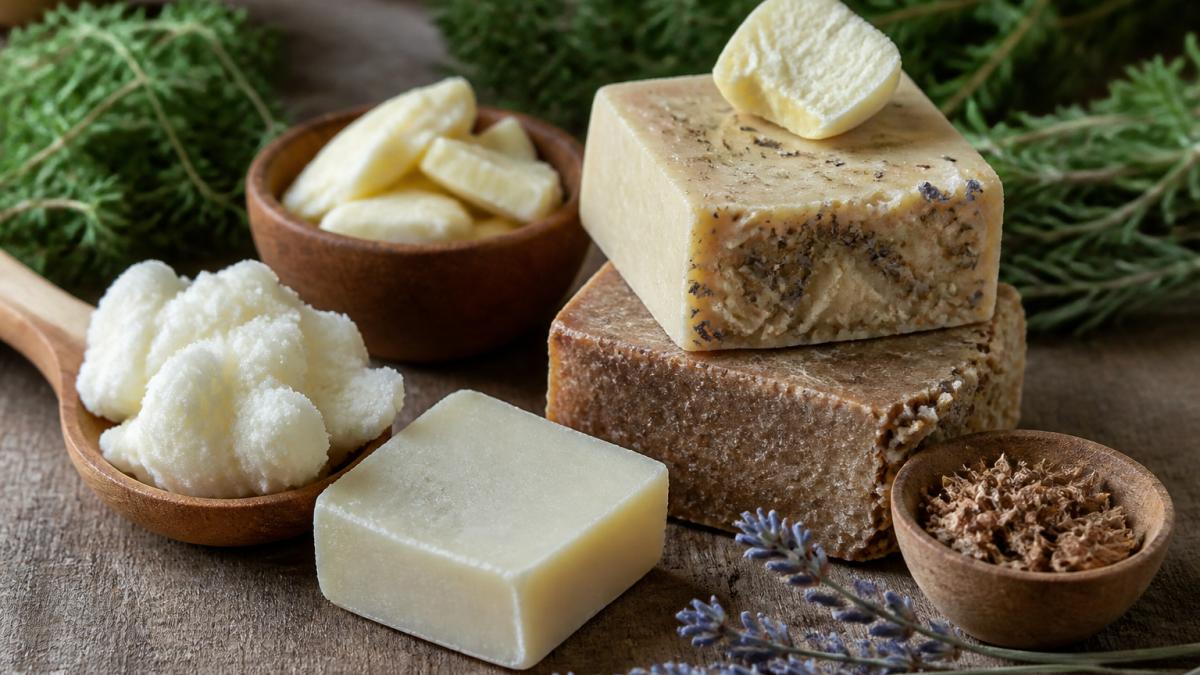
The best artisan soap ingredients fall into a few categories:
- Carrier oils that form the base and provide moisturizing properties
- Butters that add conditioning and hardness
- Milk or botanical additives that enhance mildness and skin benefits
- Natural colorants and scents from essential oils and plant sources
Reading a label requires understanding these roles; terms like "luxury" or "nourishing" don't tell you what the soap does.
Olive Oil: The Foundation of Mildness in Handmade Soap
Olive oil is the most common base oil in artisan soap because it creates an exceptionally mild bar. Saponified (reacted with lye), it produces creamy lather and leaves skin soft, not stripped.
A typical recipe uses 30-50% olive oil, the percentage behind artisan soap's reputation for gentleness; its antioxidants and fatty acids remain in the finished bar.
Olive oil contributes mildness but little lather alone, so makers combine it with other oils to cleanse without harsh stripping, key for sensitive skin.
Unrefined olive oil affects final color and scent; refined is more neutral. Both work well, choose based on whether you want visible color variation or a cleaner look.
Coconut Oil: Creating Lather and Bar Hardness
Coconut oil is the second pillar of most artisan soap formulations, creating abundant, fluffy lather. Without it, handmade soap feels slippery with few bubbles.
A typical recipe includes 20-30% coconut oil for excellent lather without overdrying; above 35% can feel stripping, especially for dry skin.
Coconut oil also hardens the bar, so soap lasts longer in the shower instead of melting quickly.
Unrefined (virgin) coconut oil has a coconut scent; refined is odorless. Both create the same lather and hardness, so makers choose based on whether they want coconut scent in the final bar.
Shea Butter and Cocoa Butter: Moisture and Conditioning
Shea and cocoa butter elevate artisan soap from basic to nourishing. Both are solid at room temperature and add richness to the bar.
Shea butter contributes vitamins and fatty acids that condition skin without a greasy residue. Most artisan soaps include 3-5%, enough to feel the benefit without making the bar too soft.
Cocoa butter adds hardness and deep conditioning while creating a creamy lather. Makers typically use 2-4%, depending on how firm and conditioning they want the bar.
Together, shea and cocoa butter separate basic handmade soap from artisan soap that feels like skincare, and they're why artisan soaps cost more: these ingredients are expensive.
Goat Milk, Castor Oil, and Other Carrier Oils
Goat milk soap is popular for sensitive skin because milk proteins add mildness and creamy texture; replacing some water with goat milk creates a bar that feels nourishing, not just cleansing.
Castor oil supports lather and adds a silky feel, used at 5-10% because too much makes soap too soft; soapmakers targeting sensitive skin value it.
Other carrier oils each bring specific benefits:
- Avocado oil adds conditioning and a creamy texture
- Almond oil provides mild, gentle cleansing
- Apricot kernel oil offers light moisturizing without heaviness
- Argan oil adds luxury conditioning (used in small percentages)
- Jojoba oil mimics skin's natural oils for balanced cleansing
- Hemp seed oil provides omega fatty acids for skin health
Soapmakers blend multiple oils to balance lather, hardness, conditioning, and mildness: olive oil as the base, coconut oil for lather, and smaller amounts of specialty oils for specific benefits.
Best Natural Soaps for Dry Skin
Dry skin needs a bar that cleanses without stripping moisture. Match the bar's dominant oil, butter content, and lather profile to how your skin feels after washing, more reliable than front-of-package claims.
Start with the dominant oil. Ingredients are listed in descending order, so the first saponified oil tells you the most.
Check the butter line. Shea and cocoa butter appear lower because they're used in small amounts, but position matters: butter before fragrance or colorant signals meaningful conditioning; butter near the end is a marketing token.
Read the lather signal. High coconut oil (roughly 25% or more) produces big bubbles but can leave dry skin tight. For good lather without stripping, look for moderate coconut oil paired with castor oil or a milk additive that softens the feel.
Match the bar to the season, not just the skin type. Dry skin feels worse in winter and hot showers, so a bar perfect in July may feel under-conditioned in January. Many shoppers keep a lighter bar for humid months and a richer one for cold months.
A quick comparison of what to prioritize by skin concern:
- Dry but not reactive: olive-led bar, 5% or more total butter, moderate coconut oil, optional milk additive.
- Dry and sensitive: olive or avocado base, low coconut oil, castor oil for lather, fragrance-free or essential-oil-light, short ingredient list.
- Dry with fragrance sensitivity: unscented or single essential oil, no "fragrance" or "parfum" entry, no synthetic dye.
- Dry and acne-prone: lighter butters, jojoba or hemp seed oil, avoid heavy occlusive butters in high amounts.
If a bar leaves your skin tight, itchy, or flaky after drying, the formula is likely too high in coconut oil or too low in conditioning oils and butters for your skin. That feedback is more useful than any label claim, and it is the fastest way to narrow down which artisan soap ingredients work for you.
How to Read a Soap Ingredient Label
An artisan soap label is a formulation document, not a marketing brochure.
Rule one: ingredients are listed in descending order of concentration. The ingredient present in the largest amount comes first, and the smallest amount comes last.
Rule two: "saponified" means the oil has already reacted with lye. A label reading "saponified olive oil, saponified coconut oil, saponified shea butter" tells you those oils were converted into soap.
Rule three: water and glycerin are normal. Water dissolves the lye and is largely driven off during curing, but it may still appear on the label.
Rule five: colorants follow the same logic. Natural colorants such as clays (kaolin, bentonite, French green clay), botanicals (spirulina, madder root, annatto), and oxides (iron oxide, titanium dioxide) are usually named specifically.
Rule six: preservatives and chelators are not automatically red flags in artisan soap. Because bar soap has low water activity, most cold-process bars do not need preservatives.
A practical label-reading checklist:
- First three ingredients: Are they saponified oils, or is the bar led by water, glycerin, or a detergent?
- Saponified language: Does the label use "saponified" or list oils directly? Either can be legitimate, but the convention should be consistent.
- Butter position: Does shea or cocoa butter appear before fragrance and colorant, or after?
- Scent disclosure: Are essential oils named, or is the label using "fragrance" or "parfum"?
- Color disclosure: Are colorants named specifically, or listed as a generic "color"?
- Additives: Are milk, honey, oatmeal, or clays named, and where do they sit in the list?
- Detergent check: Do you see sodium lauryl sulfate, sodium laureth sulfate, or cocamidopropyl betaine near the top? If so, the bar is a syndet, not a true soap.
One more distinction: an ingredient's function in the finished bar is not the same as in a skincare serum.
Ingredients to Avoid in Soap
Certain ingredients appear in commercial soaps but don't belong in artisan formulations. Understanding what to avoid helps you make better choices.
Synthetic detergents like sodium lauryl sulfate (SLS) are common in drugstore soap because they're cheap and create abundant lather. They strip skin more aggressively than natural soap and can irritate sensitive skin.
Parabens (methylparaben, propylparaben) are preservatives that extend shelf life but raise concerns about skin absorption and hormone disruption. Properly cured artisan soaps don't need them because low moisture content prevents bacterial growth.
Synthetic fragrance can contain dozens of unlisted chemicals. The word "fragrance" on a label is a catch-all term that hides the actual ingredients.
Triclosan is an antimicrobial agent found in many "antibacterial" soaps.
Artificial colorants like FD&C dyes can irritate sensitive skin. Natural colorants from clays, botanicals, and oxides provide color without the irritation risk.
The best approach: read the ingredient list first. If you recognize most ingredients and understand their purpose, the soap is likely genuine artisan.
Choosing the right artisan soap ingredients means understanding what your skin actually needs. At The Beekeeper's Basket, we craft small-batch soaps with carefully selected oils, butters, and natural additives that nourish rather than strip.
| Ingredient | Primary Benefit | Typical % in Recipe | Best For |
|---|---|---|---|
| Olive oil | Mildness, conditioning | 30-50% | All skin types |
| Coconut oil | Lather, bar hardness | 20-30% | Creating fluffy bubbles |
| Shea butter | Moisture, vitamins | 3-5% | Dry or sensitive skin |
| Cocoa butter | Hardness, conditioning | 2-4% | Luxury feel and durability |
| Goat milk | Creaminess, gentleness | 5-10% | Sensitive or reactive skin |
| Castor oil | Silky lather, mildness | 5-10% | Sensitive skin formulas |
| Specialty oils | Nourishment, scent | 2-5% | Targeted skin benefits |
Frequently Asked Questions
What ingredients make the best artisan soap?
The best artisan soap ingredients include olive oil for mildness, coconut oil for lather, shea butter and cocoa butter for conditioning, and goat milk for skin nourishment. Quality carrier oils like castor oil, avocado oil, and jojoba oil support the skin's natural moisture barrier. Natural additives such as kaolin clay, essential oils, and botanical elements enhance both function and appeal. The key is finding soaps where these ingredients are listed early in the formula, closer to the beginning of the ingredient list means higher concentration.
How do I choose the best natural soaps for dry skin?
Look for artisan soaps with high percentages of moisturizing ingredients like shea butter, cocoa butter, and oils such as avocado, jojoba, or argan oil. Goat milk soaps are excellent for dry, sensitive skin because milk proteins support hydration. Avoid soaps with sulfates, synthetic fragrances, or drying alcohols. Check the ingredient label to confirm these nourishing oils appear in the first five ingredients.
What should I avoid when buying handmade soap?
Avoid soaps listing sodium lauryl sulfate, parabens, synthetic dyes, or synthetic fragrances high in the ingredient list. Watch for vague terms like 'fragrance' or 'parfum' without clarity on whether oils are essential or synthetic. Skip soaps with added alcohol or petroleum-derived ingredients. Be cautious of claims like 'natural' without ingredient transparency, marketing language doesn't guarantee quality. Instead, choose soaps where you recognize most ingredients and can verify their sourcing.
How can I tell if artisan soap is truly made with natural ingredients?
Request or review the complete ingredient list before buying. Natural artisan soap should list recognizable oils, butters, plant extracts, and essential oils, not chemical names you cannot identify. Transparency about where ingredients come from and how the soap is made is the strongest signal of authenticity.