 listicle
Buy Organic Beeswax Body Lotion: 7 Top Picks for 2026
Table of Contents
- Why Switch to an Organic Beeswax Body Lotion?
- What to Look For in a Quality Organic Beeswax Lotion
- Our Top Picks for Organic Beeswax Body Lotion
- Benefits of Beeswax for Skin: The Natural Barrier
- Choosing Beeswax Lotion for Sensitive Skin
- How to Get the Most From Your Beeswax Lotion
- Final Thoughts: Making Your Choice
- Frequently Asked Questions
Last Updated: September 5, 2026
Why Switch to an Organic Beeswax Body Lotion?
Your skin is your largest organ, absorbing much of what you put on it. Many conventional lotions rely on mineral oils, synthetic fragrances, and preservatives that offer little nutritional value. An organic beeswax body lotion flips that script, using a natural, time-tested ingredient that has protected skin for centuries. At The Beekeeper’s Basket, we craft small-batch skin nourishing products in New England, and we’ve seen firsthand how a simple switch to beeswax-based care transforms dry, unhappy skin.
Beeswax is an occlusive agent, forming a breathable, protective shield on the skin’s surface that locks in moisture and keeps environmental irritants out. Rather than just coating the skin, a quality organic beeswax body lotion works with your body’s natural processes to support long-term skin hydration and elasticity.
Below, we’ll show you what separates a genuinely effective organic beeswax body lotion from the rest, and explain how to get the most from your purchase.
What to Look For in a Quality Organic Beeswax Lotion
Not all beeswax lotions are created equal. The difference between a product that truly nourishes and one that just sits on the skin comes down to the ingredients and their sourcing. The single most important factor is the grade of beeswax used. Look for food grade or cosmetic grade beeswax, which is filtered to remove debris and impurities while retaining its natural, honey-like aroma.
Next, examine the base oils. A well-formulated lotion pairs beeswax with nutrient-rich carrier oils and butters, such as shea butter and coconut oil for deep moisturizing, sweet almond and avocado oils for essential fatty acids, and olive oil for its soothing, antioxidant properties.
A quality product should also list a natural preservative and avoid synthetic dyes or phthalates. For sensitive skin, an unscented or naturally scented option is often safest, as synthetic fragrances are a common trigger for irritation.
Our Top Picks for Organic Beeswax Body Lotion
The market for natural skincare is crowded, but a few products stand out for their ingredient integrity and performance. We’ve evaluated options based on sourcing, texture, and barrier protection, prioritizing brands that are transparent about their supply chains and committed to sustainability.
Quick Picks:
- Best Overall: The Beekeeper’s Basket Signature Beeswax Lotion, handcrafted in small batches for maximum freshness
- Best for Sensitive Skin: Unscented, minimalist formulas with short ingredient lists
- Best for Extra-Dry Skin: Whipped, rich textures with added botanicals
The Beekeeper’s Basket Signature Beeswax Lotion
Our top pick is The Beekeeper’s Basket Signature Beeswax Lotion. As a brand with over 20,000 sales and a 5-star rating, we’ve refined our recipe to prioritize fresh, high-quality ingredients. Every batch is made in small batches in New England, ensuring you receive a product at the peak of its potency. Our lotion nourishes the skin with a subtle, natural scent that comes from the beeswax itself, not synthetic perfumes.
What sets our formula apart is the commitment to freshness. Because we produce in small batches, we can guarantee the quality and consistency of every jar, so you get the same nourishing experience with every reorder.
Simple & Pure: Unscented Options
For those who prefer a truly neutral product, unscented beeswax lotions omit essential oils entirely, focusing purely on the moisturizing benefits of beeswax, shea butter, and a single carrier oil like sweet almond. This minimalist approach is perfect for anyone sensitive to smells or who plans to layer the lotion under perfume.
These lotions are typically lighter and less greasy than whipped counterparts, absorbing quickly for daytime use or humid climates. When choosing an unscented option, verify that the brand uses a natural preservative, as water-based lotions without proper preservation can spoil.
Whipped & Rich: For Extra-Dry Skin
If you struggle with severely dry patches, especially on elbows, knees, and heels, a whipped beeswax lotion offers intense relief. These formulations incorporate a higher ratio of butters, like shea or cocoa butter, beaten into the beeswax base to create a light, airy texture. The result is a rich, occlusive layer that provides immediate comfort and long-lasting moisture retention.
Benefits of Beeswax for Skin: The Natural Barrier
Most articles stop at saying beeswax 'locks in moisture.' To make an informed purchase, it helps to understand the mechanism. Beeswax is a complex mixture of over 300 compounds, primarily esters of fatty acids and long-chain alcohols (peer-reviewed research). Its occlusive power comes from its hydrophobic nature, it physically repels water and creates a semi-permeable film on the stratum corneum.
This film works in two directions. First, it dramatically reduces transepidermal water loss (TEWL) by trapping water that has migrated from the dermis. Second, it prevents external irritants, pollutants, and cold, dry air from penetrating the barrier. The result is a stable microclimate that allows natural repair processes to proceed uninterrupted.
What sets beeswax apart from synthetic occlusives like petrolatum is its molecular structure. Petrolatum forms a completely airtight sheet, while beeswax's crystalline structure forms a lattice that allows some gaseous exchange. This is why beeswax-based lotions feel 'breathable' and are less likely to cause the clammy sensation associated with heavy mineral-oil products.
Beeswax also contains vitamin A (retinyl esters), which acts as a gentle antioxidant and supports normal cell turnover. While not concentrated enough to be a treatment, it contributes to the ingredient's skin-conditioning profile. Its natural emulsifying properties also allow formulators to create stable water-in-oil emulsions without synthetic emulsifiers like ceteareth-20 or polysorbates, which can irritate compromised skin barriers.
Understanding this chemistry also explains why beeswax is considered non-comedogenic. The molecules are too large to penetrate the follicle opening deeply, so they sit on the surface rather than clogging pores. This is a critical distinction from lighter oils like coconut oil, which has a higher comedogenic rating. For a deeper look at how occlusives function, the American Academy of Dermatology’s guide on moisturizer ingredients offers a solid scientific grounding.
Choosing Beeswax Lotion for Sensitive Skin
Finding a beeswax lotion for sensitive skin requires a careful look at the full ingredient list. While beeswax itself is generally gentle and hypoallergenic, the carrier oils and additives can be problematic. The safest choice for reactive skin is a formula with a very short list of ingredients, ideally beeswax, one or two non-comedogenic oils like jojoba or grapeseed, and nothing else.
Avoid lotions containing essential oils, artificial colors, or common allergens like soy or nut-based oils if you have known sensitivities. A patch test is always a wise first step, apply a small amount to your inner forearm and wait 24 hours to check for any reaction. This is especially important for those who have had bad reactions to other “natural” products, as sensitivity can be triggered by botanical extracts just as easily as synthetics.
How to Get the Most From Your Beeswax Lotion
Application technique matters, but what separates a great beeswax lotion experience from a frustrating one is knowing how to handle the product's unique physical properties. Beeswax has a melting point between 144°F and 147°F (62°C-64°C), meaning it is solid at room temperature and requires body heat to soften (PubMed). Here is how to work with that reality, plus how to troubleshoot common issues.
The Proper Application Sequence
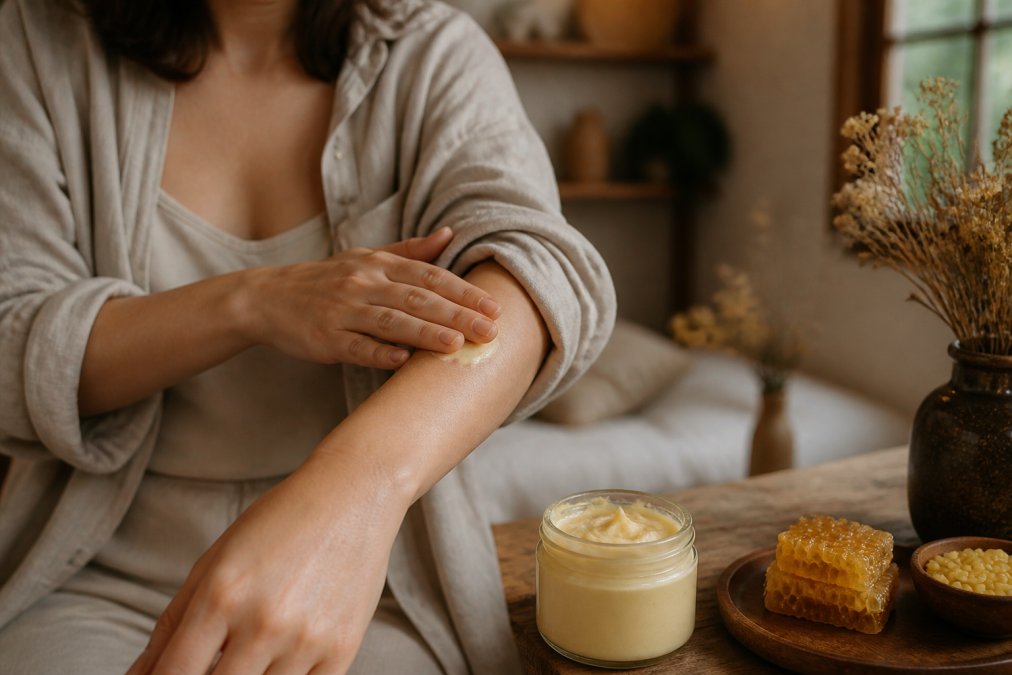
- Warm the product: Scoop a small amount (about the size of a pea for each limb) and rub it between your palms for 10-15 seconds. This friction melts the wax crystals, turning the thick balm into a spreadable oil.
- Apply to damp skin: The single biggest mistake is applying beeswax lotion to bone-dry skin. The occlusive barrier will seal in whatever is present, if the skin is dehydrated, it seals in dryness. Apply within three minutes after a shower, or mist your skin lightly with rose water or plain water before application.
- Use a pressing motion first: Rather than rubbing vigorously, press the lotion into the skin with flat palms, then follow with gentle circular strokes. This helps the product adhere evenly without pilling.
- Layer thin, not thick: A thick layer will sit on the surface and transfer to clothing. Two thin layers, applied five minutes apart, provide better absorption and longer-lasting protection.
Troubleshooting Common Lotion Failures
Issue: The lotion feels greasy and never absorbs. This usually indicates you applied too much, or to skin that was not damp enough. Beeswax is not designed to absorb fully like a water-based lotion; it leaves a protective film. If the film feels heavy, reduce the amount by half and ensure your skin is slightly moist before application.
Issue: The lotion pills or balls up on the skin. Pilling occurs when the product is applied over another layer (like a serum or sunscreen) that has not fully dried, or when the beeswax content is too high for the carrier oil ratio. Try applying to bare skin, or wait 10 minutes after layering other products.
Issue: The jar has separated or looks grainy. This is a natural phenomenon, not a defect. Beeswax can recrystallize when exposed to temperature fluctuations, creating a gritty texture. Place the closed jar in a bowl of warm water (not boiling) for 5-10 minutes, then stir thoroughly with a clean utensil. Allow it to reset at room temperature. This restores the smooth texture without degrading the ingredients.
Issue: The lotion is too hard to scoop in winter. Store your lotion in a slightly warmer location, or warm the jar in your hands for a minute before opening. Do not microwave beeswax lotions, uneven heating can destroy the delicate vitamin content and destabilize the emulsion.
Storage and Shelf-Life Considerations
A properly formulated beeswax lotion with a natural preservative (like leucidal liquid or vitamin E) will last 6-12 months. Store it away from direct sunlight and heat, as UV exposure can oxidize the carrier oils and cause rancidity. If you notice a sharp, unpleasant odor or yellow-brown discoloration, the oils have gone rancid and the product should be discarded. Always use a clean, dry spatula or your fingers, introducing water into the jar introduces bacteria.
Final Thoughts: Making Your Choice
Choosing the right organic beeswax body lotion comes down to understanding your skin’s needs and the quality of the ingredients. The right product should feel like a treat, not a chore, and you should notice a real difference in how your skin feels by the end of the week. The difference between small-batch products and drugstore finds lies in the freshness, the concentration of active ingredients, and the peace of mind that comes from supporting sustainable, ethical sourcing. When you choose a product like The Beekeeper’s Basket, you are paying for small-batch craftsmanship, fresh ingredients, and a commitment to quality that mass production simply cannot match.
Finding a lotion that genuinely nourishes your skin without synthetic additives can feel like a search for a needle in a haystack. The Beekeeper’s Basket solves that problem with handcrafted, small-batch organic beeswax body lotions made in New England, ensuring freshness and quality in every jar. With over 20,000 sales and a 5-star rating, our artisan goods are designed to nourish your skin and enhance your senses. Get started with The Beekeeper’s Basket and discover the difference that fresh, natural ingredients make. LET’S EXPLORE!
Frequently Asked Questions
Is beeswax lotion good for your skin?
Yes, beeswax is excellent for your skin. It acts as an occlusive agent, creating a protective barrier on the skin’s surface. This barrier helps lock in moisture and prevents transepidermal water loss, which is why it's so effective for dry or compromised skin. Unlike some synthetic ingredients, it is natural, non-comedogenic, and rich in vitamin A, which supports skin cell renewal and helps maintain a healthy, hydrated complexion.
What is the difference between organic beeswax and conventional beeswax?
The difference lies in the beekeeping practices. Organic beeswax comes from hives in areas free from pesticides and synthetic chemicals, and the bees are not treated with antibiotics or artificial chemicals. Conventional beeswax may contain trace residues from these substances. For skincare, especially for sensitive skin, choosing unrefined, organic beeswax ensures you are applying a pure, natural product to your skin without unwanted contaminants.
Can organic beeswax body lotion help with dry or cracked skin?
Absolutely. The occlusive nature of beeswax makes it a powerful remedy for dry, cracked skin. It forms a breathable, protective layer that seals in moisture and shields the area from further irritation. Combined with nourishing carrier oils like shea butter or coconut oil, an organic beeswax body lotion provides deep hydration, soothes roughness, and supports the skin’s natural repair process, making it ideal for areas like hands, elbows, and heels.
How should I store my organic beeswax lotion to make it last?
Because quality beeswax lotions use natural preservatives, they are best stored in a cool, dry place away from direct sunlight and heat. Try keeping it in a bedroom drawer or on a cool shelf. Always use clean, dry hands to scoop out the product to prevent introducing bacteria or water. With proper care, your lotion should maintain its quality and shelf life for six to twelve months.
This article was written using GrandRanker
Frequently Asked Questions
Q: Is beeswax lotion good for your skin?
A: Yes, beeswax is excellent for your skin. It acts as an occlusive agent, creating a protective barrier on the skin’s surface. This barrier helps lock in moisture and prevents transepidermal water loss, which is why it's so effective for dry or compromised skin. Unlike some synthetic ingredients, it is natural, non-comedogenic, and rich in vitamin A, which supports skin cell renewal and helps maintain a healthy, hydrated complexion.
Q: What is the difference between organic beeswax and conventional beeswax?
A: The difference lies in the beekeeping practices. Organic beeswax comes from hives in areas free from pesticides and synthetic chemicals, and the bees are not treated with antibiotics or artificial chemicals. Conventional beeswax may contain trace residues from these substances. For skincare, especially for sensitive skin, choosing unrefined, organic beeswax ensures you are applying a pure, natural product to your skin without unwanted contaminants.
Q: Can organic beeswax body lotion help with dry or cracked skin?
A: Absolutely. The occlusive nature of beeswax makes it a powerful remedy for dry, cracked skin. It forms a breathable, protective layer that seals in moisture and shields the area from further irritation. Combined with nourishing carrier oils like shea butter or coconut oil, an organic beeswax body lotion provides deep hydration, soothes roughness, and supports the skin’s natural repair process, making it ideal for areas like hands, elbows, and heels.
Q: How should I store my organic beeswax lotion to make it last?
A: Because quality beeswax lotions use natural preservatives, they are best stored in a cool, dry place away from direct sunlight and heat. Try keeping it in a bedroom drawer or on a cool shelf. Always use clean, dry hands to scoop out the product to prevent introducing bacteria or water. With proper care, your lotion should maintain its quality and shelf life for six to twelve months.