 listicle
Chemical Free Perfume for Sensitive Skin: 7 Safe Scents
Table of Contents
- Why Your Current Perfume Might Be the Problem
- Quick Comparison: Top Chemical Free Perfume Picks
- Natural Perfume vs Synthetic Fragrance: What Actually Differs
- Non-Toxic Fragrance Ingredients to Avoid on Ingredient Labels
- How to Identify Fragrance Allergens Before You Buy
- The 7 Best Chemical Free Perfume Options for Sensitive Skin
- 1. The Beekeeper’s Basket Botanical Perfume Oil
- 2. Solid Perfume Bars with Organic Sugarcane Alcohol
- 3. Single-Note Essential Oil Blends
- 4. Made Safe Certified Fragrance Mists
- 5. Hypoallergenic Perfume with Biodynamic Alcohol
- 6. Plant-Based Perfume for Chemical Sensitivity
- 7. Custom Small-Batch Perfume Oils
- How We Evaluated These Chemical Free Perfumes
- DIY Natural Perfume Alternatives You Can Make at Home
- Frequently Asked Questions
Last Updated: September 8, 2026
Why Your Current Perfume Might Be the Problem
That headache or red patch that shows up an hour after you spray on your signature scent is not something you have to live with. The culprit is usually a complex cocktail of synthetic fragrance compounds, not the idea of perfume itself. A chemical free perfume for sensitive skin swaps those lab-built molecules for plant-derived ingredients, which changes how your body reacts from the first spritz.
At The Beekeeper’s Basket, we craft small-batch fragrances in New England. This guide walks through what is actually in your bottle, which ingredients to avoid. The goal is to help you shop with confidence, whether your sensitivity shows up as contact dermatitis, fragrance-induced headaches, or simple irritation. Below, we will show you exactly how to decode ingredient labels and find a scent profile that works with your body, not against it.
Chemical sensitivity is not the same as a true allergy, although both can produce miserable symptoms. A fragrance allergy involves an immune system response, while chemical sensitivity is a more direct irritation of the skin or respiratory tract. Understanding the distinction matters because it changes how you choose products. Either way, the fix is the same: eliminate the irritants.
Quick Comparison: Top Chemical Free Perfume Picks
The options below range from ready-to-wear perfumes to DIY projects. Here is a snapshot of what each offers.
| Product Type | Best For | Key Feature | Application |
|---|---|---|---|
| Botanical Perfume Oil | Daily wear, sensitive skin | Roll-on, no alcohol | Pulse points |
| Solid Perfume Bar | Travel, no-spill carry | Wax-based, pocket-friendly | Wrists and neck |
| Essential Oil Blend | Custom scent control | Single-note or simple mixes | Pulse points |
| Fragrance Mist | Light, all-over wear | Water-based, sheer | Body and hair |
| Biodynamic Alcohol Spray | Traditional feel | Grain-based alcohol | Pulse points |
| Plant-Based Oil | Chemical sensitivity | Minimal ingredients | Pulse points |
| Small-Batch Custom Oil | Unique scent needs | Made to order | Pulse points |
Natural Perfume vs Synthetic Fragrance: What Actually Differs
The core difference between natural perfume vs synthetic fragrance comes down to molecular complexity. A synthetic scent may contain hundreds of manufactured compounds, many of which are designed to make the fragrance last longer or smell stronger. Natural perfumes rely on essential oils, botanical extracts, and other plant-derived materials, which offer a more nuanced but often softer scent.
Synthetic fragrance is frequently the trigger for sensitive skin because it can include phthalates, which help the scent cling to skin, and other volatile organic compounds that evaporate and irritate. Natural perfumery avoids these additives entirely. What most guides miss is that "natural" does not automatically mean safe for everyone; citrus oils, for instance, can cause photosensitivity. The advantage of natural options is transparency. You can see what is in the bottle, research each oil, and make an informed decision about your own triggers.
Non-Toxic Fragrance Ingredients to Avoid on Ingredient Labels
Learning to read a label is the single most effective skill for anyone with fragrance sensitivity. Under the FDA's labeling requirements for cosmetics, companies can list "fragrance" as a single ingredient, which legally protects the specific formula as a trade secret. That means you often cannot see the individual components, so you must look for the red flags that indicate a product is not suitable for sensitive skin.
The main offenders to scan for are phthalates, parabens, formaldehyde, and sulfates. Phthalates are plasticizers that make scents linger; parabens are preservatives linked to skin irritation; formaldehyde can appear as a preservative or contaminant; and sulfates are detergents that can strip skin. None of these belong in a product marketed for sensitive skin. Beyond those, watch for the catch-all term "fragrance" or "parfum" near the end of an ingredient list. If you see it and the brand does not disclose what is inside, treat it with caution.
The American Academy of Dermatology's guidance on fragrance sensitivity notes that fragrance is one of the most common causes of allergic contact dermatitis. That is why ingredient transparency is not just a marketing preference; it is a safety feature. Brands that list every component, down to the individual essential oils, give you the information you need to avoid a reaction.
How to Identify Fragrance Allergens Before You Buy
Your skin is the final judge, but you can do a lot of detective work before a product ever touches your body. Start by checking whether the brand lists complete ingredients, not just "fragrance." Then cross-reference those ingredients against your known triggers. If you have never identified your specific allergens, a patch test is the gold standard. Dermatologists use this method to isolate which substances cause a reaction on your skin.
You can perform a simplified version at home. Apply a small amount of the perfume to the inside of your elbow, cover it with a bandage, and leave it for 24 to 48 hours. If you see redness, itching, or swelling, that product is not for you. This is a screening step, not a replacement for professional allergy testing, which can identify the precise chemical compounds you react to. Knowing whether you are sensitive to, say, limonene versus linalool, both common botanical terpenes, changes which natural products you can wear safely.
The 7 Best Chemical Free Perfume Options for Sensitive Skin
These seven approaches represent the most reliable ways to wear fragrance without triggering a reaction. They range from commercial products to custom solutions, and each fills a different need.
1. The Beekeeper’s Basket Botanical Perfume Oil
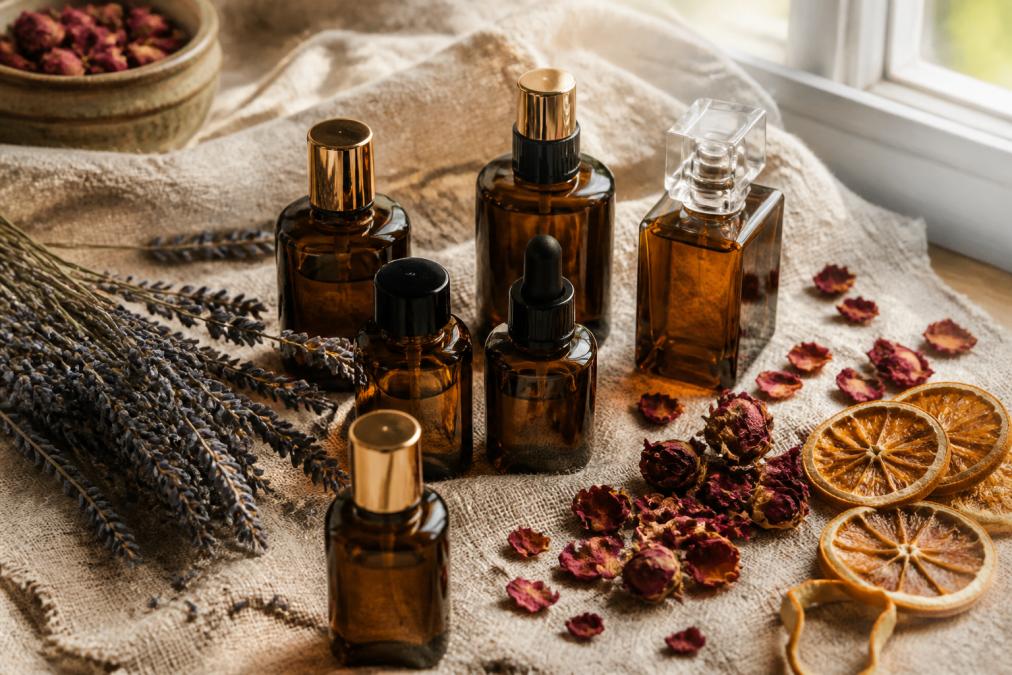
Our top pick for most sensitive skin types is a botanical perfume oil, and The Beekeeper’s Basket makes a version we are proud to recommend. Perfume oils skip alcohol entirely, which eliminates a major source of irritation and dryness. The Beekeeper’s Basket crafts these in small batches in New England, blending essential oils and botanical extracts into a carrier oil that absorbs gently. With over 20,000 sales and a 5-star rating, the oil format also means the scent sits closer to the skin, creating a personal aura rather than a room-filling cloud. For daily wear on sensitive skin, this is the format that wins.
2. Solid Perfume Bars with Organic Sugarcane Alcohol
Solid perfume bars are the practical choice for travel and touch-ups. They use a beeswax or plant-wax base infused with essential oils, which makes them spill-proof and easy to carry. Some formulations include a small amount of organic sugarcane alcohol to help the scent bloom, which is a gentler alternative to the synthetic denatured alcohol found in most sprays. These bars are ideal if you want to control how much fragrance you apply and reapply through the day without committing to a full spray.
3. Single-Note Essential Oil Blends
If you are new to natural perfume or have a very specific trigger profile, single-note oils are the safest starting point. A single-note blend contains one dominant essential oil, like lavender, sandalwood, or bergamot, diluted in a carrier. This simplicity means fewer potential allergens and easier identification if something does cause a reaction. You can layer two or three single notes yourself to build a custom scent. The tradeoff is less complexity; you will not get the multi-layered top, middle, and base notes of a blended perfume.
4. Made Safe Certified Fragrance Mists
For those who want a lighter, all-over application, a fragrance mist is a good option, provided it carries a credible certification. The Made Safe certification criteria screens for known carcinogens, reproductive toxins, and other hazardous ingredients, giving you an independent check on the brand's claims. These mists typically use water and a small amount of plant-based emulsifier to disperse the essential oils. They are sheer and evaporate quickly, so they are not the choice for long-lasting scent, but they are excellent for a fresh, subtle finish that is unlikely to overwhelm sensitive skin.
5. Hypoallergenic Perfume with Biodynamic Alcohol
Some people genuinely prefer the ritual of a spray perfume. If that is you, look for one that uses biodynamic alcohol as its base. Biodynamic alcohol is derived from certified organic sugarcane or grapes, and it lacks the petrochemical impurities found in standard denatured alcohol. This makes it significantly less likely to irritate skin or trigger fragrance sensitivity headaches. A hypoallergenic label here should be backed by a complete ingredient list and, ideally, dermatologist testing. This option bridges the gap between conventional perfumes and the natural category.
6. Plant-Based Perfume for Chemical Sensitivity
For individuals with pronounced chemical sensitivity, the most reliable choice is a plant-based perfume with the shortest ingredient list you can find. These products often contain just a carrier oil and one or two essential oils, with nothing else added. No preservatives, no stabilizers, no fixatives. The absence of synthetic additives is the entire point. The downside is that these perfumes have limited scent longevity because they lack the synthetic fixatives that make conventional scents last all day. You will likely need to reapply, which is a fair trade for avoiding a reaction.
7. Custom Small-Batch Perfume Oils
The ultimate solution for difficult cases is a custom small-batch perfume oil. A perfumer works with you to identify your specific triggers and then builds a scent profile that avoids them entirely. This is the most expensive and time-consuming route, but it is also the most effective for people who have reacted to everything they have tried. You get a signature scent that no one else has, made with ingredients you have individually approved.
How We Evaluated These Chemical Free Perfumes
DIY Natural Perfume Alternatives You Can Make at Home
Making your own perfume oil is surprisingly simple and gives you total control over every ingredient. You need a carrier oil, such as jojoba or fractionated coconut oil, and your chosen essential oils. A basic recipe uses about 30 drops of essential oil per 10 milliliters of carrier oil. Start with a 2:1:1 ratio of base note to middle note to top note for a balanced scent. Sandalwood is a classic base note, lavender works as a middle, and bergamot or sweet orange provides the top note lift.
Combine the oils in a small amber glass bottle, which protects the blend from light degradation. Shake well and let the mixture sit for 48 hours so the oils can meld. Test it on your inner elbow before full use. This DIY approach is the most affordable way to experiment with natural perfumery, and it eliminates the risk of hidden synthetic additives entirely. The learning curve is real, but the payoff is a scent that is truly yours, made with ingredients you trust.
Finding a fragrance that does not irritate your skin is a process of elimination, not a compromise. The chemical free perfume for sensitive skin market has grown precisely because so many people have been let down by synthetic-heavy formulas. At The Beekeeper’s Basket, we believe the answer lies in transparency, small-batch production, and ingredients you can pronounce. Explore our collection of botanical perfume oils and solid bars, handcrafted in New England with the care that only small-batch production allows. Get started with The Beekeeper’s Basket and find a scent that finally works with your skin.
Frequently Asked Questions
Are there any truly non-toxic perfumes?
Yes. Look for perfumes made with 100% plant-based ingredients, essential oils, and biodynamic alcohol with no synthetic additives. Check for Made Safe or similar certifications. The Beekeeper's Basket creates small-batch botanical perfumes in New England. Always read the full ingredient list rather than trusting marketing terms like clean or green.
What perfumes are safe for sensitive skin?
Perfumes with short ingredient lists, no synthetic fragrance, and no common irritants like phthalates or parabens are safest for sensitive skin. Perfume oils are often gentler than alcohol-based sprays because they lack the drying effect of ethanol. Patch test any new scent on your inner arm for 24 hours before applying it to your neck or wrists.
How do I know if a perfume is hypoallergenic?
Hypoallergenic is not a regulated term, so you must verify the ingredient list yourself. Look for products labeled Made Safe certified, dermatologist-tested, or fragrance-free if you have extreme reactions. Identify fragrance allergens by checking for specific botanical oils you know you tolerate. When in doubt, contact the maker directly and ask about their sourcing and testing process.
What is the difference between natural perfume and synthetic fragrance?
Natural perfume uses essential oils, botanical extracts, and plant-based carriers like jojoba oil or organic sugarcane alcohol. Synthetic fragrance contains manufactured aroma chemicals, some of which act as irritants for sensitive people. Natural scents tend to have shorter longevity on skin but carry far lower risk of triggering headaches or dermatitis. Synthetic fragrances often last longer because they use fixatives that natural perfumery lacks.