 How-to
How to Choose a Signature Botanical Scent: A Step-by-Step Guide
Last Updated: October 24, 2026
Quick Summary
How to choose a signature botanical scent starts by identifying scents you already enjoy in everyday life, then exploring fragrance families like floral, fresh, woody, and spicy to find what resonates with you. Test candidates on your skin using a four-day protocol, match the fragrance to your climate and lifestyle, and choose based on how it develops through its top, middle, and base notes over time.
- Botanical fragrances last 4-6 hours on skin, shorter than synthetics, because natural oils are lighter and fade gradually.
- Top notes last 5-15 minutes, middle notes last 1-3 hours, and base notes last 4-6+ hours; wait at least 15 minutes before deciding on a scent.
- Always patch test on inner elbow for 24 hours first, especially with sensitive skin, since natural materials can trigger reactions.
- Heat and humidity accelerate evaporation, so choose lighter concentrations for hot weather and richer bases for cold weather.
- Test one fragrance at a time, spacing tests at least 24 hours apart, because botanical scents are chemically complex and your nose fatigues quickly.
Table of Contents
- Understanding What Is a Botanical Fragrance
- Identify Scents You Already Enjoy
- Explore Fragrance Families and Fragrance Notes
- Natural Perfume vs Synthetic Fragrance: What You Need to Know
- How to Test Perfume on Skin Before Committing
- Understanding Natural Perfume Longevity and How Scents Develop
- Match Your Signature Scent to Lifestyle and Personality
- Finding Your Signature Botanical Scent at The Beekeeper's Basket
- Frequently Asked Questions
Understanding What Is a Botanical Fragrance
A botanical fragrance is a scent made primarily from natural plant-based ingredients like flowers, herbs, fruits, and resins rather than synthetic chemicals, with oils extracted directly from botanical sources.
Unlike mass-produced perfumes, botanical fragrances evolve naturally on your skin to reveal different layers.
Many people also find natural fragrances gentler on sensitive skin and more authentically connected to the scent itself.
Identify Scents You Already Enjoy
Start with smells you already love in everyday life, this is the foundation for how to choose a signature botanical scent.
Walk through your home and notice what draws you in:
- Fresh herbs in the kitchen (basil, mint, rosemary)
- Flowers in a garden or vase (roses, lavender, jasmine)
- Citrus fruits when you peel them
Next, consider scents tied to memories. A fragrance recalling your grandmother's garden or a vacation beach carries emotional weight that often leads to scents you'll wear for years.
Test at home before committing: light a candle, crush a fresh herb, or open a spice jar. Scents that feel natural and comforting are good starting points.
Explore Fragrance Families and Fragrance Notes
Understanding fragrance families helps narrow your choices. The main fragrance families are:
- Floral: Rose, peony, orchid, lotus blossom, and other flower-based scents. These are warm and romantic.
- Fresh: Citrus, green tea, and aquatic notes. These feel light and energizing.
- Woody: Sandalwood, cedar, and mossy scents. These are earthy and grounding.
Most fragrances blend families, floral with woody undertones, or fresh with spicy notes.
Top, Middle, and Base Notes Explained
Every fragrance has three layers that unfold over time; understanding them helps you choose a scent that develops beautifully on your skin.
Top notes are what you smell first, usually citrus, herbs, or light florals.
Middle notes (heart notes) emerge after the top notes fade, often florals, fruits, or spices.
Base notes are the foundation, heavier ingredients like sandalwood, amber, musk, and vanilla.
The main fragrance families each offer distinct characteristics and emotional qualities.
| Fragrance Family | Key Notes | Character |
|---|---|---|
| Floral | Rose, peony, orchid, lotus blossom | Warm and romantic |
| Fresh | Citrus, green tea, aquatic notes | Light and energizing |
| Woody | Sandalwood, cedar, mossy scents | Earthy and grounding |
| Spicy | Pepper, cinnamon, clove notes | Warm and complex |
Natural Perfume vs Synthetic Fragrance: What You Need to Know
Natural fragrances use oils extracted directly from plants, flowers, fruits, resins, and herbs.
Synthetic fragrances are lab-created to mimic or enhance natural scents.
Many people with sensitive skin find natural fragrances gentler, while synthetics sometimes trigger headaches or irritation.
Information on fragrance safety and skin sensitivity
Natural fragrances also develop differently on your skin: your chemistry interacts with the botanical oils, creating a scent unique to you.
Want to understand more about the value of natural options? Is Natural Perfume Worth the Price? breaks down what you're paying for when you choose botanical fragrances.
How to Test Perfume on Skin Before Committing
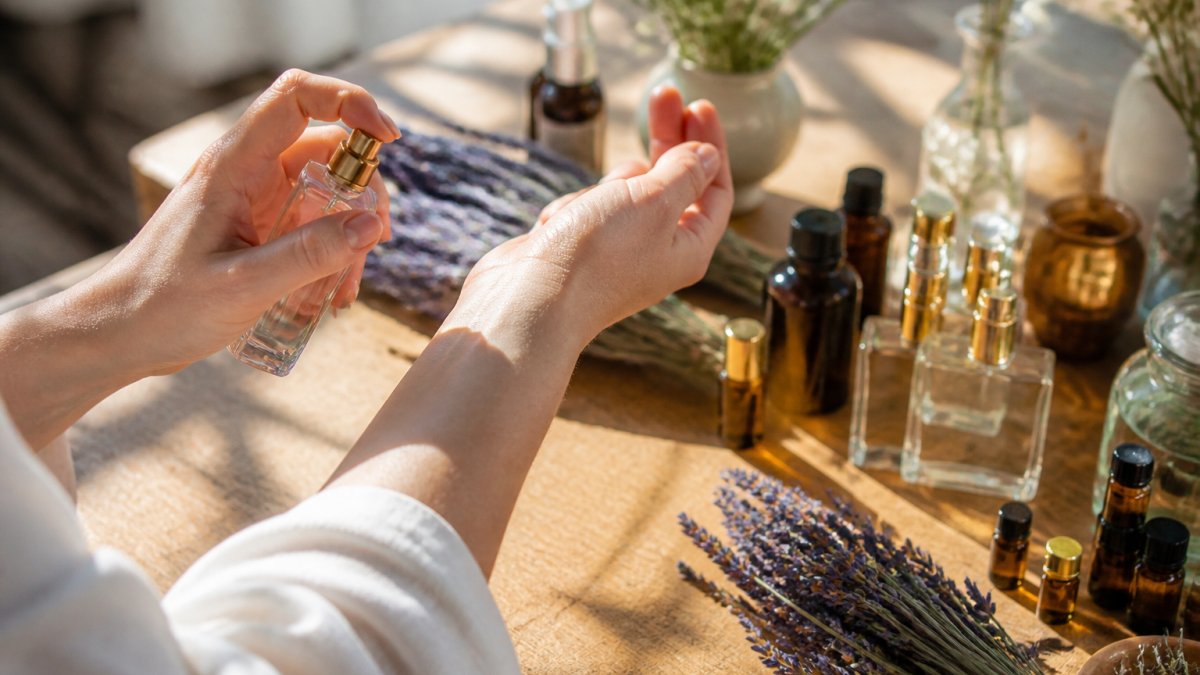
Testing on your actual skin is the only way to know if a fragrance is right for you. Paper strips don't capture how scent interacts with body chemistry, and botanical oils shift dramatically from blotter to skin.
The Four-Day Sampling Protocol
A single spritz in a store tells you almost nothing. Botanical fragrances evolve through top, heart, and base notes, and the base can take hours to settle. Use this sequence:
- Day 1, Patch test only. Apply a single dab to the inner forearm or inner elbow. Wait 24 hours. Check for redness, itching, swelling, or a rash. If you react, stop and do not apply elsewhere.
- Day 2, One full wear. Apply to pulse points (inner wrists, inner elbows, base of the neck) in the morning. Note the opening, the heart at the two-hour mark, and the base at hour six. Write down three words for each stage.
- Day 3, Repeat wear. Wear the same fragrance again in a different setting (office vs. weekend). Botanical scents read differently against ambient smells, so you want to know whether it holds up in your real routine.
- Day 4, Compare. Only now bring in a second candidate. Test it on the opposite arm, never layered over the first, and keep the two fragrances at least one day apart so your nose resets.
A common pattern: the fragrance you loved on day 2 feels flat by day 3, or a scent that seemed quiet opens up on the second wear. That's why repeat wear matters.
Why One-at-a-Time Testing Matters More With Botanicals
Natural materials are chemically complex, a rose absolute contains hundreds of compounds, and your nose fatigues quickly when complex scents compete. Testing multiple fragrances the same day blends them into a muddle, so space tests at least 24 hours apart.
Patch Testing for Sensitive Skin
If you have sensitive skin, a history of eczema, or known plant allergies, treat the patch test as non-negotiable. Apply a small amount to the inner elbow and wait a full 24 hours before evaluating. Watch for:
- Redness, warmth, or a raised rash
- Itching or a tingling sensation that persists
- Swelling or blistering (stop use immediately)
Some botanical materials are sensitizers or phototoxic, bergamot and cold-pressed lime can increase sun sensitivity, and certain resins and absolutes irritate reactive skin. If you're pregnant, breastfeeding, or managing a skin condition, check with a dermatologist first.
Reading the Dry-Down Like a Formulator
When you evaluate the dry-down, ask three questions: Is the base pleasant on its own, or does it only work because the heart is still present? Does the fragrance stay close to the skin or project? Does the character change in a way you enjoy, or collapse into a flat note? Botanical bases built on sandalwood, vetiver, or resins hold their shape; lighter citrus and green bases fade faster.
Information on fragrance safety and skin sensitivity
Understanding Natural Perfume Longevity and How Scents Develop
A common question about botanical fragrances is how long they last.
Longevity is how long a fragrance lasts on your skin.
The reason is chemistry. Synthetic fragrances use compounds designed to stick around. Natural botanical oils are lighter and fade more gradually.
Sillage is how far your fragrance projects. Natural fragrances tend to have softer sillage than synthetics, and some people prefer this intimate quality.
How a fragrance develops over time is one of the most interesting aspects of how to choose a signature botanical scent, it tells a different story at each stage:
- Hour 1: Top notes dominate. You smell the bright, fresh elements.
- Hours 2-4: Middle notes take over. This is where the fragrance's personality shines.
- Hours 4+: Base notes emerge. You smell the warm, lasting foundation.
Match Your Signature Scent to Lifestyle and Personality
Your signature scent should feel like an extension of who you are, but it also has to survive your actual day. Botanical fragrances respond to temperature, humidity, and activity in ways synthetics often mask, so matching a scent to your lifestyle means thinking about performance, not just how it smells on the blotter.
Start With Your Day, Not Your Personality Quiz
Before you reach for a fragrance family, map your typical week:
- Where you spend most of your time: climate-controlled office, outdoor job site, gym, or home.
- How active you are: movement raises skin temperature, which pushes top notes forward and can make a fragrance read louder.
- How close people get: open-plan office and client meetings call for different projection than a solo commute.
Write down your answers. They narrow the field faster than any personality label.
How Climate Changes Botanical Performance
Heat and humidity accelerate evaporation: a citrus-forward botanical that feels crisp in cool, dry air can turn sharp or vanish within an hour on a hot, humid afternoon. Cold air slows diffusion, so a resinous or woody botanical that feels heavy in summer may read soft and close to the skin in winter.
A practical rule of thumb:
- Hot and humid: lean toward lighter concentrations and base notes that hold structure without shouting, vetiver, light woods, green herbs. Reapply midday if needed rather than over-spraying in the morning.
- Cold and dry: richer bases, sandalwood, amber, resins, deep florals, have room to unfold and will feel less overwhelming than they do in summer.
- Variable or transitional seasons: a fragrance with a clear heart note and a moderate base tends to adapt best; it won't collapse in warmth or disappear in cold.
That's why a fragrance that smelled perfect on a spring vacation can feel wrong at home in January, the scent didn't change, the conditions did.
Match the Concentration to the Occasion
Botanical fragrances come in different strengths, and format matters as much as family:
- Eau de cologne and light eau de toilette: best for daytime, warm weather, and close-quarters settings. Expect shorter wear and plan to reapply.
- Eau de parfum: the most versatile choice for a signature scent; enough presence for evening without overwhelming a shared office.
- Perfume oil and extrait: concentrated and often slower to project, which makes them well suited to evening wear, cold weather, and people who prefer a scent that stays close.
If your routine includes a gym session or long commute, a lighter concentration you can refresh is more practical than a heavy extrait applied once in the morning.
Personality Is the Tiebreaker, Not the Starting Point
Once performance and climate narrow your options, personality helps you choose between two scents that both work. Ask yourself:
- Do you want to smell like a garden after rain (green, earthy, mossy) or like a florist's shop (petals, stems, nectar)?
- Do you prefer a scent that announces itself or one that is discovered?
- Do you want a fragrance that feels traditional and familiar, or one with an unusual botanical twist, say, a tomato leaf or a smoky resin?
There's no wrong answer, but there is a wrong fit for your routine: a dramatic, resinous botanical can be perfect for evenings and miserable in a shared office, while a bright citrus cologne can be ideal for summer weekends and invisible by dinner.
Build a Small Rotation Instead of One Rigid Signature
Many botanical wearers find a small rotation of two or three scents that share a family more practical than one rigid signature. A green herbal for daytime, a floral for evenings, and a woody or resinous base for cold weather covers most of the year. The rotation still reads as "you" because the fragrances share an underlying taste, like a wardrobe built around one palette.
Finding Your Signature Botanical Scent at The Beekeeper's Basket
Once you understand fragrance families, notes, and how to test properly, you're ready to find your signature botanical scent.
At The Beekeeper's Basket, we create botanical fragrances in small batches for freshness and quality, each crafted with real plant-based ingredients for the authentic botanical experience. Explore options like our Orange Blossom Mandarin Perfume to discover a botanical scent that matches your preferences.
Our approach is simple: explore options that match your preferences, test them on your skin, and choose what feels right. Compare fragrances like our Strawberry Fields Perfume to find the botanical scent that resonates with you.
Choosing a botanical fragrance isn't just picking a scent, it's choosing how you want to feel.
Identify the fragrance families that call to you, test options carefully on your skin, give each time to develop, and notice how it makes you feel throughout the day.
Your signature botanical scent is waiting. It's the one that feels like you.
Frequently Asked Questions
How do I choose a signature botanical scent that won't irritate my sensitive skin?
Start by testing small amounts on a patch of skin away from your face, like your inner wrist or behind your ear. Wait 24 hours to check for reactions. Natural botanical fragrances typically contain fewer synthetic irritants than conventional perfumes, but sensitivity varies by individual. Keep a list of ingredients that have caused problems in the past, and ask for samples before purchasing full-size products. The Beekeeper's Basket crafts small-batch perfumes with pure botanical ingredients, allowing you to review exactly what you're applying to your skin.
What is a botanical fragrance and how is it different from regular perfume?
A botanical fragrance is made primarily from plant-derived ingredients like essential oils, flower extracts, and herb infusions rather than synthetic chemicals. These scents come from flowers, fruits, woods, spices, and other natural sources. Natural perfume vs synthetic fragrance comes down to sourcing: botanical fragrances rely on nature's ingredients, while synthetic fragrances use lab-created compounds. Botanical scents often feel more complex and personal because they interact with your skin chemistry in unique ways, creating a signature fragrance that's truly yours.
How long does natural perfume last compared to synthetic fragrance?
Natural perfume longevity typically ranges from 2 to 6 hours, depending on the concentration of essential oils and the specific botanical ingredients used. Synthetic fragrances often last 6 to 8 hours or longer because synthetic molecules are engineered for persistence. However, natural perfumes often develop a beautiful dry-down phase where the base notes become more prominent, creating a richer scent experience. Reapplication of natural perfume is part of the ritual, many people enjoy refreshing their scent throughout the day as part of their daily routine.
How do I test a natural perfume before choosing it as my signature scent?
Request a sample or test the fragrance on a small area of skin first, ideally your inner wrist or behind your ear where skin is sensitive. Avoid washing that area for at least 4 hours so you can experience how the scent develops. Notice the top notes (initial bright scents), middle notes (the heart of the fragrance), and base notes (lasting warmth). Wear it during different times of day and in various activities to see how it performs in your lifestyle. Testing perfume on skin reveals how your personal chemistry interacts with the botanical ingredients, ensuring your signature scent truly matches your personality.
Finding your signature botanical scent takes time, but it's worth the effort. A fragrance that truly matches your personality and lifestyle becomes something you reach for every day. We invite you to explore our collection of handcrafted botanical fragrances at The Beekeeper's Basket and discover the scent that feels authentically yours. Understanding fragrance ingredients and natural sourcing can help you make informed choices about what goes on your skin.