 How-to
How Do You Safely Test New Skincare at Home?
Last Updated: November 7, 2026
Quick Summary
To test new skincare safely at home, apply a pea-sized amount to a hidden spot like the inner arm or behind the ear, then check it at 1, 24, 48 and 72 hours. Potent actives need a longer 7 to 10 day window. Stop the product if you notice burning, itching, or spreading redness.
- Use a pea-sized amount, roughly the size of a pencil eraser, for the test.
- Check the test spot at 1 hour, 24 hours, 48 hours and 72 hours.
- Test retinoids, acids and vitamin C once daily for 7 to 10 days.
- Patch test along the jawline for three to five days before using the full face.
- Stop the product and seek care for swelling, breathing trouble, or a rash that spreads quickly.
Table of Contents
- Why You Should Patch Test Before Full Use
- Where to Do a Patch Test for Your Face
- Step-by-Step: How to Patch Test a Face Serum
- How to Patch Test Glycolic Acid and Other Actives
- Irritation, Allergic Reaction, or Purging: How to Tell the Difference
- What to Do If a Reaction Happens
- Limits of Home Testing and Building a Safe Introduction Schedule
- Frequently Asked Questions
Why You Should Patch Test Before Full Use
Patch testing is the simplest way to find out whether a new skincare product will irritate your skin, so it is worth making a habit to test new skincare before you commit to it. Learn how common skin irritants in soap are identified before you start using a product.
This matters most if you have sensitive skin. Some reactions to a product appear only after using it daily for a week or more. A patch test gives you a chance to catch a problem early, before the product touches your whole face.
We still recommend a patch test for every new product, because every skin type responds differently.
A patch test is a small trial that shows how your skin responds to a product before full use. The goal is simple: learn your reaction on a small area first.
Here is what a good patch test does for you:
- Shows whether you get redness, itching, or burning
- Helps you avoid a full-face reaction
- Lets you test one product at a time, so you know which one caused a problem
Where to Do a Patch Test for Your Face
The best spot for a facial patch test is an area that is similar to your face but easy to hide and watch. The inner arm and the area behind the ear are two common choices.
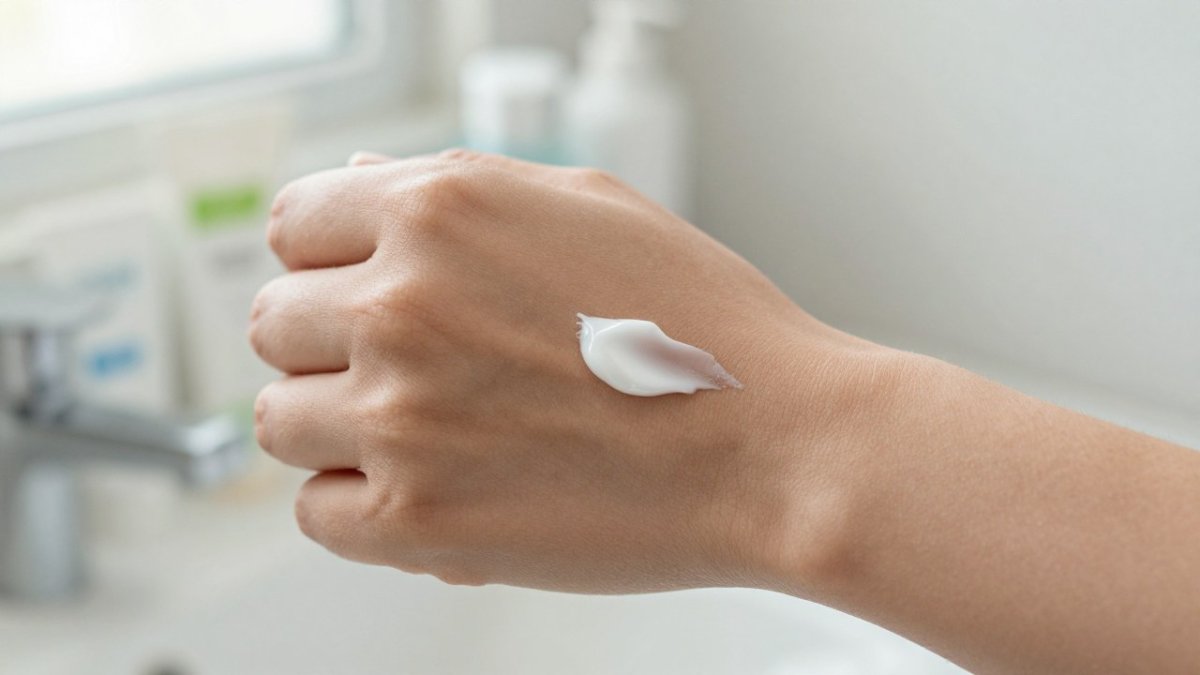
Pick a spot that is clean and dry. Avoid areas that are already irritated, sunburned, or covered in a rash. A test on damaged skin will not give you a clear answer.
Many people use the inner forearm because it is easy to see and check.
Watch out: Do not test on a freshly shaved area or right after a waxing appointment. Broken or raw skin can react strongly and give you a false result.
Step-by-Step: How to Patch Test a Face Serum
A serum is not a cream. Serums carry actives in concentrated, often low-pH or alcohol-based vehicles, so the same test that works for a moisturizer can under- or over-state the risk.
- Prep the site. Wash the inner forearm or the area behind the ear with a gentle cleanser, pat dry, and do not apply anything else to that spot for the rest of the day.
- Measure a realistic dose. Use a pea-sized amount, roughly the size of a pencil eraser, not a quarter. A quarter-sized blob is far more than your face receives per application and can create irritation that would never happen in normal use.
- Apply and leave it. Spread it thinly and let it dry. Do not rinse unless the label says to.
- Check at set intervals. Look at the spot at 1 hour, 24 hours, 48 hours, and 72 hours. Photograph it in consistent light so you can compare rather than rely on memory.
- Extend the window for actives. For retinoids, acids, and vitamin C, keep the spot test going for 7 to 10 days, applying once daily, because delayed and cumulative reactions are common with these ingredients.
- Do a facial-area confirmation. If the arm or ear spot stays calm, apply a small amount along the jawline for three to five days before moving to the full face.
- Introduce gradually. Start every other night for the first week, then move to nightly only if the skin stays calm.
Watch out: Do not test on freshly shaved or waxed skin, on a sunburn, or on an area you are already treating with another active.
Adjusting the method by product class:
- Rinse-off cleansers: These have short contact time, so a single 24-hour leave-on test overstates risk. Instead, dilute a small amount with water, apply to the inner forearm, leave for the product's normal contact time (usually under a minute), rinse, and check at 24 and 48 hours. Repeat once daily for three days.
- Leave-on serums and moisturizers: Use the full 72-hour to 10-day window above, since the product stays in contact with skin and cumulative irritation is the main risk.
- Sunscreen: Test on the inner forearm and then on the upper cheek or jaw for two to three days, because sunscreen is applied in larger amounts and often near the eyes, where stinging shows up first. Reapply as you normally would during the test so you catch reactions to the full dose.
- Potent actives (retinol, glycolic acid, vitamin C, benzoyl peroxide): Start at the lowest strength the product offers, test once daily for 7 to 10 days, and expect some transient tingling. Distinguish that from burning that lasts more than a few minutes, which signals irritation rather than a normal adjustment.
Keep a short written log: product name, strength, date started, site tested, and what you saw at each check.
The article lays out the key timings and sites for a serum patch test, which a quick reference can make easy to scan.
| Step | What to do | Time or frequency |
|---|---|---|
| Prep the site | Wash inner forearm or behind ear, pat dry | Before testing |
| Measure dose | Use a pea-sized amount | One application |
| Check at intervals | Look at the spot and photograph it | 1 h, 24 h, 48 h, 72 h |
| Extend for actives | Test once daily for retinoids, acids, vitamin C | 7 to 10 days |
| Facial confirmation | Apply along the jawline | 3 to 5 days |
| Introduce gradually | Apply every other night, then nightly if calm | First week, then nightly |
How to Patch Test Glycolic Acid and Other Actives
Active ingredients, such as glycolic acid, retinol, and vitamin C, can cause stronger reactions than basic moisturizers.
For glycolic acid and other actives, start with a lower strength if the product offers one. Apply the product once a day for the first few days, then increase the frequency if your skin stays calm. Watch for tingling, stinging, or peeling that goes beyond normal.
Here is a simple way to test an active:
- Day 1 to 3: Apply once, in the evening, to the test spot only
- Day 4 to 7: If there is no reaction, apply to the test spot twice a day
- Day 8 to 10: If your skin still looks calm, you can try the product on a small part of your face
Avoid combining a new active with other new products during the test, so you can tell which one caused a problem.
Irritation, Allergic Reaction, or Purging: How to Tell the Difference
Not every skin change means the product is wrong for you, and the three most common responses behave very differently. Find out whether natural skincare products can actually trigger allergic reactions before you decide what your skin is telling you. The useful question is not "is my skin reacting?" but "which kind of reaction is this, and what does it tell me to do next?"
Irritation (irritant contact dermatitis). This is a direct chemical insult to the skin barrier, not an immune response.
Allergic contact dermatitis. This is an immune reaction and it is delayed. It typically appears 24 to 72 hours after contact, sometimes longer on first exposure, and it can spread beyond the test spot.
Purging. This is not damage; it is the accelerated turnover of existing clogged pores, most associated with retinoids and exfoliating acids.
A practical way to sort them out:
- Timing: minutes to hours points to irritation; one to three days points to allergy; two to six weeks of acne-like bumps in your usual zones points to purging.
- Location: confined to the application site favors irritation; spreading past it favors allergy; matching your normal breakout pattern favors purging.
- Sensation: burning and stinging favor irritation; itching favors allergy; purging is usually not itchy or painful.
- Trajectory: irritation eases when you stop; allergy worsens with repeat use; purging improves over weeks while you continue.
When in doubt, stop the product and watch the area for 48 to 72 hours. If it clears, you likely had irritation and can consider a lower-strength or less frequent retrial later.
What to Do If a Reaction Happens
If you notice a reaction, stop using the product right away. Rinse the area with lukewarm water and pat it dry. Avoid scrubbing or using other actives on the skin until it calms down.
Skin usually starts to recover within a few days after you stop an irritating product. The skin barrier, the outer layer that protects against dryness and irritation, can take one to two weeks to fully recover from mild irritation.
To soothe itchy or irritated skin, try these steps:
- Use a cool, damp cloth on the area for a few minutes
- Apply a plain, fragrance-free moisturizer
- Avoid hot water, scrubs, and exfoliants until the skin feels normal
- Wear sunscreen daily if the area is exposed to light
See a doctor if you have swelling around the eyes or lips, trouble breathing, a rash that spreads quickly, or signs of infection such as pus or heat.
Limits of Home Testing and Building a Safe Introduction Schedule
A home patch test is useful, but it has limits.
Home testing also cannot tell you what is causing an allergy. If you react to a product more than once, a dermatologist can order allergy testing to find the specific ingredient.
To introduce new skincare safely, follow a simple schedule:
- Add one new product at a time
- Wait at least one to two weeks before adding another
- Start with a small amount and use it every other day at first
- Move to daily use only after the skin stays calm
- Keep a short log of what you used and how your skin looked
This approach makes it easier to find the cause of any problem. It also lets your skin adjust slowly, which is especially helpful for sensitive skin.
Even so, we suggest you patch test every new product before full use. You can explore our collection at The Beekeeper's Basket for current product details. LET'S EXPLORE!
Frequently Asked Questions
How long should you test a new skincare product before using it on your face?
Most patch testing guidance suggests applying a small amount to the test area once or twice daily for about seven to ten days before regular use. Watch the spot for redness, itching, burning, swelling, or a rash during that window, since some reactions are delayed. If the area stays calm for the full period, you can begin using the product on a larger part of your face. If you notice any reaction, stop using the product and wash the area gently with lukewarm water.
Can patch testing prevent every skincare reaction?
No. A patch test lowers the chance of a bad reaction, but it cannot predict every response. Reactions can develop after the test period, when a product is used on a larger area, or when it is combined with other actives like glycolic acid or retinol. Home testing also cannot identify every allergy. If you have a history of severe reactions, persistent dermatitis, or a known allergy, a dermatologist or professional allergy testing is the more reliable route.
Should you introduce one new skincare product at a time?
Yes. Adding one product at a time makes it much easier to identify the cause if irritation appears. Wait until your skin has tolerated the first product for a week or two before adding another. Start with the gentlest product in your routine, and introduce stronger actives such as glycolic acid more slowly, beginning with a lower concentration or less frequent use.
How should you test new skincare if you have acne-prone skin?
Apply the product to a small area along the jawline or behind the ear, since these spots are close to where breakouts often occur. Expect some purging with actives like salicylic acid or retinoids, which can cause temporary breakouts in areas where you already get them. Purging usually appears in the first few weeks and clears up, while irritation tends to bring burning, stinging, or spreading redness. If you are unsure which you are seeing, pause the product and check with a dermatologist.