 Ultimate guide
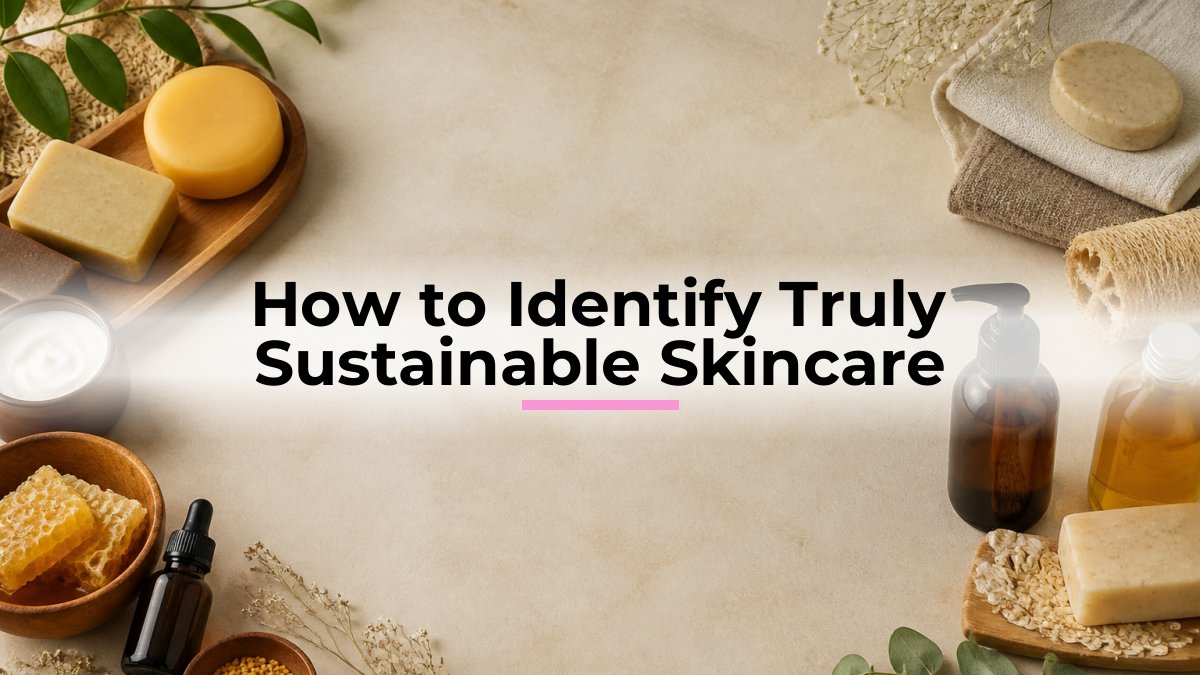
How to Identify Truly Sustainable Skincare
Quick Summary
Sustainable skincare is a product approach that reduces harm across a product's full life, covering ingredients, manufacturing, packaging and disposal. To identify it, check whether a brand names its sourcing, publishes full ingredient lists, and ties each certification to the exact product you are buying.
- Ask four questions: where ingredients came from, how they were processed, what the container becomes, and whether evidence matches marketing.
- Terms like natural, clean and eco-friendly are not regulated for most personal care products in the United States.
- Each certification checks a different slice, so match the seal to the claim it actually verifies.
- Treat any green claim you cannot verify with specific details within two minutes as unverified.
- Using up a product that suits your skin often reduces waste more than a packaging change.
Table of Contents
- What Sustainable Skincare Actually Means
- Why Words Like Natural, Clean, and Eco Need Evidence
- Sustainable Skincare Labels: What Each Certification Does and Does Not Verify
- Recognizing Greenwashing in Skincare
- Ingredient Transparency, Sourcing, and Trade-Offs
- Eco-Friendly Skincare Packaging and Lifecycle Impact
- How to Check If a Brand Is Sustainable
- Choosing Your Next Skincare Order With Confidence
- Frequently Asked Questions
What Sustainable Skincare Actually Means
Last Updated: November 2, 2026
Sustainable skincare is a product or brand approach that aims to reduce harm across the full life of a product, from the ingredients it contains to the packaging it ships in. Many shoppers assume the word simply means "natural," but sustainability covers sourcing, formulation, manufacturing, packaging and disposal.
A useful way to think about it is to ask four questions: Where did the ingredients come from? How were they processed? What does the container become after you finish the product? And does the company's own evidence match its marketing? A product can score well on one question and poorly on another, which is why a single "eco" badge rarely tells the whole story.
Why Words Like Natural, Clean, and Eco Need Evidence
"Natural," "clean," and "eco-friendly" are not regulated terms for most personal care products in the United States. The Federal Trade Commission's guidance on environmental marketing claims asks sellers to back up general environmental benefit claims with substantiation, but the words themselves do not carry a fixed meaning. That gap is why shoppers should look for specifics. A brand that names its plant-based ingredients, explains its sourcing, and shows its packaging materials is giving you something to check.
Sustainable Skincare Labels: What Each Certification Does and Does Not Verify
Certifications can help, but each one checks something different, and treating seals as interchangeable is a common mistake. Our guide to clean beauty and why it matters explains how the clean label differs from a sustainability claim. The most useful way to read a label is to ask three questions: Who runs the standard?
Here is how several well-known programs differ in scope. None of these is a complete sustainability score; each covers a slice.
- USDA Organic (run by the U.S. Department of Agriculture under the National Organic Program): verifies how agricultural ingredients were grown and handled, and sets thresholds for the percentage of organic content. It says nothing about packaging, manufacturing energy, or animal testing.
- NSF/ANSI 305 (NSF International): a standard for personal care products containing organic ingredients. It verifies organic content and certain processing requirements for the personal-care category, not the full environmental footprint of the product.
- COSMOS (managed by the COSMOS-standard AISBL, with U.S. participation through certifying bodies): a European-origin organic and natural cosmetics standard with tiers (COSMOS ORGANIC and COSMOS NATURAL). It covers ingredient origin, processing, and some packaging and environmental criteria, but it is not a U.S. government program and its scope is defined by the standard owner.
- Leaping Bunny (Cruelty Free International): verifies a brand's animal-testing policy and supply-chain monitoring for finished products and ingredients. It does not verify ingredient sourcing, biodegradability, or packaging.
Third-Party Certifications and Their Limits
Third-party certifications are only as useful as their scope. Ask which standard the seal follows, which ingredients or steps it covers, and whether the certifier audits the supply chain or only reviews paperwork.
A few practical checks close most of the gap:
- Find the standard owner, not just the logo. A seal issued by a trade group, a nonprofit, or a government agency carries different weight and different audit rules.
- Read the scope statement. Most certifiers publish what is and is not covered; if the brand does not link to it, that is a signal.
- Check the certificate, not the marketing page. Certifiers usually maintain searchable directories where you can confirm a specific product or facility is listed and current.
- Match the seal to the claim. A Leaping Bunny mark answers a cruelty question; it does not answer a packaging question. An FSC mark answers a paper question; it does not answer a formula question.
Watch out: a brand can hold a legitimate certification on one product line and display the seal near unrelated products, so confirm the seal applies to the exact item you are buying. Our piece on whether natural skincare can cause allergic reactions covers why natural does not automatically mean safe.
USDA National Organic Program Leaping Bunny program B Lab directory
Each certification checks a different slice of sustainability, so the table below shows what each one verifies and what it leaves out.
| Certification | What it verifies | What it does not verify |
|---|---|---|
| USDA Organic | Growing and handling of agricultural ingredients | Packaging, manufacturing energy, animal testing |
| NSF/ANSI 305 | Organic content and processing for personal care | Full environmental footprint |
| COSMOS | Ingredient origin, processing, some packaging criteria | Not a U.S. government program |
| Leaping Bunny | Animal-testing policy and supply-chain monitoring | Ingredient sourcing, biodegradability, packaging |
| EWG Verified | Ingredient disclosures against EWG criteria | Manufacturing and packaging |
| B Corp | Overall company social and environmental performance | A single product's formula |
| FSC | Responsible forestry for paper and wood fiber | Formula or ingredients |
| How2Recycle | Likely handling of a component in U.S. recycling | Not a sustainability certification |
Recognizing Greenwashing in Skincare
Greenwashing happens when a brand presents a product as more environmentally responsible than the evidence supports. Common warning signs include a green leaf icon with no explanation, a claim like "earth-friendly" that never specifies what it means, and a vague promise about "reducing impact" with no baseline. Our rule of thumb is simple: if you cannot find a specific detail within two minutes of looking, treat the claim as unverified.
Ingredient Transparency, Sourcing, and Trade-Offs
Full ingredient lists are the starting point for ingredient transparency. Look for a brand that publishes complete INCI-style lists online, not only the marketing highlights. For handcrafted products, see our guide to artisan soap ingredients to look for.
Trade-offs are real. A preservative-free formula may spoil faster, which can mean more waste if it is not used in time. A botanical ingredient with a small footprint may still be hard to source at scale.
Eco-Friendly Skincare Packaging and Lifecycle Impact
1. Ingredient production. Agricultural ingredients carry impacts from land use, water, fertilizer, and harvest.
2. Processing and formulation. Extracting, refining, and formulating ingredients use energy and water, and some processes generate waste streams.
3. Transport. Weight and volume drive shipping emissions.
4. Product use. How much water, energy, or cotton a product consumes in use can outweigh packaging.
5. Disposal. What happens at the end depends on local infrastructure.
Comparing Packaging Options Honestly
- Glass: highly recyclable where programs accept it, but heavy to ship and energy-intensive to produce; refillable glass performs best when reused many times.
- PET and HDPE plastic: lightweight and widely accepted in U.S. curbside recycling, but recycled content and actual reclamation rates vary by region.
- Aluminum: light, recyclable, and often accepted, but production is energy-intensive; best where recycling access is strong.
- Refill pouches and concentrates: can cut packaging weight and shipping volume substantially, but many flexible pouches are not recyclable curbside.
Waste Prevention Beats Packaging Optimization
The single largest lever most shoppers control is whether a product gets used up.
Watch out: a refill system only reduces impact if you actually reuse the container multiple times; a refill bought once and abandoned leaves you with two packages instead of one.

How to Check If a Brand Is Sustainable
Use this simple process before you buy:
- Read the full ingredient list and note any ingredients the brand does not explain.
- Look for a sourcing statement that names regions, suppliers or practices.
- Check whether certifications are named, linked and clearly scoped to specific products.
- Review the packaging description for specific materials and recycling guidance.
- Look for a published policy on testing, waste and manufacturing.
If a brand answers most of these questions with specifics, it is giving you evidence you can evaluate. If it answers with slogans, keep looking.
Choosing Your Next Skincare Order With Confidence
Start by identifying one or two things that matter most to you, such as ingredient transparency or packaging, and use them to narrow your options. Our small-batch products are made in New England, and we are happy to share details about our ingredients and packaging so you can judge for yourself. Explore our collection and let's find the right pieces for your routine.
Frequently Asked Questions
What is the most sustainable skincare brand?
No single brand is sustainable across every measure, because sustainability depends on ingredient sourcing, formulation, packaging, manufacturing, and disposal. Instead of relying on a ranking, look at how a brand discloses its practices. Strong candidates publish full ingredient lists, explain where key ingredients come from, name their packaging materials, and back claims with third-party certifications or specific data. Compare brands on the criteria that matter most to you, such as recyclable packaging or responsibly sourced botanicals, rather than on a general reputation.
What labels should you look for when shopping for sustainable skincare?
Look for certifications that verify specific claims rather than broad ones. Examples include USDA Organic for agricultural ingredients, B Corp certification for overall company performance, and Leaping Bunny for cruelty-free testing standards. Each label checks something different, and none covers the whole product lifecycle. Read the certification's scope on the issuer's website to confirm which ingredients, facilities, or practices it actually covers.
How can you spot greenwashing in skincare?
Greenwashing usually shows up as vague wording without proof. Words like natural, clean, eco, and green are not regulated in most cases, so they do not guarantee anything. Watch for claims with no measurable detail, imagery of nature that does not match the formula, and sustainability statements that cover only one product or one step of production. A brand that is transparent will tell you what a claim means, how it was measured, and who verified it.
How can you check if a brand is sustainable?
Start with the brand's website and check for a sourcing page, a full ingredient list with function for each ingredient, and a clear description of packaging materials. Next, look for independent certifications and confirm their scope. Then search for third-party reviews or news coverage that examines the company's practices. If key details are missing or hard to find, treat that as a signal to ask the brand directly for documentation about sourcing and manufacturing.
What makes skincare packaging sustainable?
Packaging is more sustainable when it uses less material, contains recycled content, can be refilled or reused, and can be recycled through programs available where you live. Glass and aluminum are widely recyclable in many areas, though recycling rates vary by location. Look for specific claims such as percentage of recycled content and clear disposal instructions. Packaging that is labeled recyclable but cannot be processed by your local system does not deliver the benefit the label implies.
Are natural skincare products always more sustainable?
No. Natural does not automatically mean sustainable. A plant-derived ingredient can be grown with heavy water or pesticide use, shipped long distances, or harvested in ways that strain local ecosystems. Synthetic ingredients can sometimes have a lower environmental footprint per use. The most reliable approach is to evaluate sourcing, formulation, and packaging together rather than assuming a natural label signals a lower impact.
What are the 7 R's of sustainability and how do they apply to skincare?
The 7 R's framework includes refuse, reduce, reuse, repurpose, recycle, rot, and redesign. In skincare, refusing unnecessary packaging, reducing product size to fit your routine, reusing containers or choosing refills, and recycling empty packaging all cut waste. Composting suitable organic materials and redesigning your routine toward fewer, longer-lasting products also help. Applying these steps lowers the environmental impact of your purchases without requiring you to change everything at once.
How can you compare the sustainability of skincare products?
Compare products using the same criteria: ingredient transparency, sourcing disclosures, certifications and their scope, packaging materials and recycled content, and whether the product is concentrated or refillable. Measure how much product you actually use and how long it lasts, since a product that you finish quickly can create more waste than a larger, longer-lasting one. Build a simple checklist and score each product against it to make the comparison concrete.