 How-to
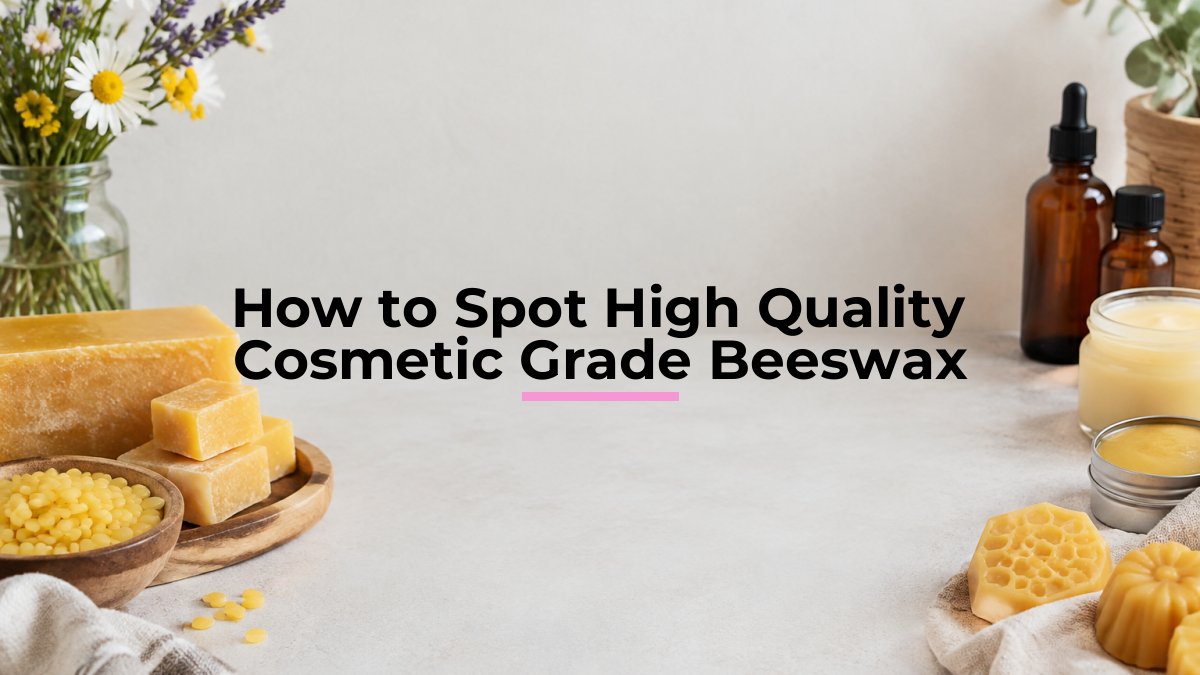
How to Spot High Quality Cosmetic Grade Beeswax
Last Updated: November 16, 2026
Quick Summary
High quality cosmetic grade beeswax looks uniform in color with no dark specks, smells faintly of honey and warm wax rather than perfume or chemicals, and feels firm but slightly tacky, chipping or snapping rather than crumbling. Rub a small piece between your fingers: quality wax softens with body heat, leaves a subtle non-greasy film, and has no grit.
- Yellow beeswax keeps more of its natural color from pollen and propolis; white beeswax is bleached or filtered further.
- A clean block should chip or snap rather than crumble, and grit means the wax was not filtered well.
- In the water test, beeswax should sink; a piece that floats is a red flag.
- If a block fails two or more of the seven home checks, treat it as suspect.
- A certificate of analysis only proves something if its lot number matches the wax you received.
Table of Contents
- What Cosmetic Grade Beeswax Should Look, Smell, and Feel Like
- How to Tell If Beeswax Is Pure: A Home Inspection Checklist
- Where Sensory Tests Stop: Confirming Purity and Spotting Adulteration
- Cosmetic-Grade Beeswax vs Food-Grade Beeswax
- The Best Beeswax for Skin-Care Products: Matching Grade to Formulation
- What a Beeswax Supplier Certificate of Analysis Should Tell You
- Pellets, Blocks, and Pricing: Comparing Forms and Cost per Pound
- Choosing Wax for Your Next Batch of Handmade Skin Care
- Frequently Asked Questions
What Cosmetic Grade Beeswax Should Look, Smell, and Feel Like
Cosmetic grade beeswax is purified beeswax that has been filtered to remove debris, pollen, and propolis, then graded for use in skin-care formulations. It should look, smell, and feel consistent from batch to batch, with no grit and no chemical odor.
Wax is a core material in skin-care making, so the first impression matters. A quick look, sniff, and squeeze tells you more than most product listings do. The signs of high quality cosmetic grade beeswax show up in three places: color, scent, and texture.
Color: Natural Yellow Versus Bleached White
Natural yellow beeswax gets its color from pollen and propolis picked up in the hive. Expect a warm honey-to-golden tone, sometimes with slight variation between blocks.
White beeswax has been bleached or filtered further to strip that color. Neither is automatically better. Yellow tells you less processing happened; white suits formulators who want a neutral base that won’t tint a finished cream.
What you don’t want is a grayish, muddy, or unevenly mottled block with dark specks throughout. That usually signals impurities left in the wax.
Scent and Texture Clues
Real beeswax smells faintly of honey and warm wax, not perfume. If a block smells strongly sweet or chemical, something was added.
Texture matters just as much. A clean block feels firm but slightly tacky, and it should chip or snap rather than crumble. Rub a small piece between your fingers: quality wax softens with body heat and leaves a subtle, non-greasy film.
Grit is a warning sign. If you feel sand-like particles, the wax wasn’t filtered well.
How to Tell If Beeswax Is Pure: A Home Inspection Checklist
You can run a solid purity check at home with no lab equipment. The goal isn’t a certificate; it’s catching obvious problems before you melt a whole batch.
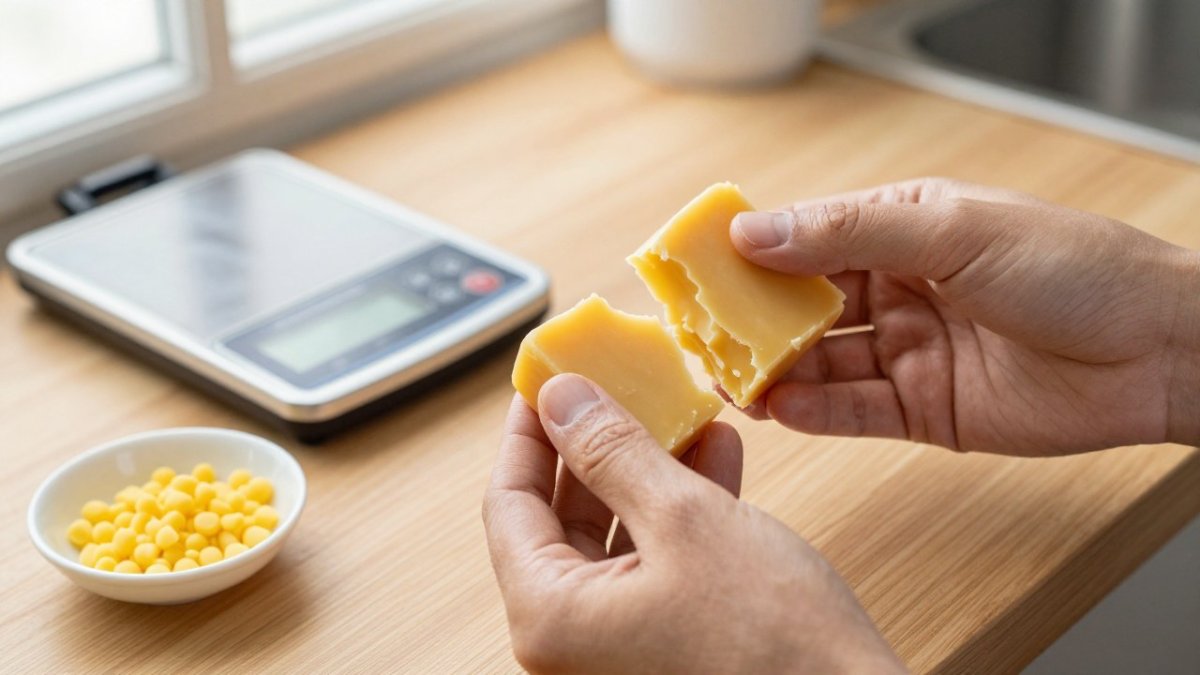
Step 1, Visual inspection. Break the block or scoop a spoonful of pellets onto white paper in daylight.
Step 2, Scent check. Warm a pea-sized piece between your palms for ten seconds, then smell. Expect a faint honey-and-warm-wax note. A sharp chemical smell, a strong perfume smell, or a tallow-like smell are all reasons to slow down. Scent is a clue, not proof: paraffin is nearly odorless, and some refined waxes lose most of their honey note without being adulterated.
Step 3, Feel and snap. At room temperature, a clean block should feel firm but slightly tacky, and it should chip or snap rather than crumble.
Step 4, Squeeze test. Press a small piece between thumb and forefinger for several seconds.
Step 5, Water test. Drop a small piece into a glass of room-temperature water. Beeswax is denser than water and should sink, not float.
Step 6, Melt test. Melt a tablespoon of wax in a clean, dry container over low heat.
Step 7, Skin patch. Rub a tiny amount of the cooled wax on the inside of your forearm and wait 24 hours.
If a block fails two or more of these steps, treat it as suspect. Our full guide on how to identify pure beeswax walks through each test step by step.
Where Sensory Tests Stop: Confirming Purity and Spotting Adulteration
Sensory tests catch gross problems, not subtle ones. Wax cut with paraffin, stearic acid, or another cheap wax can look and feel close to the real thing, especially in a small sample.
Common adulterants and what they look like.
-
Paraffin. A petroleum-derived wax blended in to stretch volume. It is nearly odorless, melts at a lower temperature than beeswax, and burns cleaner with less soot. In a block, paraffin tends to look flatter and more uniform than beeswax, with less of the subtle color variation that pollen and propolis create. A melt test can hint at it, paraffin melts faster and cools to a smoother, more translucent cake, but a small percentage blended into real wax is hard to see.
-
Stearic acid. A fatty acid used to harden soaps and candles. It raises the melting point and gives a harder, more brittle block. Wax cut with stearic acid may snap too sharply and feel less tacky between the fingers. It can also leave a slightly acrid or tallow-like note when warmed.
-
Tallow or other animal fats. Sometimes used as a cheap extender. These tend to smell faintly of cooked fat rather than honey, feel greasier on the skin, and can turn rancid over time. A tallow-cut wax may also develop a yellowish-gray cast.
-
Soy or vegetable wax blends. Common in candle making, less so in cosmetic supply, but they show up in resold blocks. These waxes are softer, melt lower, and often carry a faint vegetable-oil smell. A block that feels unusually soft at room temperature is worth questioning.
-
Dyes and fillers. Some sellers dye pale wax to fake a rich honey color or add fillers to add weight. Dye shows up as an unnaturally uniform, saturated color with none of the batch-to-batch variation real beeswax has. Fillers show up as grit, a residue ring after melting, or a cloudy layer at the bottom of the melt.
Why home tests can be inconclusive. A water test tells you density, not identity. A melt test tells you how a sample behaves, not what it contains. A scent check can be masked by a small amount of real beeswax blended into a cheaper base.
When to move to documentation or lab testing. Ask for supplier paperwork when you are buying in volume, when the price is unusually low, when the wax will go into products you sell, or when a sample passes your sensory checks but you have a nagging doubt.
Cosmetic-Grade Beeswax vs Food-Grade Beeswax
Cosmetic-grade and food-grade beeswax are both purified, but they’re graded for different end uses. Food grade must meet stricter handling and safety standards because it may be eaten. Cosmetic grade is filtered for skin contact, where color and scent consistency matter more than edibility.
| Feature | Cosmetic Grade | Food Grade |
|---|---|---|
| Primary use | Balms, creams, soaps | Candy, food glazes |
| Filtering | Fine-filtered, low debris | Fine-filtered, food-safe handling |
| Color/scent | Consistent, controlled | Less emphasis on appearance |
| Documentation | Purity and grade specs | Food-safety compliance |
For skin care, cosmetic grade is the right pick. You’re not eating your lip balm, but you are wearing it all day. If you’re weighing what wax actually does for skin, our guide to the benefits of beeswax for skin covers that in detail.
The Best Beeswax for Skin-Care Products: Matching Grade to Formulation
The best beeswax for skin-care products depends on what you’re making. There’s no single winner, just the right match for the job.
- Lip balms and salves: Yellow cosmetic grade adds a warm tint and holds firm texture.
- Face creams: White cosmetic grade keeps the base neutral so it won’t shift color.
- Body balms: A slightly softer, well-filtered wax blends easily with natural oils.
- Soaps: Cosmetic grade with consistent melt behavior keeps batches predictable.
Match the grade to the finish you want, then confirm the wax melts cleanly. If you’re ready to put your wax to work, our walkthrough on how to melt beeswax for cosmetic use covers temperatures and technique.
What a Beeswax Supplier Certificate of Analysis Should Tell You
A certificate of analysis, or CoA, is the document that backs up everything your senses can’t confirm. Ask for one before you buy in volume.
A useful CoA should list:
- Product name and grade
- Melting point range
- Color and odor description
- Filtering method
- Batch or lot number
- Test results for impurities or additives
What most buyers miss is that a CoA is only as good as its batch link. If the lot number on the certificate doesn’t match the wax you received, the paperwork proves nothing. Ask suppliers how they source and filter, and whether they can trace a batch back to the apiary.
Pellets, Blocks, and Pricing: Comparing Forms and Cost per Pound
Beeswax comes in pellets, blocks, and pastilles, and the form you choose changes how easy it is to work with. Pellets and pastilles melt fast and measure cleanly. Blocks cost less per pound in many cases but take longer to break down.
| Form | Best For | Trade-off |
|---|---|---|
| Pellets | Small batches, quick melting | Higher cost per pound |
| Pastilles | Precise measuring | Similar to pellets |
| Blocks | Bulk melting, value | Requires chopping |
On pricing, cost per pound is the number to watch. A cheap block that’s cut with filler costs more in wasted batches than a clean one at a higher sticker price. Compare price per ounce across forms, and treat unusually low prices as a reason to ask harder questions about purity. Pricing depends on quantity, form, and supplier; check The Beekeeper’s Basket’s website for current prices or a quote.
Choosing Wax for Your Next Batch of Handmade Skin Care
Start with a small test batch before you commit to a full run. Melt a little wax, watch how it behaves, and check the finish on your skin. A wax that snaps clean and melts evenly will treat your formulation well.
For a first project, a simple lip balm is the easiest way to see how your wax performs. Our beeswax lip balm recipe for dry lips gives you a straightforward formula to test. If body care is more your goal, here’s how to use beeswax body balm on dry elbows, step by step.
The Beekeeper’s Basket makes its bee-inspired skin-nourishing products in small batches in New England.
The hardest part of buying cosmetic grade beeswax is trusting what’s in the block. The Beekeeper’s Basket takes that guesswork out of the equation with handcrafted, small-batch products made with fresh ingredients and a genuine love for bees. Explore our soaps, balms, and beeswax melts, and see what small-batch care feels like.
Frequently Asked Questions
How can you tell real beeswax from fake?
Start with your senses, then verify with paperwork. Real cosmetic grade beeswax has a honey-like aroma, a slightly sticky texture, and a color that ranges from pale yellow to golden. It should show a fine, grainy break when snapped, not a clean plastic-like cut. A scratch test can reveal a lighter streak beneath the surface. None of these tests prove purity on their own, so ask the supplier for a certificate of analysis listing melting point and confirming no additives or fillers.
What's the difference between food-grade and cosmetic-grade beeswax?
Both come from the same wax, but they are handled and documented for different end uses. Food-grade beeswax must meet stricter purity expectations for anything ingested, while cosmetic-grade beeswax is filtered and refined for skin-care use. Cosmetic-grade wax may still be filtered to remove impurities, but the key difference is the documentation and intended use. If a wax is labeled cosmetic-grade only, do not assume it is safe to eat.
What should high-quality cosmetic-grade beeswax smell like?
It should smell faintly of honey, with a warm, waxy undertone. The aroma is usually subtle, not sharp or perfumed. A strong chemical or smoky smell can point to over-processing or contamination. Because scent fades with age and refining, a weak aroma is not automatically a red flag, but a synthetic or solvent-like smell is. Pair the scent check with a certificate of analysis and a look at color and texture before you buy in bulk.
Is yellow or white beeswax better for skin-care products?
Yellow beeswax is filtered but unbleached, so it keeps more of its natural color and honey scent. White beeswax has been bleached or further refined, which makes it useful when you want a neutral base for tinted or fragrance-sensitive formulas. Neither is inherently better. Choose yellow for a more natural feel and white when color or scent would clash with your other ingredients. In both cases, confirm the wax is cosmetic grade and free of additives.