 blog
Natural Perfume Ingredients to Avoid: A Safety Guide
Last Updated: October 26, 2026
Quick Summary
Natural perfume ingredients to avoid include undiluted essential oils, botanical extracts like rose absolute and sandalwood, and hidden chemicals masked by terms like fragrance or parfum. Patch testing before use is essential, as natural ingredients can still cause skin reactions and may contain formaldehyde-releasing preservatives despite clean marketing.
- Patch test one new fragrance at a time, spacing tests at least a week apart to identify which product causes reactions
- Watch for red flags: fragrance, parfum, BHT, synthetic musks, formaldehyde-releasing preservatives, and diethyl phthalate on ingredient lists
- Botanical extracts like rose absolute, sandalwood, and vetiver are potent allergens that concentrate during processing
- Fragrance-free and phthalate-free labels are not reliable; request full ingredient disclosure and third-party testing from brands
- Prioritize brands with complete ingredient transparency and recognized certifications over marketing claims of natural or clean products
Table of Contents
- Why Natural Perfume Ingredients Still Require Caution
- Natural Perfume vs Synthetic Fragrance: What's the Real Difference
- The Natural Ingredients Most Likely to Cause Skin Reactions
- Understanding Phthalates in Perfume and Why They Hide in Labels
- How to Read Perfume Labels and Spot Hidden Synthetic Chemicals
- The Natural Labeling Loophole: What 'Natural' Actually Means
- Patch Testing Protocol: Your First Step Before Trying New Fragrances
- Finding Your Safe Fragrance Match
- Frequently Asked Questions
Why Natural Perfume Ingredients Still Require Caution
Just because an ingredient comes from nature doesn't mean it's safe for your skin, which is why understanding natural perfume ingredients to avoid is essential. Understanding which natural ingredients pose risks is the first step toward finding fragrances that work with your skin, not against it.
Natural Perfume vs Synthetic Fragrance: What's the Real Difference
The distinction between natural perfume and synthetic fragrance matters, but not always in the way marketing suggests.
The Natural Ingredients Most Likely to Cause Skin Reactions
Essential Oils and Concentrated Allergens
The problem intensifies when essential oils are used undiluted or in high concentrations, which maximizes scent throw but increases irritation risk. Patch testing is essential before committing to any essential oil-based fragrance.
Tree Nuts and Botanical Extracts
Botanical extracts like rose absolute, sandalwood, and vetiver are natural but potent, and processing concentrates their allergens. Many contain formaldehyde-releasing preservatives, contradicting the "clean" marketing these products rely on. Check whether botanical extracts appear on your ingredient list and research each one's allergen profile. Learn how to identify skin irritants in similar products like soap to apply the same caution across your personal care routine.
Understanding Phthalates in Perfume and Why They Hide in Labels
A few practical rules help. Treat any undisclosed "fragrance" entry as a black box that may contain phthalates unless the brand provides full disclosure. Prioritize brands that list every component by name, essential oils, absolutes, carriers, and preservatives. If a brand markets "phthalate-free" without verification, ask for it in writing. And remember phthalates are also common in plastics, packaging, and household dust, so fragrance is one exposure source among several, reducing avoidable exposure in products you wear daily is a reasonable, evidence-based step, not a panic response.
How to Read Perfume Labels and Spot Hidden Synthetic Chemicals
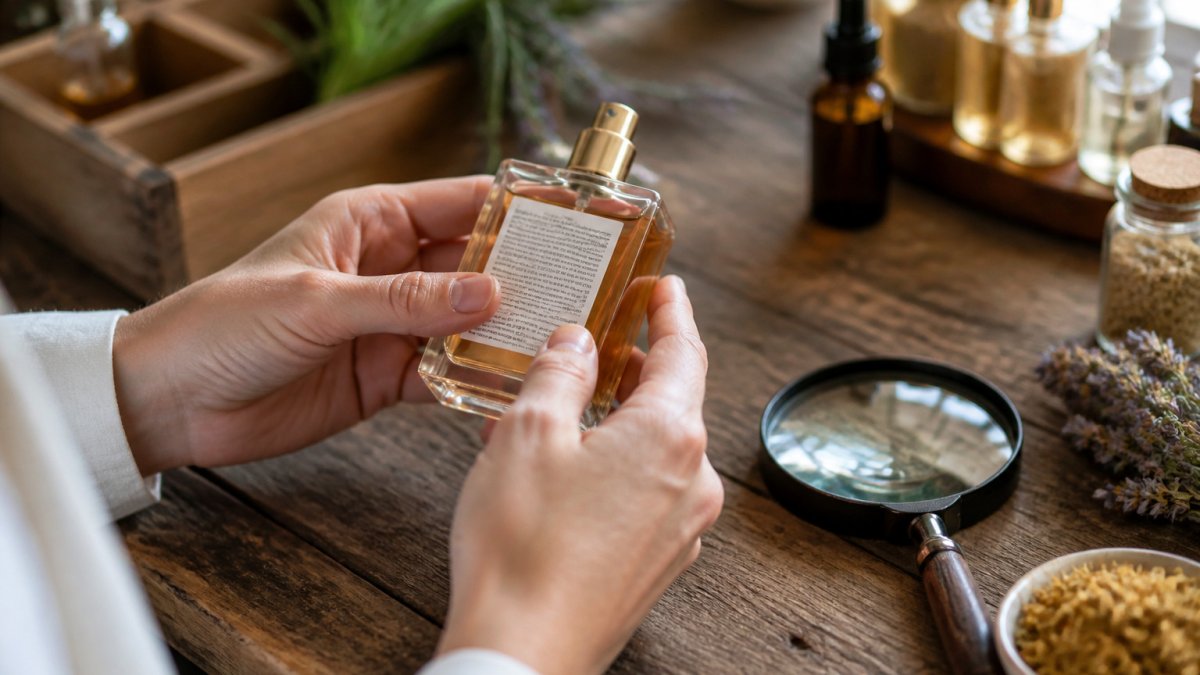
Look for these red flags on ingredient lists:
- "Fragrance" or "Parfum", This catch-all term hides phthalates, synthetic musks, and other undisclosed chemicals
- Butylated hydroxytoluene (BHT), A synthetic preservative and potential endocrine disruptor
- Synthetic musks, Polycyclic compounds used to extend scent; they bioaccumulate in body tissues
- Formaldehyde-releasing preservatives, Often found in "natural" products; these include DMDM hydantoin and imidazolidinyl urea
- Diethyl phthalate (DEP), When listed explicitly, this is your clearest warning of phthalate presence
Watch for these warning signs when scanning perfume ingredient lists.
| Red Flag Ingredient | What It Hides or Does | Why It Matters |
|---|---|---|
| Fragrance or Parfum | Phthalates, synthetic musks, undisclosed chemicals | Catch-all term masks harmful components |
| Butylated hydroxytoluene (BHT) | Synthetic preservative | Potential endocrine disruptor |
| Synthetic musks | Polycyclic compounds that extend scent | Bioaccumulate in body tissues |
| Formaldehyde-releasing preservatives | DMDM hydantoin, imidazolidinyl urea | Often found in natural-marketed products |
| Diethyl phthalate (DEP) | Explicit phthalate presence | Clearest warning of phthalate use |
The Natural Labeling Loophole: What 'Natural' Actually Means
To navigate this confusion, prioritize brands that provide full ingredient disclosure and third-party testing results. Look for certifications from recognized bodies that verify ingredient sourcing. Transparency is the only reliable indicator of what's actually in your fragrance.
Patch Testing Protocol: Your First Step Before Trying New Fragrances
The bottom line: a proper patch test is a 72-hour, two-reading process with dilution and one variable at a time, slower than a wrist dab, but the difference between guessing and knowing.
Finding Your Safe Fragrance Match
Finding a fragrance that works for your skin means moving beyond marketing claims to ingredient reality. Learn how to choose a signature botanical scent that aligns with your safety concerns. Natural perfumes offer genuine appeal, but they demand the same scrutiny as any cosmetic product. Understand why botanical perfumes fade faster and how to manage this practical limitation. Start with transparency, patch test before committing, and track how your skin responds over time. The best fragrance isn't the most expensive or the most "natural", it's the one your skin tolerates well and that makes you feel confident wearing it.
Frequently Asked Questions
What are some common natural perfume ingredients to avoid if I have sensitive skin?
Essential oils like lavender, citrus, and cinnamon are frequently used in natural perfumes but can trigger contact dermatitis or skin sensitization in sensitive individuals. Botanical extracts from tree nuts and certain flowers also cause allergic reactions. Fragrance mix, a blend of common allergens, affects many people with dermatitis. Always patch test new fragrances on a small area of skin first, and review ingredient lists for known irritants before purchasing.
How do phthalates in perfume hide on labels, and why does the FDA allow this?
Phthalates are chemicals that make fragrance last longer, but manufacturers can list them simply as 'fragrance' or 'parfum' without naming the specific compounds. The FDA allows this blanket term under trade secret protections, meaning the full ingredient list never reaches consumers. This labeling loophole makes it difficult to identify phthalates like diethyl phthalate, which can act as endocrine disruptors. To avoid them, choose perfumes with transparent ingredient disclosure or look for 'phthalate-free' claims on the label.
What's the difference between natural perfume vs synthetic fragrance when it comes to safety?
Natural perfumes use essential oils and plant extracts, while synthetic fragrances are lab-created compounds. Neither is automatically safer: natural ingredients can cause skin sensitization and allergic reactions, while synthetic fragrances may contain volatile organic compounds or endocrine-disrupting chemicals like synthetic musks. The key difference is transparency. Many natural perfume makers disclose all ingredients, while synthetic fragrances often hide components under the term 'fragrance.' Safety depends on ingredient disclosure and your individual skin sensitivity, not whether the source is natural or synthetic.
How do I know if a perfume is truly natural or just using the 'natural' label as marketing?
The term 'natural' has no legal definition in fragrance products, so brands can use it loosely. Check for specific certifications, transparent ingredient lists, and avoid vague claims. Truly natural perfumes list essential oils, distillation methods, and botanical sources clearly. Be wary of products claiming 100% natural with synthetic-sounding ingredients or those using only the word 'fragrance' without detail. Small-batch artisan makers typically provide more ingredient transparency than mass-market brands, making it easier to verify authenticity.